
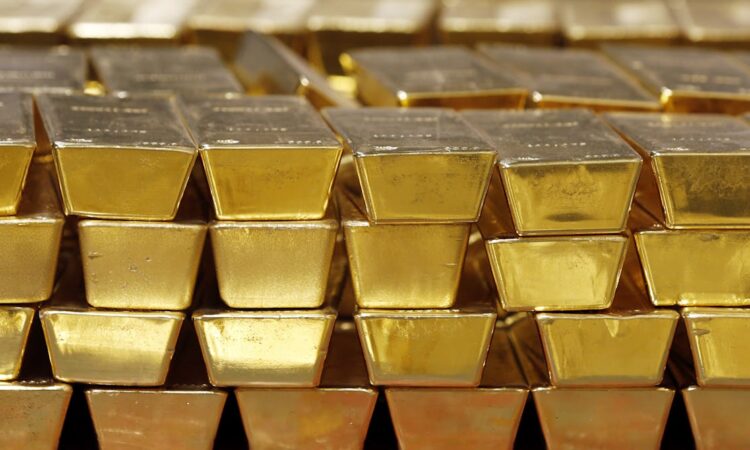
Over the past few years, central banks have been quietly buying up significant quantities of gold.
As the trend has accelerated, official agencies now hold the highest quantity of gold since 1975 – more than 36,000 tonnes of the precious metal.
Central bank buying of gold picked up after Russia’s invasion of Ukraine in 2022. The World Gold Council says central banks have bought an average of 1,000 tonnes a year over the past four years – double the average of the previous decade. It’s one factor behind the
surge in the gold price last year.
The council also noted a record 45% of central banks surveyed expect to increase their holdings over the next year.
So, what’s behind this increased desire to hold physical bullion?
Why do central banks hold reserve assets?
Central banks hold a variety of assets as “reserves” or savings. They can use these assets to help intervene in financial markets to support their currency, or in times of market stress.
Reserves can help absorb pressures during currency crises (such as when the Australian dollar plunged to a record low of 47.75 US cents in April 2001) or when borrowing from overseas is difficult or too expensive.
These reserve assets are held in foreign currencies and typically include government debt such as US Treasuries, deposits, banknotes and precious metals such as gold.
What’s behind the recent rise in gold holdings?
The strong central bank demand for gold has not been broad-based. Since 2009 it has largely come from emerging markets and developing economies, led by Russia, China, Turkey, India and Kazakhstan.
There are several reasons for this. The World Gold Council’s annual survey of central banks found 90% cited the performance of gold during times of crisis.
Other top reasons were that gold is a long-term store of value, particularly during periods of high inflation; and portfolio diversification, meaning investing in a range of assets and places to reduce risk.
A shield against sanctions
However, another important explanation has emerged. Gold also provides protection against financial sanctions that can be imposed by foreign governments.
Financial sanctions are punitive measures designed to restrict or limit a country’s access to money, financial services or global markets. Governments use sanctions to put pressure on a country and influence its behaviour.
Research suggests the increasing use of financial sanctions by the United States, the European Union and other governments is behind the accelerated move into gold by emerging market economies.
Following financial sanctions imposed on Russia after it annexed Crimea in 2014, the Russian central bank accelerated gold purchases and since 2014 has bought more gold than any other nation.
Russia’s exclusion from the international payments system SWIFT in 2022 and the freezing of around US$300 billion of its central bank’s foreign assets led to a further rise in gold purchases by several emerging market and developing economies, especially in China, Turkey and India.
The recent survey of central banks by the World Gold Council also highlighted concerns about sanctions. Around 37% of emerging market and developing economies central banks reported “concerns about sanctions” or the “anticipation of changes in the international monetary system” as factors behind their decision to hold gold.
The increased focus on gold by central banks comes as the mix of official reserves is also changing. European Central Bank research shows central bank gold reserves (27%) are now larger than holdings of US Treasuries (22%) – that is, US-government issued debt that has traditionally been seen as one of the safest assets to hold. Part of this shift is also due to the surge in the gold price.
It is useful to put this demand for gold into perspective. While it is part of a deliberate move away from dependence on the globally dominant US dollar, gold is still only a small part of total official reserves. This is especially the case for emerging and developing economies.
Does gold still have a place in official reserves?
Gold holdings by central banks are now close to the levels held towards the end of the Bretton Woods system of fixed exchange rates in 1971, when the value of the US dollar was pegged to the price of gold.
By the 1990s, many central banks had begun selling off significant portions of their physical gold holdings. Indeed, in 1997 the then Treasurer of Australia, Peter Costello, remarked:
gold no longer plays a significant role in the international financial system.
So the Reserve Bank of Australia went ahead and sold 247 tonnes of its gold. This was during a period when the gold price had fallen below $US400 per ounce. The sale, worth around A$4 billion (US$2.8 billion) at the time, would be worth around A$49 billion now.
With hindsight, this looks like a bad decision. But it’s not as bad as what became known as “Brown’s bottom”. Between 1999 and 2002, Gordon Brown, the UK’s Chancellor of the Exchequer, authorised the sale of 395 tonnes of the UK’s gold reserve for an average price of US$275 per ounce. At the time, this was a 20-year low in the price of gold.
As long as economic uncertainty and geopolitical risks remain high, there will always be a desire by central banks to hold gold. But it is unlikely to return to its former glory days when major currencies were linked to the gold standard.


