Summary of key points: –
- NZ, Aussie and US interest rates set to converge to the same level
- US interest rate markets continue to underestimate the sharp decrease in inflation
- What else can the Japanese do to stop their currency slide?
Over the last four years, the most dominant force over the level and direction of the NZD/USD exchange rate has been the differential between US and New Zealand short-term interest rates. As the chart below confirms, the change in the interest rate gap from +1.0% (blue line, right-hand axis) in 2023 (when NZ two-year swap interest rates were 1.00% above US equivalent interest rates), to NZ rates reducing to 1.00% below US rates in 2025 and 2026, depreciated the Kiwi dollar from 0.6400 to hovering between 0.5600 and 0.6000 over the last 18 months. Global Hedge funds and currency speculators have dined out on selling the Kiwi dollar against the US, picking up the forward points benefit in doing so, as NZ interest rates remained below those of the US.
The 2% swing in the interest rate differential through from 2023 to the end of 2025 largely coming about by the RBNZ’s overly aggressive loosening of monetary policy as they slashed the OCR interest rates from 5.50% to 2.25%. The US Federal Reserve also cut interest rates in 2024 and 2025 period, however to a lesser degree from 5.35% to 3.65%.
Today, the interest rate differential is changing again with the commencement of the removal of monetary stimulus by the RBNZ. The gap in the two-year interest rate reducing from -1.0% to -0.6% as NZ interest rates increase. The NZD/USD rate lifting from 0.5630 to 0.5850 as a consequence.
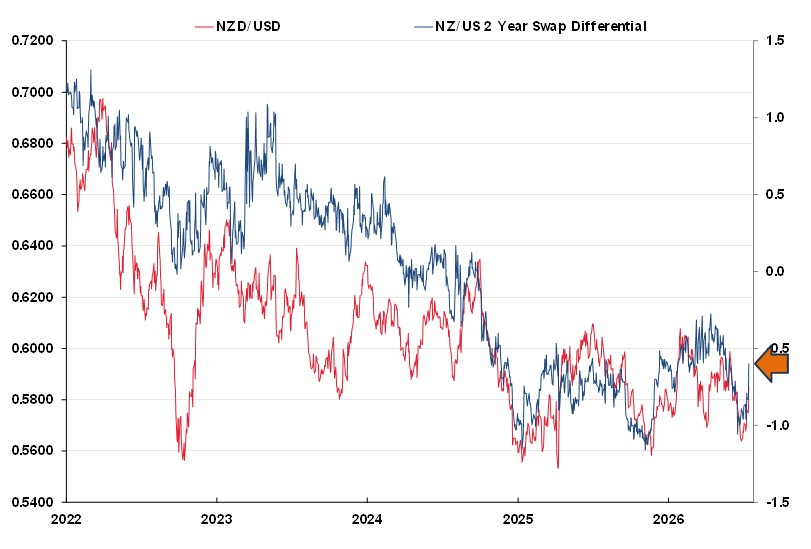
Looking ahead, the two-year swap interest rate differential between the US and New Zealand has the potential to move a lot further from the current level of NZ rates 0.6% below those of the US. Current NZ two-year swap interest rates are 3.7%, effectively already pricing-in further increases in the OCR by the RBNZ over the next 12 months from 2.5% to 3.5%. If and when the OCR is increased to the “new neutral” for “not tight/not loose” monetary policy settings of 3.5%, the two-year swap rate is likely to be trading nearer to 4.0% than 3.5%.
On the other side, depending on how US inflation and employment trend over the next six months, there is the increasing probability that forward pricing of the US Fed Funds interest rate will shift from pricing an increase from 3.65% to above 4%, to pricing lower interest rates at or below 3.5%. In other words, both the NZ OCR and the US Fed Funds interest rate converge to be together at 3.5% in 12 months’ time. On the assumption that US inflation is still decreasing to their 2% target and US employment continues to soften, the US interest rate markets are likely to price Fed cuts in 2027, resulting in their two-year swap rate reducing from the current 4.3% level to nearer 3.5%.
Over coming months there appears to be a reasonable probability that NZ two-year swap interest rates will rapidly adjust from being 0.60% below the US, to somewhere close to 0.50% above the US two-year swap interest rates i.e. the blue differential line in the chart above shooting upwards from the current -0.6% to +0.5%. The implications for the NZD/USD exchange rate are obvious and unilaterally positive.
The chart below plots the central bank interest rates of New Zealand, Australia and the US. The three coloured dotted lines going forward is the current market pricing based off the respective interest rate yield curves. Our view is that the US Fed does not hike rates this year, but either holds steady at 3.65% of makes one cut (red arrow). A significant slowdown in the Australian economy suggests that the RBA will eventually be forced to cut their OCR from the current 4.35% (green arrow). The net result is all three central banks ending up at the same 3.50% level – the convergence scenario.
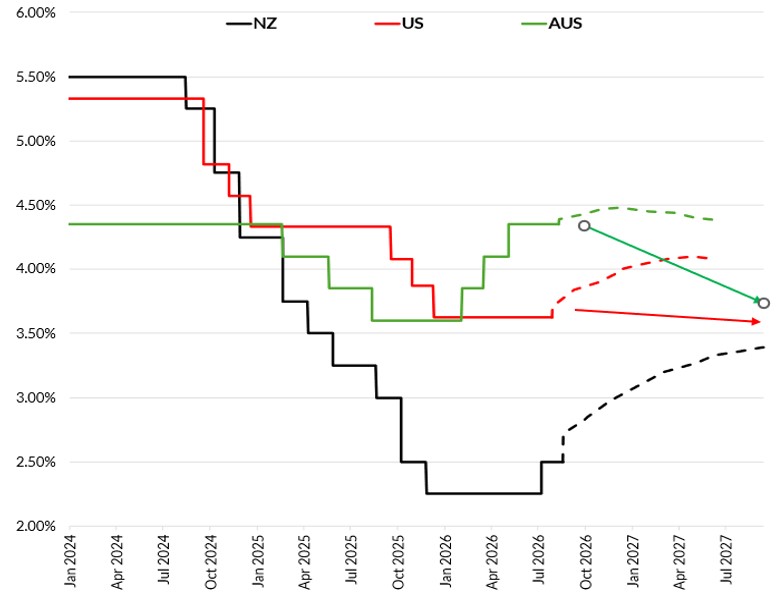
Should our potential scenario of all three interest rates ending up at 3.50% transpire into reality, the implications for future exchange rate direction becomes somewhat interesting.
The currency “carry-trade” of borrowing/selling the low-interest rate currency and buying/investing in the high-interest rate currency is suddenly not that attractive for the hedge funds and FX speculators. With all the interest rates the same (or close to the same level) the incentive to trade and hold speculative positions as previously disappears. The foreign exchange markets will have to locate other factors and influences as a reason to buy or sell.
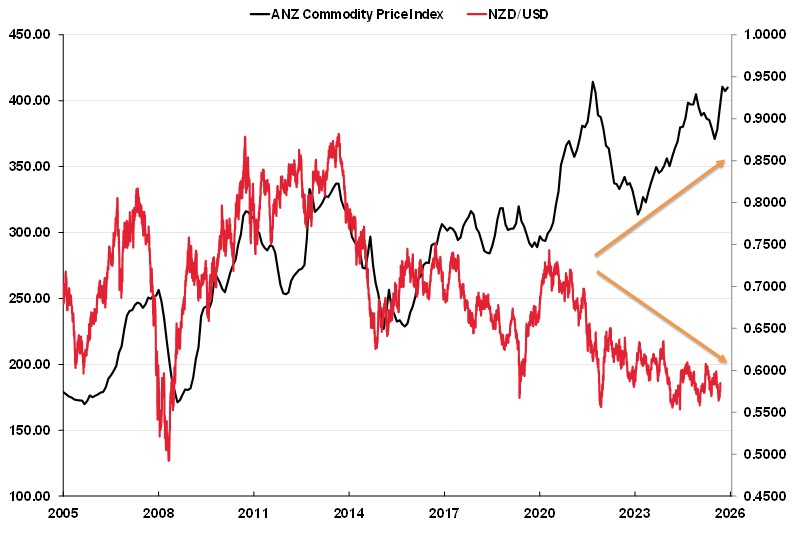
Prior to interest rate differentials dominating the NZD/USD exchange rate movements over the last four to five years, the Kiwi dollar displayed a close correlation with our export commodity prices. If all the interest rates are at similar levels, the spectre of the Kiwi dollar becoming a “commodity currency” once gain does loom as a distinct possibility. The chart below confirms how well connected to the Kiwi dollar was to New Zealand’s commodity prices prior to 2020. A return to commodity prices to once again being a major determinant of NZD/USD exchange rate direction, would suggest that the NZ dollar is currently massively undervalued vis-à-vis our prime economic performance driver (export commodity prices).
In a benign interest rate differential environment not being that too far away, it would not be surprising to see global foreign exchange markets (outside of geo-political risk events) reverting to old fashioned exchange rate determinants such as relative GDP growth performances, Balance of Payments Current Account balances/trends, Government fiscal policies, and cross-border investment capital flows. In this respect, the New Zealand economic story is looking much more positive, largely driven by the strong export-led recovery to robust economic growth. Many factors influence both portfolio investment inflows and foreign direct investment inflows into New Zealand, however if a growing number of offshore players see the undervaluation of the Kiwi dollar against its dominant economic fundamental (export commodity prices), they will be enticed that it is a good time to shift capital into New Zealand, buying the Kiwi dollar as they do so.
US interest rate markets continue to underestimate the sharp decrease in inflation
The currency markets and the US interest rate markets interpreted the Last Federal reserve meeting on monetary policy a month ago as an outrightly hawkish statement that they would lead to increasing interest rates as inflation has been above their 2.00% target for far too long. The markets adopted that stance as new Fed Chairman; Kevin Warsh was unequivocal about the Fed’s goal to return inflation to 2.00%. US short-term and long-term interest rates increased in response to the Fed meeting, as did the USD currency value. The minutes of the meeting that were subsequently released were not so clear cut about the need to increase interest rates. The Fed remains very divided on the direction of inflation and employment in the US economy; therefore, the more likely outcome is no change to US interest rates until the evolving economic data provides evidence that inflation and employment are either increasing or softening.
The economic evidence from last week with data on both retail prices (CPI inflation numbers for June) and wholesale prices (Producer Price Index for June) was that inflation was reducing more rapidly than generally expected in the US on much lower oil prices. Headline inflation decreased 0.4% in the month of June, the first monthly decrease since May 2020. The prior consensus forecasts were for a 0.0% no change. The annual rate of inflation dropping from 4.20% in May to 3.50% in June. The annual core rate of inflation also reducing from 2.90% to 2.60%. Of course, oil prices have reversed back up over the last seven days as the US and Iran abandon peace talks and escalate military attacks again. The Iran war is turning into a nightmare for US President Donald Trump, and he does not seem to have the answers to extract himself from a war that the American public are increasingly disillusioned with.
Further evidence of a US economy that is only really expanding on Wall Street with AI stock prices, was weak Retail Sales numbers for June, a limp 0.20% increase for the month against prior forecasts of a 0.50% lift. Core retail sales ex autos fell 0.20%. The US residential property market also remains very weak with building permits contracting 3.00% in June, again much softer than forecasts. Industrial and manufacturing production in June were also below forecast.
The next key signposts for the US economy will be June quarter GDP growth numbers on Thursday 30th July, with a real possibility that the annual growth rate will drop away from +2.10% in the March quarter to less than +1.00% in the June quarter. Following that data will be Non-Farm Payrolls employment figures for July on Friday 7th August. The June jobs numbers were a sharp reversal lower from earlier months of the year, the same should be expected for July jobs as well.
Confirmation of a slowdown in the US economy, together with lower inflation and jobs numbers should be sufficient evidence for the interest rate markets to change their tune about expecting Fed interest rate hikes this year. Lower US two-year and 10-year Treasury Bond yields over coming weeks are expected as both investors and borrowers adjust their views and outlook about what the Fed will do next. Lower market interest rates in the US transmits through to a lower US dollar value from its current 100.59 level on the USD Dixy Index.
What else can the Japanese do to stop their currency slide?
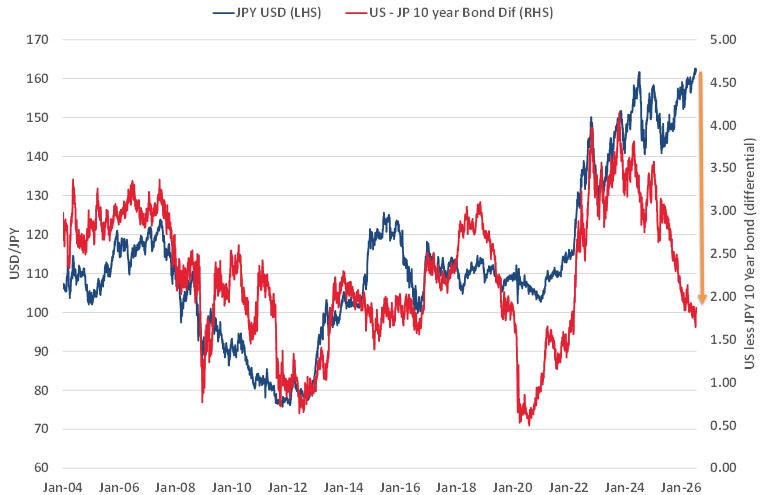
The Bank of Japan and their Ministry of Finance must be near to their combined “wit’s end” as to what to do next to arrest the continued depreciation of the Yen exchange rate. They have increased their short-term interest rates (albeit too slowly to make an impact) and spent US$73 billion during May on direct intervention in the FX markets buying Yen in an attempt to stop its slide. Neither strategy has worked, as the Yen falls away to 162.50 against the US dollar. Finance Minister, Ms Satsuki Katayama came up with another plan to reverse Yen selling with Yen buying, a vague proposal to encourage Japan’s massive pension funds to bring money home and reduce their investment exposure amounts in offshore markets. Ms Katayama followed that up with calling for local investors to be given tax free income from investing in Japanese Government Bonds, also devised to reduce offshore investment and bring money home. Time will tell whether these investment changes actually come about and cause a flood to funds coming back into Japan to strengthen the Yen.
By all sorts of measures the Yen should not be weakening as the Japanese economy is growing and their stock market is one of the best performing in the world. The Yen is unable to appreciate as global hedge funds are still betting on the carry trades of borrowing Yen at a 1.00% interest rate and investing in higher yielding currencies such as the USD and AUD. It will take some time for the big Japanese investment houses and pension funds to allocate more investment assets to home base. However, in the meantime the Bank of Japan clearly needs to be more aggressive with interest rate hikes to narrow the gap to US interest rates and halt the carry trades that hurt the Yen.
History tells us that when the difference in the yield of Japanese 10-year Government Bonds and US 10-year Treasury Bonds closes up, the Japanese investors do repatriate funds home and the Yen strengthens. Over the last two years the gap between Japanese and US bond yield has reduced dramatically from 4.00% (red line in the chart below) to 1.83% (US bonds are 4.54% and Japanese bonds are 2.71%). With US inflation returning to 2%, US bond yields will not be staying as high as 4.54% for too much longer. At some point, maybe not that far away, when the bond yield difference is lower at say 1.5%, the Japanese will all shift at once causing the Yen to reverse its direction and significantly appreciate. It appears inevitable that Investment capital flows coming back home to Japan has the potential to force a paradigm shift in the Yen’s value.
Select chart tabs
*Roger J Kerr is Executive Chairman of Barrington Treasury Services NZ Limited. He has written commentaries on the NZ dollar since 1981.