
Not only wilful defaulters, poor lending practices and undue influence, but also macroeconomic factors have contributed to the rise in bad loans in Bangladesh’s banking sector, according to a new study by the Centre for Policy Dialogue (CPD).
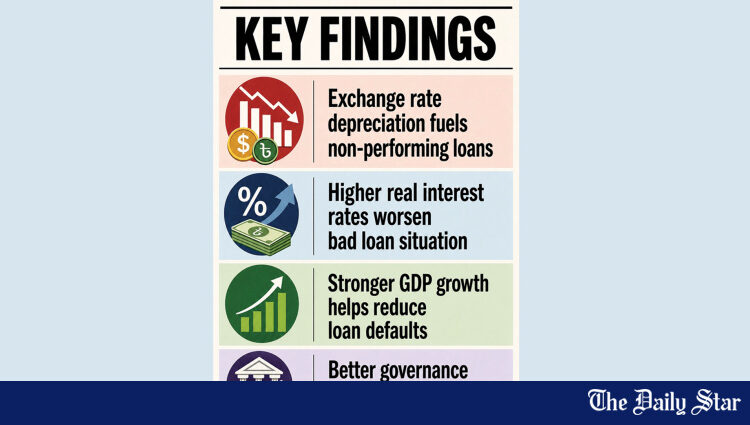
Currency depreciation, high real interest rates and governance deficits are among the key drivers of the bad loan crisis, the organisation said, citing an empirical model based on banking sector data from 2015 to 2025.
The damage intensifies precisely when the banking sector is already under stress, CPD found, analysing data sourced from the Bangladesh Bank, World Bank and the Bangladesh Bureau of Statistics.
The findings were unveiled yesterday at a press briefing on the state of the economy, where Executive Director Fahmida Khatun said the sector has suffered from long-standing weaknesses that official figures continue to understate.
According to the BB, the gross bad loan ratio fell from 35.7 percent in September 2025 to 30.60 percent in December. But CPD said the decline does not reflect genuine recovery.
The think-tank noted that loan rescheduling, restructuring and write-offs — accounting tools that delay rather than resolve defaults — were largely responsible for the drop rather than an improvement in banks’ financial health.
These tools have also hidden the real extent of stress in the sector, it said, pointing out that by March this year, the ratio had climbed back to 32.26 percent. “Actual classified loans are higher than reported figures.”
Asset quality reviews of six banks have already found bad loan levels significantly higher than previously disclosed, CPD said, adding that more reviews are underway.
WEAKER TAKA MEANS HIGHER NPLs
The think-tank’s empirical model — which measures how strongly different factors push NPLs up or down across normal and high-stress conditions — found currency depreciation to be the most consistent driver of bad loans.
The weaker the taka, the higher the NPLs, and the relationship holds whether the banking sector is healthy or struggling. During high-stress periods, the model shows the effect is roughly 2.5 times stronger than during normal conditions.
High borrowing costs follow a similar pattern. Rising real interest rates show a significant impact on loan quality during periods of elevated stress, compared to normal times. GDP growth works in the opposite direction. Stronger economic activity reduces bad loans by supporting borrowers’ ability to repay.
The effect is sharpest during stress periods, underlining how closely the banking sector’s health is tied to the broader economy.
Fahmida noted that private sector credit growth fell to a record low of 4.72 percent in March, reflecting weak business confidence and high financing costs. High borrowing costs and economic uncertainty have also discouraged companies from making new investments.
The CPD also noted that excess liquidity — idle funds sitting in banks that are not being lent out — rose from 43 percent in May 2025 to 55 percent in March 2026. It, however, cautioned against viewing this as a positive development as it essentially means banks are lending less and businesses are borrowing less.
“This indicates weak economic activity rather than a healthy banking sector,” the think-tank commented.
Fahmida noted that the slowdown in economic activity is creating a vicious cycle for the banking sector. As businesses face weaker demand, higher financing costs and lower profitability, their ability to repay loans comes under pressure.
This weakens credit quality and increases the risk of more loans becoming non-performing, she said.
GOVERNANCE QUALITY DAMPENS NPLs UNDER STRESS
The CPD analysis also finds that institutional quality — stronger oversight, less political interference, more transparent lending decisions — reduces bad loans most powerfully during periods of financial stress.
During such periods, the model shows governance improvements have a measurable and significant dampening effect on NPLs, while the impact is negligible when conditions are calm.
The overall capital adequacy ratio — a measure of banks’ financial buffers against losses — has turned deeply negative, falling to -2.9 percent against an international minimum of 12.5 percent. Specialised banks are in far worse shape, at -87.9 percent as of September 2025.
CPD also raised concerns about recent regulatory relaxations that allow borrowers to reschedule defaulted loans for up to 10 years with only a 2 percent down payment. The think-tank warned the measure could weaken repayment discipline and delay recovery.
The CPD report warned that the bad loan problem is now affecting the wider economy. Weak banks reduce the flow of credit to productive sectors, discourage investment and slow job creation. Rising NPLs also hurt borrowers’ repayment capacity and weaken overall credit quality in the financial system.
To address the crisis, CPD called for stricter enforcement of loan classification rules, stronger bank supervision, better governance and less political interference in lending decisions.
The think-tank also said reforms currently under way, including asset quality reviews, bank mergers, bank resolution measures and proposed legal changes to strengthen governance, should be implemented quickly and effectively.


