
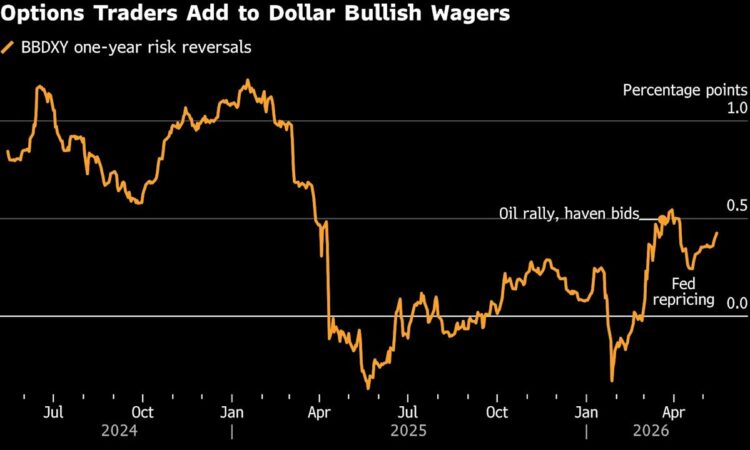
(Bloomberg) — The dollar is heading for its best week in over two months after US data showed price pressures that could push the Federal Reserve to raise interest rates over the next year.
Most Read from Bloomberg
A gauge of the greenback is up more than 1% this week, on track for its best performance since early March. Two back-to-back inflation reports this week have spooked Treasury investors and spurred one Fed official to say the US has “got an inflation problem.”
Money markets now favor a Fed hike this year, a sharp contrast with pricing a month ago that leaned toward easier policy.
“It’s a combination of some re-escalation in the Middle East, which has prompted higher oil prices again, and hotter-than-expected US inflation data,” said Andrew Hazlett, a foreign-exchange trader at Monex Inc. “This indicates to me that even as the conflict in Iran winds down, the dollar will retain some strength over its pre-war levels.”
While the dollar has been sensitive to war headlines and crude futures prices, it has mostly been supported by its haven status and the US’s status as a major oil exporter. The greenback weakened briefly after a ceasefire was first announced in early April but has since recovered as a peace deal remains elusive.
Thierry Wizman, director of global currencies and an interest-rate strategist at Macquarie Futures, said he will remain a dollar bull as long as the war continues. The greenback, along with the US economy, are benefiting from higher oil prices, he said, adding that it will proceed to gain against the euro and the pound.
The war in Iran upended global energy markets and highlighted Europe’s dependence on supply from the Middle East. That soured the outlook on the region’s economies, while fanning price growth, which has weighed on the euro. Brent Donnelly, president of Spectra Markets, said earlier this week that it’s time to enter a trade that shorts the euro against the greenback as Fed hikes are being priced in. Similarly, RBC Capital Markets’ Daria Parkhomenko sees the dollar gaining in the near term against its lower-yielding counterparts in the Group of 10, in particular the euro and the Swiss franc.
“Growing US rates could cement the dollar’s position as a high-yielding currency that should gain from robust market demand for FX carry trades,” said Valentin Marinov, head of G-10 FX research and strategy at Credit Agricole. On top of this, he said the dollar could continue to benefit from foreign portfolio inflows into both Treasuries and US tech stocks.


