Gold is ‘insurance’ against currency crisis, inflation overreaction, dollar devaluation – Steve Forbes
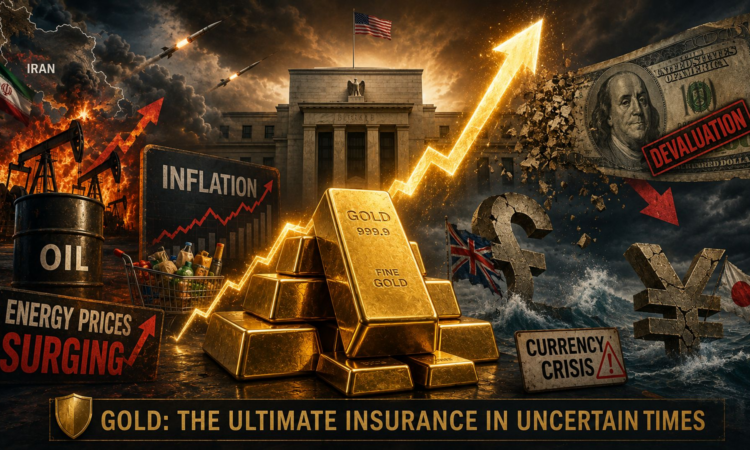
(Kitco News) – Markets have experienced a dollar resurgence more than a decline in the gold price, while the Iran war – and the U.S. reaction to its inflation pressures – make gold essential insurance for investors, according to Steve Forbes, Chairman and Editor-in-Chief of Forbes Media.
Forbes acknowledged that gold prices have seen a precipitous decline since hitting their late January highs near $5,600 per ounce, but said gold isn’t what’s actually changed.
“Better than any item on earth, gold keeps its real value and has done so for thousands of years,” he wrote. “Gold is to measuring the worth of a currency what the North Star is to measuring direction. When the price of the yellow metal changes, it’s the value of currency that has changed. Gold is the constant.”
“What we’re experiencing is a rally in the value of the dollar, not a fall in the real worth of gold,” he added. “The greenback has also gone up against other currencies.”
Forbes believes the main driver of the dollar rally – and gold’s retracement – is a change in tone from the U.S. government.
“The biggest factor is that since gold surged past $5,000 in January, the Trump Administration has stopped muttering about the need to devalue the dollar to reduce our trade deficit,” he said. “Cheapening a currency is the very definition of monetary inflation. It’s always a formula for damaging an economy.”
He added that Kevin Warsh has also played a role in strengthening the dollar, saying the new Fed chair appears to be focused on fighting inflation by stabilizing the currency rather than by reining in economic activity.
But Forbes said this begs another question. “If the dollar has been getting stronger, why are interest rates going up on both short-term and long-term Treasury securities? The two-year Treasury, for instance, has jumped past 4%,” he said. “The answer is supply and demand. The government is issuing boatloads of Treasurys to pay for our huge budget deficit and to refinance trillions of dollars in existing debt that is coming due. When the dollar was fixed to gold, the level of interest rates fluctuated, depending on market conditions.”
Forbes cautioned against premature celebration over the dollar’s recovery from its earlier lows, however, pointing out that it has still lost a great deal of value since 2022.
“Gold was then around $1,800 an ounce,” he noted. “Two years ago, it had moved up to $2,300; a year ago, $3,300. Today, the price of an ounce is still up more than 20% from last summer. What may well be happening here is the stock market equivalent of a bear market rally.”
Forbes warned that the Iran war still has the potential to send energy prices even higher. “The Federal Reserve’s reactionaries are likely to then put pressure on Warsh to hike interest rates,” he said. “He will resist, but the uncertainty will unsettle the debt markets.”
He also sees the potential for an international monetary crisis, perhaps centering on the Japanese yen or the British pound.
“Japan’s national debt is proportionately twice our own. Its financial institutions are loaded with government debt that was issued with virtually no rate of interest, sharply reducing the value of that paper today,” he noted. “If the UK’s new prime minister acts half as radically as he has sounded, that will pound the country’s currency and curtail the government’s ability to sell bonds to pay its deficits.”
Forbes pointed out that the U.S. dollar’s relative strength against other major currencies in the mid-1980s prompted Washington to devalue the dollar, which contributed to the stock market crash of 1987.
“Gold is not an investment; it is insurance for financial troubles,” he said. “Keep the insurance.”
Forbes has been predicting a greater role for gold in the international financial system for a number of years. In May 2024, he wrote that the world is progressing towards a new gold standard.
“It’s hard to believe, but the world is beginning to lurch toward a gold-based monetary system,” Forbes wrote at the time. “This, despite the fact that the historical gold standard is held in almost universal contempt by economists and financial officials.”
He said that despite the many myths and pervasive ignorance surrounding gold-based money, it worked very well for a long time. “The U.S. was on a gold-based system for 180 years until the early 1970s,” Forbes wrote. “We never had inflation when the dollar’s value was tied to the yellow metal, and the U.S. experienced the greatest long-term economic growth in human history.”
Conversely, Forbes said that since the U.S. abandoned the gold standard, its average growth rates have declined by around 33%. “Median household income today would be at least $40,000 higher if our traditional pattern of growth for those 180 years had been maintained,” he said. “Nonetheless, the contumely and scorn for a gold-based monetary system is universal.”
Despite these prevailing attitudes, Forbes believes that he’s seeing several indications that a gold monetary system could be brought back.
“One is that central banks in recent years have been purchasing gold at record levels,” he noted. “Buyers include China, India, Russia and a number of other nations such as Poland. These countries are reacting to growing doubts about the long-term value of the dollar, which in turn is a symptom of the perceived decline of the United States.”
The growing popularity of cryptocurrencies is another indication, which Forbes characterizes as “a high-tech cry for help in the face of increasingly unreliable fiat currencies.”
He added that the ongoing trend of runaway public and private debt creation “will inevitably kindle crises that cannot be easily extinguished.”
Disclaimer: The views expressed in this article are those of the author and may not reflect those of Kitco Metals Inc. The author has made every effort to ensure accuracy of information provided; however, neither Kitco Metals Inc. nor the author can guarantee such accuracy. This article is strictly for informational purposes only. It is not a solicitation to make any exchange in commodities, securities or other financial instruments. Kitco Metals Inc. and the author of this article do not accept culpability for losses and/ or damages arising from the use of this publication.