
How Do Emerging Market Stocks Move with a Strong vs. Weak Dollar? The Characteristics of Southeast Asian Currencies [2026]|世界成長株投資ラボ

“Vietnamese stocks are up 10% in a year!”
You happily open your brokerage account, only to find that the profit converted into yen is negligible. Have you ever had that experience?
The culprit is exchange rates.
The performance of emerging market stocks is heavily influenced not just by the stock price itself, but by the movements of three currencies: the dollar, the local currency, and the yen.
In particular, whether the dollar—the center of the world’s money—becomes stronger or weaker is like the weather for emerging market stocks. If it’s sunny, it’s a tailwind; if it turns into a storm, it’s a major headwind.
In this article, we will explain the following three points clearly with diagrams.
-
The four channels through which a strong or weak dollar affects emerging market stocks
-
The calculation of “double exchange rates” that only Japanese investors face
-
The unique characteristics of Southeast Asian currencies that vary completely by country
First, the basics: What do “strong dollar” and “weak dollar” mean?
A strong dollar means the value of the dollar rises against other currencies. A weak dollar is the opposite.
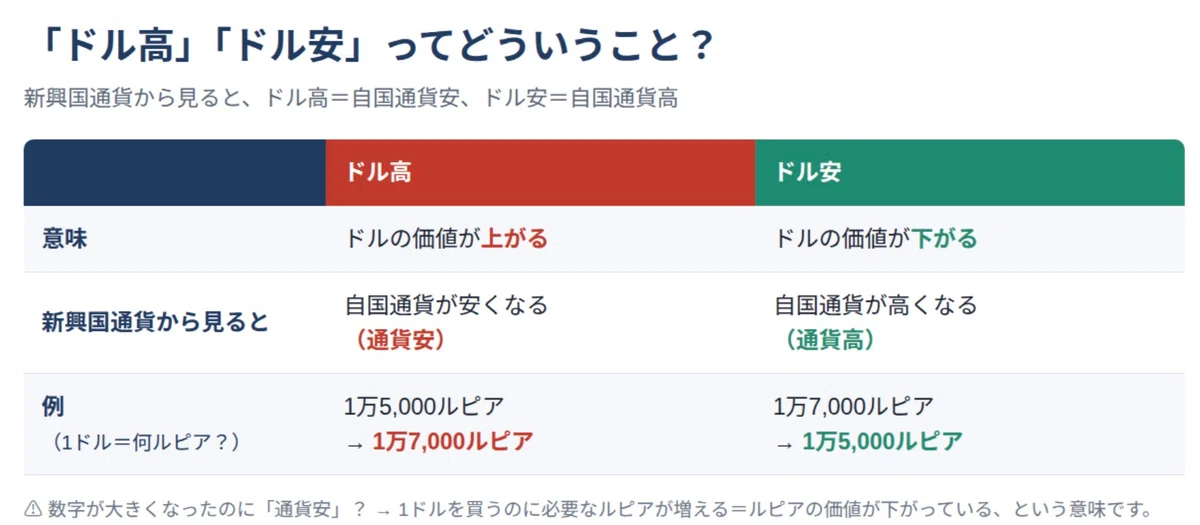
Be careful, as it is easy to get confused when you see “the number went up, but it’s a ‘weak currency’?” It means more rupiah are needed to buy one dollar, which means the value of the rupiah is falling.
The “Dollar Index” that measures the strength of the dollar
The Dollar Index is often used to see whether the dollar is strong or weak overall.
It summarizes the strength of the dollar against major currencies like the euro and the yen into a single number. If you hear on the news that the “Dollar Index has risen,” remember that “the dollar is getting stronger overall = a potential headwind for emerging markets.”
So, what specific impact does a strengthening or weakening dollar have on emerging market stocks?
The “four channels” through which a strong dollar hurts emerging market stocks
A strong dollar affects emerging market stocks through four channels. When the dollar is weak, everything works in the opposite direction.
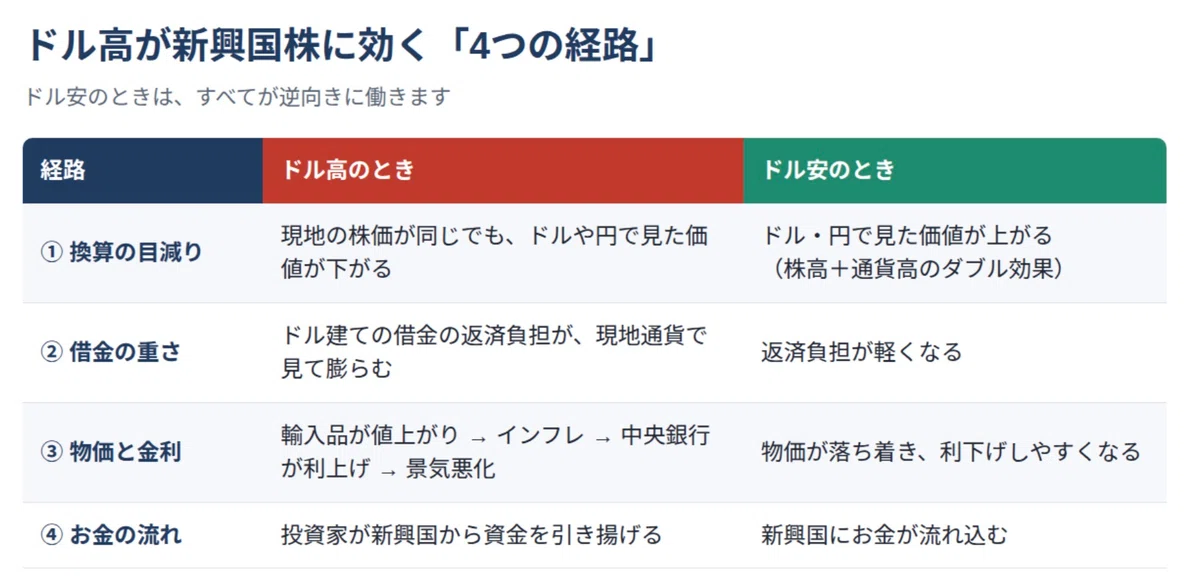
Channel 1: “Shrinkage” even if the stock price remains the same
This is the easiest to understand. Even if a certain emerging market stock index does not move at all for a year, if that country’s currency falls by 10% against the dollar, the asset value in dollar terms will decrease by about 10%.
Since foreign investors ultimately measure their performance in dollars (or their own currencies), stocks in countries where the currency is expected to weaken are more likely to be sold off.
Path 2: Dollar-denominated debt has a “gradual” effect
Emerging market governments and companies often borrow money in dollars, where interest rates are lower.
However, when the dollar strengthens, even the same $100 million debt results in a ballooning repayment amount when converted into local currency.
Sales are in local currency, but debt is in dollars. Companies burdened with this currency mismatch see their performance deteriorate as the dollar strengthens.
Path 3: Import inflation cools the economy
When a currency weakens, imported goods such as crude oil and food become more expensive.
When prices rise, central banks are forced to raise interest rates to protect their currency and curb inflation. If interest rates rise, mortgage loans and corporate borrowing decrease, which cools the economy.
Path 4: Capital flight
During phases of a strong dollar, more investors think that “holding dollars is the safest and most advantageous option.”
Because emerging market scales are small, even a small outflow of capital causes stock prices and currencies to fluctuate significantly. And those movements trigger further currency depreciation. Sometimes, they fall into such a vicious cycle.
Up to this point, the story is common to investors around the world. But in fact, for us Japanese, there is another “currency barrier.”
A pitfall only for the Japanese: Let’s calculate the “double currency effect”
When Japanese people invest in emerging market stocks, their performance is determined by the multiplication of the following three factors:
Performance in yen = (1) Local stock price movement × (2) Local currency vs. dollar movement × (3) Dollar vs. yen movement
Since the exchange rate affects the outcome in two stages, it can be called a “double currency effect.”
Even when converting local currency directly into yen, the exchange rate is effectively determined via the dollar, so the logic remains the same.
Calculation example: When the local stock price rises by +10% in one year
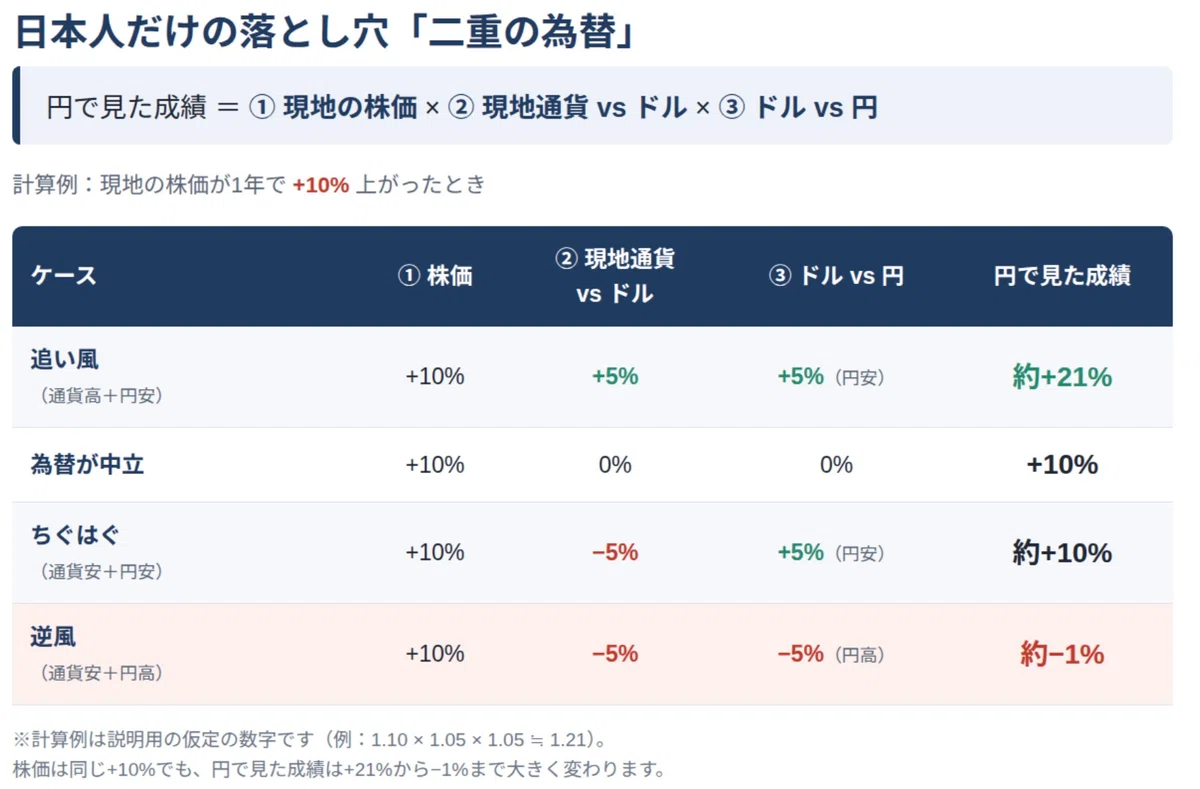
*The calculation example uses hypothetical figures for explanation (e.g., 1.10 × 1.05 × 1.05 ≒ 1.21).
What do you think?
Even though the stock price is the same +10% in every case, the performance in yen terms varies significantly, ranging from +21% to -1%. The ‘Vietnamese stocks went up but I didn’t make money’ scenario mentioned at the beginning is exactly the last case.
3 points to remember
1. A weak dollar is a tailwind for emerging market currencies. However, a strong yen often comes as a set. While a weak dollar tends to make (2) positive, (3) can become negative due to a strong yen, sometimes canceling out the effect.
2. The worst scenario is the simultaneous occurrence of ‘weak emerging market currency + strong yen’. In times of global risk aversion, emerging market currencies are sold off, and the yen, considered a ‘safe-haven currency,’ tends to be bought. Remember that this combination is likely to occur.
3. Exchange rates in the short term, stock prices in the long term. Even if the impact of exchange rates seems large on a one-year basis, corporate growth (rising stock prices) is more likely to have a greater impact on performance over a 10-year period.
Companies that ‘benefit’ and ‘lose’ from a strong dollar
Even for stocks in the same country, the impact of a strong or weak dollar can be the exact opposite depending on the company. The key is which currency the sales and debts are in.
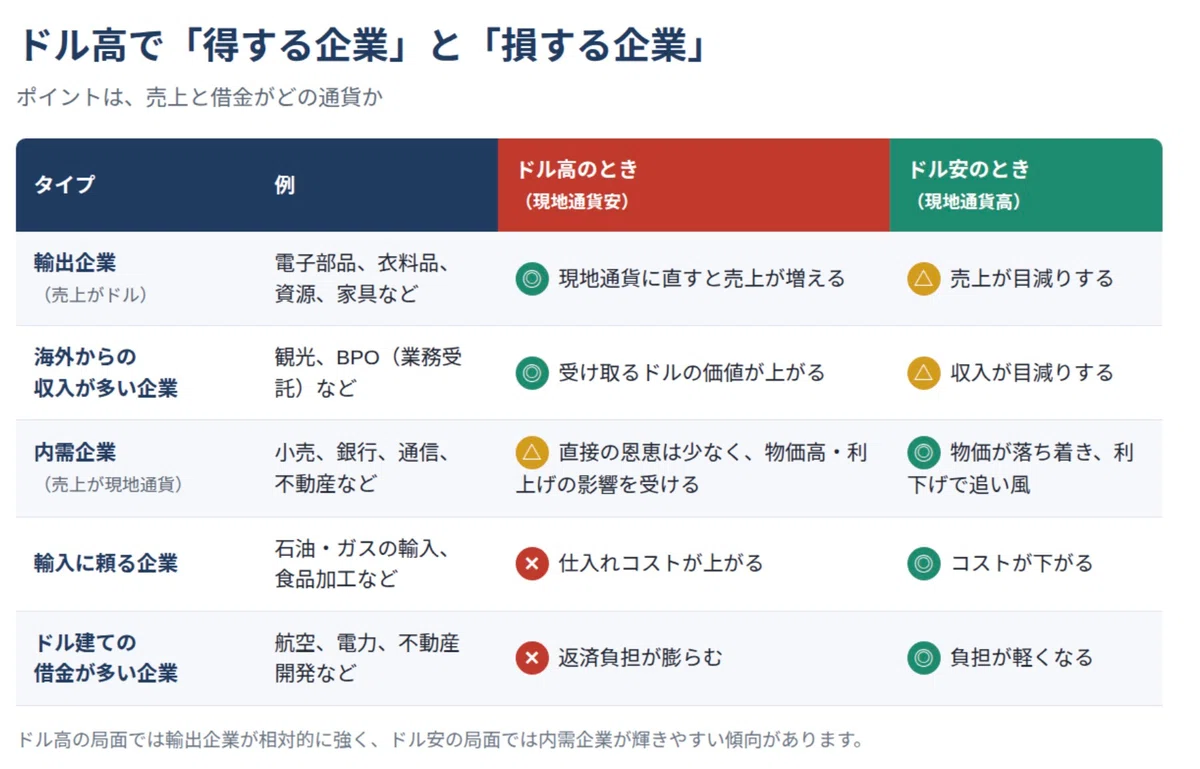
In other words, there is a tendency for export companies to be relatively strong during periods of a strong dollar, while domestic demand companies tend to shine during periods of a weak dollar.
👉️More people means more money! Emerging market stocks in the demographic bonus period and the ‘remaining time’ for various Asian countries, the ‘companies earning domestically’ introduced in that article are exactly domestic demand companies.
While aiming for the benefits of the demographic bonus over the long term, they are temporarily susceptible to headwinds during periods of a strong dollar.
Knowing both sides of this will help you avoid panicking over price movements.
So, does ‘weak dollar = high emerging market stocks’ hold true in actual data?
Data verification: ‘Weak dollar years’ are good years for emerging market stocks
When you line up the dollar index and the performance of emerging market stocks over the past few years, the relationship becomes clear.
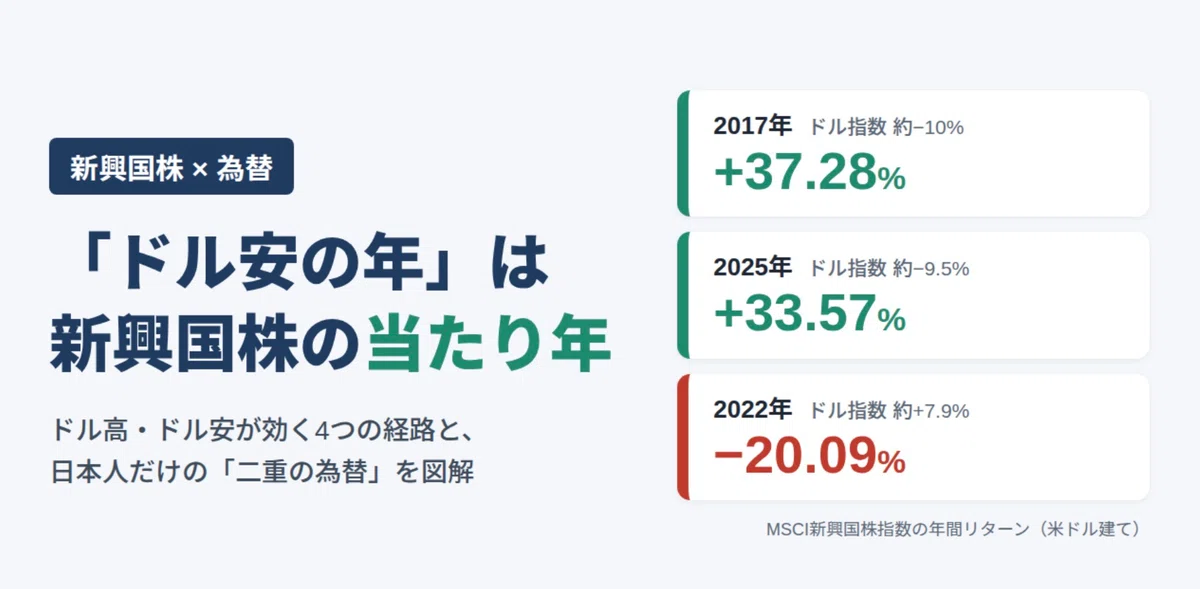
Source: Dollar index from Business Standard (comparison between 2025 and 2017), CNBC (2022), The Kobeissi Letter (2024). Stock prices are the annual total return (in US dollars) from MSCI and S&P Dow Jones Indices.
In 2017 and 2025, when the dollar fell significantly, both were great years for emerging market stocks, with returns exceeding +30%.
On the other hand, in 2022 and 2024, when the dollar was strong, emerging market stocks performed poorly and lost to US stocks.
What about now in 2026? The footsteps of a strong dollar are approaching
The dollar in 2026 hit a low of about 4 years at the beginning of the year, but then recovered triggered by the war in the Middle East (J.P. Morgan).
And since the Fed’s interest rate hike in September, the trend of a strong dollar has been strengthening.
In late September, the dollar index exceeded 101, reaching its highest level in about two months. The market now puts the probability of an additional rate hike in October at about 70% (Trading Economics).
Emerging market stocks have performed well since the beginning of the year, but if the dollar continues to strengthen, that tailwind could weaken. We can say that we are currently at such a turning point.
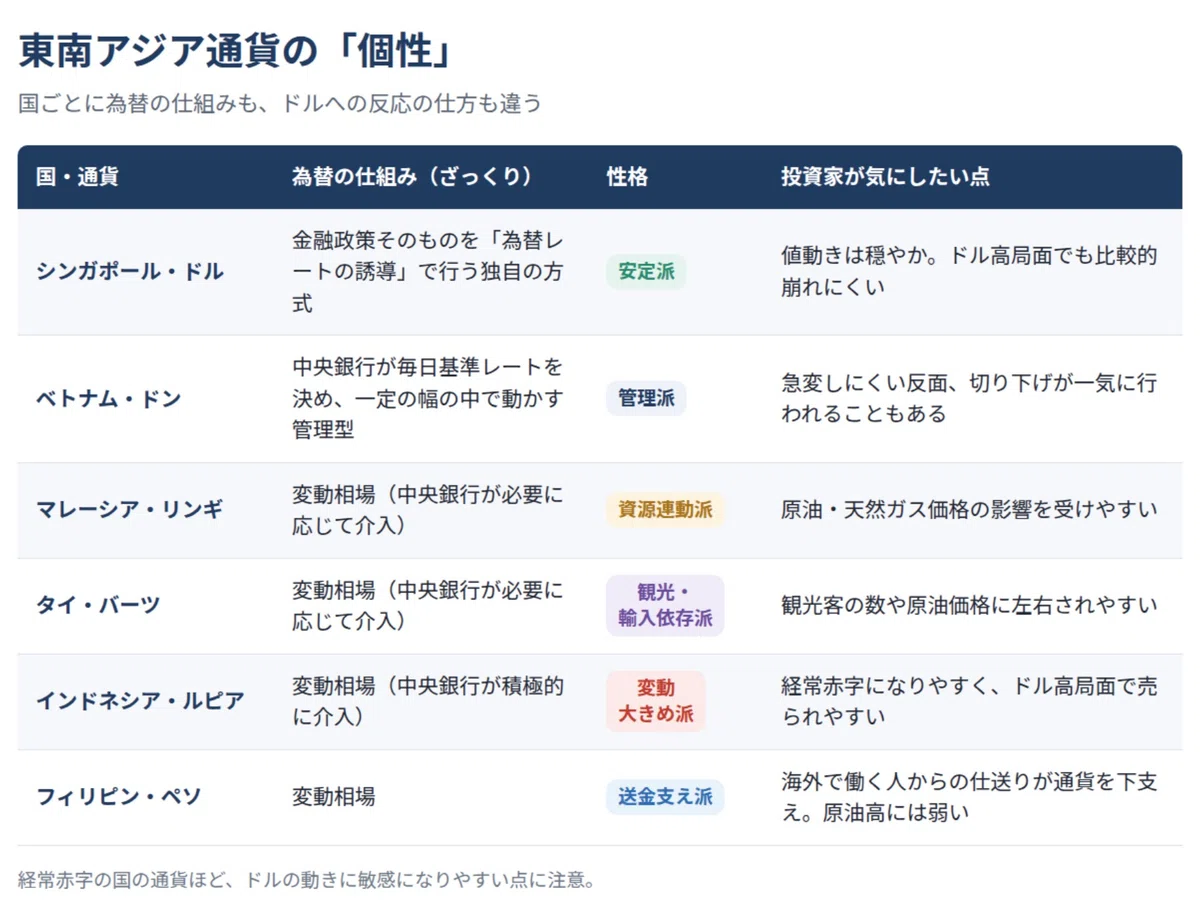
A word of caution here. While we tend to group them all as “emerging market currencies,” the currencies of Southeast Asia actually have completely different characteristics from country to country.
Understanding the “personality” of Southeast Asian currencies
Southeast Asian currencies differ by country in their exchange rate mechanisms and how they react to the dollar. Let’s grasp their general characteristics.
Learning from history: Lessons from the Asian Financial Crisis
The 1997 Asian Financial Crisis began when Thailand could no longer maintain its de facto fixed exchange rate with the dollar. Based on this experience, many Southeast Asian countries shifted to floating exchange rate systems and built up substantial foreign exchange reserves.
As a result, current Southeast Asian currencies are significantly more resilient to crises than they were back in 1997.
Even so, the structure that makes them prone to being sold off during periods of a strong dollar remains unchanged. In particular, keep in mind that the currencies of countries with current account deficits are more sensitive to dollar movements.
Four tips for managing exchange rate risk effectively
No one can predict exchange rates. That is precisely why it is important to find ways to live with them rather than trying to “guess” them.
Tip 1: Use dollar-cost averaging to “diversify exchange rate timing”
By investing a fixed amount every month, you end up buying less when the currency is expensive and more when it is cheap. This averages out the ups and downs of the exchange rate and helps you avoid the risk of “investing the entire amount at the worst possible time.”
Tip 2: Consider investment trusts with “currency hedging”
Some investment trusts offer a “currency hedged” type that suppresses exchange rate fluctuations. While this can reduce the impact of exchange rates, it is important to note that hedging comes with costs.
In general, the higher the interest rate of a country’s currency, the higher the hedging cost tends to be, and the reality is that there are few products with hedging available for emerging market currencies.
Tip 3: Diversify your currencies as well
If you concentrate on a single country, you have nowhere to hide if that country’s currency plummets. By spreading your investments across multiple countries, the movements of the currencies will to some extent cancel each other out.
Tip 4: Don’t get caught up in short-term exchange rate fluctuations
As seen in the calculation of “double exchange rates,” the impact of exchange rates can look significant on a one-year basis. However, when viewed over a 10- or 20-year time horizon, it is primarily corporate growth that determines performance.
When investing in long-term themes like demographic dividends, it is also important to accept exchange rates as an unavoidable fluctuation.
Summary: Understanding exchange rates allows you to read the ‘fluctuations’ in emerging market stocks.
-
A strong dollar acts as a headwind for emerging market stocks through four channels: valuation shrinkage, debt burden, import inflation, and capital outflow. If the dollar is weak, all of these turn into tailwinds.
-
Japanese investors are exposed to local currency × dollar × yen dual exchange rates. Even if stock prices rise by the same 10%, the performance in yen can vary significantly.
-
The worst combination is ‘weak emerging market currency + strong yen.’ This tends to occur during periods of global risk aversion.
-
Export-oriented companies tend to be relatively stronger when the dollar is high, while domestic demand-oriented companies tend to be stronger when the dollar is low.
-
2017 and 2025, which saw a significant weakening of the dollar, were banner years where emerging market stocks gained over 30%.
-
Since September 2026, the trend of a strong dollar has been strengthening; be aware of the possibility that tailwinds may weaken.
-
Southeast Asian currencies have different characteristics by country, and the currencies of countries with current account deficits are more sensitive to the dollar.
Even if you cannot predict exchange rates, knowing the mechanisms allows you to avoid being swayed by price movements.
“Since the dollar is strong right now, it might be a time to be patient with emerging market stocks.”
Just being able to maintain that calm perspective should significantly increase your success rate in long-term investing.
Disclaimer
This article is for informational purposes only and does not recommend investing in any specific country, financial product, or stock. The data provided is based on public information available at the time of writing (September 2026). Calculation examples are hypothetical for explanatory purposes and do not indicate future exchange rates or stock prices. Please make investment decisions at your own risk.


