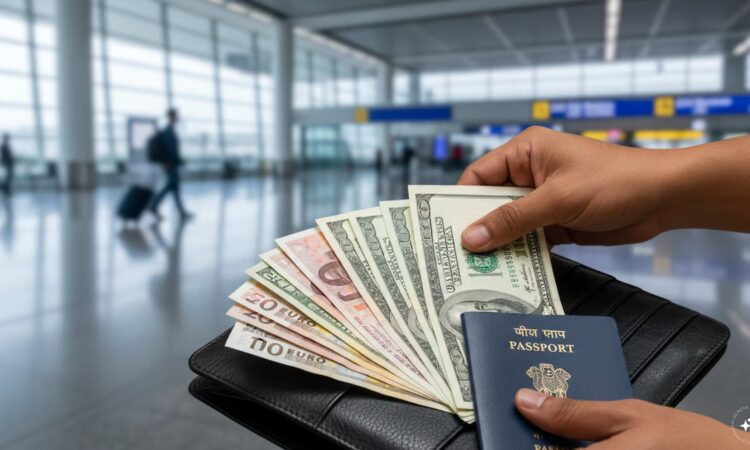
The Thai baht, UAE dirham, Singapore dollar, Malaysian ringgit and Vietnamese dong are gaining traction alongside the dollar, according to Thomas Cook India’s India Forex Report 2026.
The report is based on the company’s forex transaction data between April 2025 and March 2026.
The US dollar accounted for 49% of forex demand in the period. Europe-linked currencies made up another 23%, followed by Asia at 11% and the Middle East at 9%. Australia and New Zealand accounted for 5%, while Canada contributed 3%.
The changing currency mix comes as Indian travellers look beyond traditional destinations. Southeast Asian currencies, in particular, are gaining importance as short-haul international travel grows.
Smaller cities drive more than half of forex demand
The change is not limited to where Indians travel. It is also spreading the geographic base of forex demand within India.
Tier 2 cities accounted for 41% of Thomas Cook India’s forex demand and Tier 3 cities another 12%. Together, they contributed 53%, compared with 47% from Tier 1 cities, including metros.
Leisure travel remained the biggest source of demand at 57%, followed by corporate travel at 27% and overseas education at 16%.
Indians are buying forex closer to travel
The timing of forex purchases is changing as well. Travellers are now buying foreign currency around four to seven days before departure, compared with 10–14 days earlier.
Digital channels are becoming more important in this shorter purchase cycle. While branches still account for 75% of purchases, 25% of customers now transact through websites, apps, WhatsApp and quick-commerce platforms.
Thomas Cook India said usage of its self-service digital platforms has grown 50% year-on-year over the past two years. The average digital forex transaction stands at ₹76,000.
Cards take a larger share of overseas spending
Cash continues to dominate holiday forex transactions, accounting for 75% of transactions. Cards account for 25%.
However, cards represent 39% of the total load value, suggesting that they are being used for a larger share of planned overseas spending.
The shift is even more pronounced among corporate travellers. Forex cards account for 84% of corporate forex usage, with multi-currency cards making up 76% of corporate card usage.
Study-abroad destinations are changing too
The diversification extends to overseas education. Europe accounts for 38% of study-abroad forex demand, followed by the US at 34%, Australia at 10%, and Canada and the UAE at 3% each.
Demand is also coming from beyond the traditional metro markets. Mumbai accounts for 12% of education-related forex demand, Delhi-NCR 11% and Chennai 10%, while Hyderabad and Bengaluru contribute 7% each. Cities such as Pune, Surat and Lucknow are also emerging as source markets.