“Middle East War Intensifies Inflationary Pressures…Asia Faces Dual Vulnerability of High Oil Prices and Weak Currencies”[2026 Financial Forum]
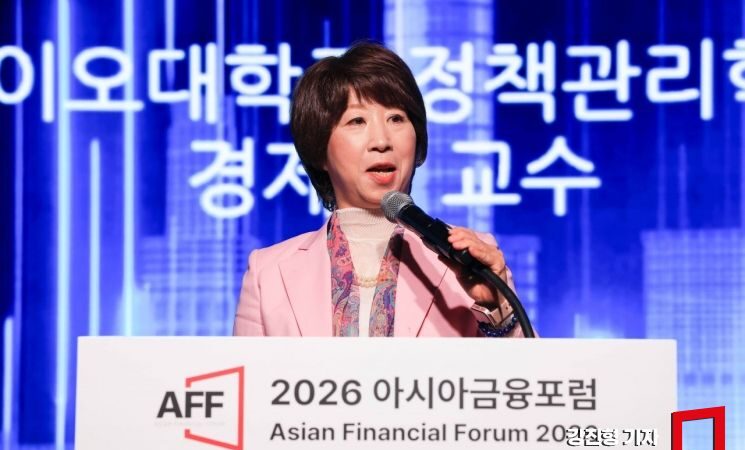
Sayuri Shirai, Professor of Economics at Keio University
Special Lecture at the ‘2026 Asia Financial Forum’
“Energy and Currency Depreciation Shocks… Serious Policy Trade-Offs for Korean and Japanese Central Banks”
“AI-Driven Su
As global inflationary pressures intensify due to the war in the Middle East, there is growing concern that Asian countries such as South Korea and Japan are facing a “dual risk” of rising energy prices and depreciating currencies. Such supply-side shocks are severely constraining the fiscal and monetary policies of Asian countries, exacerbating the dilemma of policy mix choices.
Sayuri Shirai, Professor of Economics at Keio University in Japan and former member of the Bank of Japan’s Monetary Policy Board, delivered a special lecture on “Structural Changes in the Global Economy and the Evolving Role of Asian Financial Markets” at the “2026 Asia Financial Forum” hosted by The Asia Business Daily at the Westin Chosun Seoul on May 21.
Professor Shirai stated, “The recent geopolitical developments in the Middle East once again remind us of how crucial energy security is not only for the global economy but especially for Asia.”
Dual Shock of Rising Oil Prices and Currency Depreciation… Heightened Monetary Policy Dilemma

Sayuri Shirai, Professor of Economics at Keio University’s Faculty of Policy Management, is delivering a special lecture on the topic of “Structural Changes in the Global Economy and the Evolving Role of Asian Financial Markets” at the ‘2026 Asia Financial Forum’ hosted by The Asia Business Daily, held at the Chosun Hotel in Jung-gu, Seoul on May 21, 2026. Photo by Jinhyung Kang
Professor Shirai assessed that the Middle East-driven energy risk is not just about fluctuations in oil prices, but constitutes a structural issue directly linked to inflation, exchange rate volatility, and macroeconomic uncertainty. She especially noted that the recent upward trend in oil prices could persist over the long term. “As the influence of the Organization of the Petroleum Exporting Countries (OPEC) weakens, it has become unclear how strictly member countries will adhere to the existing quota system,” she explained. “Even if a ceasefire is achieved in the future, physical supply constraints may persist for a considerable period,” she analyzed.
The breakdown in energy supply chains is casting a dark cloud over the economies of South Korea and Japan, which are highly dependent on the Middle East. Professor Shirai pointed out, “The collapse of the collateral system that used to support oil prices has resulted in greater price volatility,” and added, “We are witnessing a resurgence of inflation in the United States, Japan, and South Korea. Even if inflation rates slow in the near future, the absolute price level is likely to remain elevated.”
Additionally, heightened preference for the U.S. dollar as a safe haven due to Middle East risks is driving sharp declines in the value of major Asian currencies, further increasing import costs. Professor Shirai said, “The Japanese yen has experienced the most significant depreciation among Asian currencies, followed by the Korean won and the Indian rupee. Asia is exposed to a ‘double vulnerability’—the dual impact of external energy price risks and currency depreciation.”
The problem, she stressed, is that viable policy response options are extremely limited. Normally, rising prices would be met with base rate hikes or fiscal tightening, but such measures have little effect in the face of supply shocks. “Rising inflation leads to higher long-term government bond yields (interest rates), which threatens the sustainability of national debt, making it difficult for governments to pursue large-scale fiscal expansion,” Professor Shirai said.
She also pointed out that central banks now face a monetary policy dilemma. “Since the current inflation is driven by supply-side shocks, it is extremely difficult for central banks to present the right policy solutions,” she said. “If central banks raise interest rates to stabilize both exchange rates and prices, it could end up suppressing the real domestic economy.” She further emphasized, “The conflict between curbing inflation by raising rates and avoiding downward pressure on economic growth is growing ever more severe.”
Regarding the response to currency depreciation in Asian countries, Professor Shirai explained, “Raising the base rate may slow the pace of depreciation, but it will also suppress domestic demand, while higher government bond yields increase the burden of debt repayment costs.” She concluded, “Not only is the tension between external objectives and domestic policy rising, but the complexity of the fiscal and monetary policy mix is also increasing.”
AI-Driven Surge in Energy Demand: Korea-Japan Cooperation Needed for the ‘ASEAN Grid’

Sayuri Shirai, Professor of Economics at Keio University’s Faculty of Policy Management, attended the ‘2026 Asia Finance Forum’ hosted by The Asia Business Daily on May 21 at the Chosun Hotel in Jung-gu, Seoul. She gave a special lecture on the topic of “Structural Changes in the Global Economy and the Evolving Role of the Asian Financial Market.” 2026.5.21 Photo by Kang Jinhyung
Professor Shirai emphasized that the explosive growth of the artificial intelligence (AI) industry has emerged as a new “structural constraint” on economic growth. “AI currently generates enormous demand for power and energy, which leads to energy shortages, greater price volatility, and carbon regulation risks,” she said. “Securing stable energy supplies has now become a key determinant of national economic competitiveness,” she stressed.
As a solution, she proposed that South Korea and Japan should actively cooperate in the “ASEAN Grid” project, a cross-border power grid initiative being promoted by ASEAN countries. “ASEAN, India, and other regions are experiencing a steep surge in energy demand due to rapid digitalization, but their supply remains grossly inadequate,” Professor Shirai explained. “Vietnam has a strength in solar energy, while other ASEAN regions specialize in hydropower, and efforts are underway to interconnect these power grids.” She suggested, “If Korea and Japan provide technological and financial support, it would create a win-win structure that helps resolve energy constraints within the Asian region together.”
Diversification of Cross-Border Payment Systems… Gradual Fragmentation of Dollar Hegemony
Finally, Professor Shirai predicted that technological advancements in cross-border payment systems could eventually serve as a catalyst for reducing dependence on the U.S. dollar. “Currently, there is vigorous development of QR code-based cross-border payment linkages in ASEAN, India, the United Arab Emirates (UAE), and elsewhere,” she said. “In the future, major economies are likely to increasingly settle payments directly with resource-exporting countries like the UAE and India, using their own currencies.”
She added, “While yen-won transactions currently require the use of the U.S. dollar as an intermediary, a denser web of payment linkages within Asia will ultimately increase direct bilateral transactions. Innovations in payment infrastructure are reshaping the way currencies are used.”
Hot Picks Today

At President Lee’s Call to “Give Enough to Shock,” Whistleblower Rewards Become a Real Lottery
Professor Shirai concluded, “Although the existing global system based on the U.S. dollar and SWIFT will not collapse overnight, it is highly likely that, in the future, multiple alternative payment systems will develop in parallel, leading to the partial fragmentation of dollar hegemony.”
This content was produced with the assistance of AI translation services.
© The Asia Business Daily(www.asiae.co.kr). All rights reserved.