
New indicators of the euro’s global appeal from the euro area international investment position

Published as part of the The international role of the euro, June 2026.
This box presents novel indicators to assess the euro’s global appeal, based on newly available currency breakdowns in the euro area international investment position (IIP). Specifically, the indicators show the currency composition of the euro area’s cross-border assets and liabilities – denominated in euro, US dollars and other currencies – excluding intra-euro area positions. The indicators, which are fully consistent with official ECB data on the euro area IIP, are constructed from the euro area and individual countries’ IIP data, complemented with estimates based on the ECB’s securities holdings statistics and the Bank for International Settlements’ locational banking statistics.[1]
The new indicators show that around one-third of euro area cross-border assets and two-thirds of liabilities were denominated in euro in 2025, with the remainder largely in US dollars (Chart A, panel a). In that year, both euro area cross-border assets (excluding reserve assets) and liabilities amounted to around €36 trillion.[2] The lower share of euro-denominated cross-border assets relative to liabilities implies that the euro area is “short” in euro (i.e. the net foreign asset position in euro is negative) and “long” in foreign currencies, most notably the US dollar. This configuration implies that a depreciation of the euro generates valuation gains and positive wealth effects in periods of external shocks accompanied by a depreciation of the euro exchange rate, thereby acting as a buffer for the euro area. While this mechanism is well established in the literature when it comes to advanced economies – including the United States and individual euro area countries – the new indicators provide, for the first time, comprehensive quantitative evidence for the euro area as a whole.[3]
Focusing on euro area cross-border liabilities, the euro’s share rose from 54% in 2015 to 66% in 2025, suggesting that the currency’s appeal to global investors has been growing over the past decade (Chart A, panel b). The rising share of the euro was broad-based across IIP components and largely mirrored by a decline in the US dollar share.[4] The euro’s share increased the most in foreign direct investment – by almost 20 percentage points to 52%, albeit from a relatively low initial level. Although the euro’s shares were already high in 2015 for other IIP components, they have increased further over the past decade, reaching 78% in portfolio equity, 71% in portfolio debt and 62% in other investment. The US dollar remains by far the second most important currency in euro area IIP liabilities, although its shares have decreased across all components.
Chart A
Increase in the euro’s global appeal over the past decade
|
a) Euro area cross-border assets and liabilities by currency |
b) Change in currency shares of euro area cross-border liabilities |
|---|---|
|
(EUR trillions) |
(percentages) |
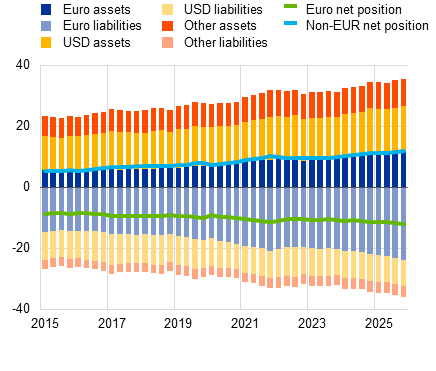 |
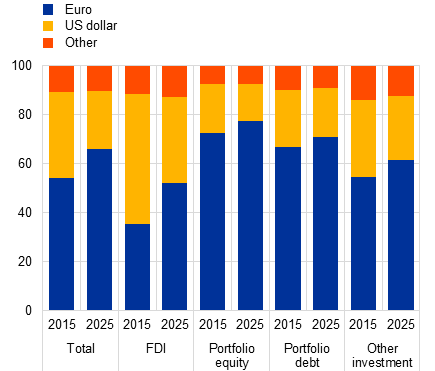 |
Sources: BIS, ECB and ECB staff calculations.
Notes: In panel a), the latest observation is for the fourth quarter of 2025. “EUR assets”, “USD assets” and “Other assets” refer to euro area cross-border assets denominated in euro, US dollars and other currencies respectively. “EUR liabilities”, “USD liabilities” and “Other liabilities” refer to euro area cross-border liabilities denominated in the respective currencies and are shown with a negative sign. “EUR net position” refers to the difference between euro-denominated euro area cross-border assets and liabilities. “Non-EUR net position” refers to the difference between euro area cross-border assets and liabilities denominated in currencies other than the euro. In panel b), changes between the fourth quarter of 2015 and the fourth quarter of 2025 are shown. FDI = foreign direct investment.
While foreign direct investment liabilities recorded the largest increase in share, portfolio equity made the largest contribution to the overall rise in the euro’s share since 2015, owing to its larger volume. Euro-denominated euro area cross-border liabilities have expanded by more than €9 trillion over the past decade (Chart B, panel a). Portfolio equity accounted for the largest increase (€4.9 trillion), followed by foreign direct investment (€2.1 trillion) and other investment (€1.9 trillion), while portfolio debt increased only modestly (€0.4 trillion). The growth in portfolio equity liabilities explains more than half of the total 12 percentage-point increase in the euro’s share since 2015 (Chart B, panel b). The growth reflects strong global investor demand for both listed shares and investment fund shares, with the latter accounting for around three-quarters of the overall expansion in portfolio equity liabilities. While euro area listed shares are almost exclusively denominated in euro, this is less the case for euro area investment fund shares. Still, the euro is used as the currency of issuance for the majority of euro area investment fund shares.[5]
Chart B
Portfolio equity liabilities drove most of the euro’s share increase
|
a) Euro-denominated euro area cross-border liabilities by IIP component |
b) Cumulative changes in euro-denominated euro area cross-border liabilities by IIP component |
|---|---|
|
(EUR trillions; percentages) |
(percentages, four-quarter moving average) |
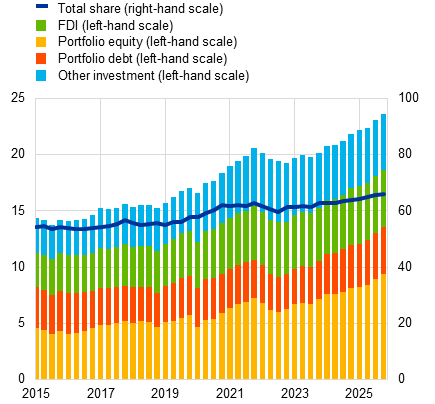 |
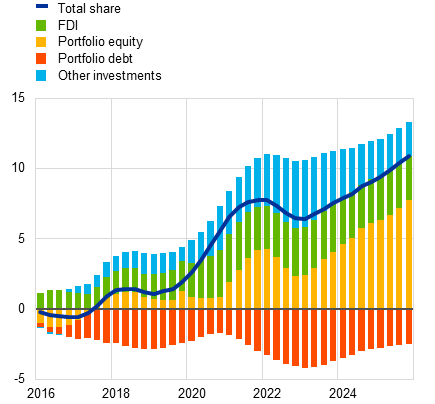 |
Sources: BIS, ECB and ECB staff calculations.
Notes: The latest observation is for the fourth quarter of 2025. FDI = foreign direct investment. In panel a), “Total share” refers to the share of euro-denominated liabilities in total euro area cross-border liabilities. In panel b), the cumulative changes reflect the combination of (i) changes in the share of euro-denominated liabilities within each category (depicted in Chart A, panel b) and (ii) changes in the size of each category as a share of total euro-denominated liabilities. Therefore, the total share represents the overall increase in the share of euro-denominated euro area cross-border liabilities.
Factors such as asset supply, interest rates, trade intensity, business sentiment towards Europe and policy uncertainty may shape the euro’s growing global appeal. The euro’s share in euro area cross-border liabilities (or its IIP components) is positively associated with more ample euro area government debt supply, higher interest rates, more extra-euro area trade and a favourable business sentiment towards Europe, as well as with lower economic policy uncertainty (Chart C).[6] These results suggest that policies promoting trade openness, an ample supply of safe assets and a predictable, low-uncertainty macroeconomic environment may help boost the euro’s attractiveness as an international investment currency.
Chart C
Asset supply, interest rates, market sentiment, policy uncertainty and trade intensity may shape the euro’s global appeal
Correlations with changes in the euro’s share in cross-border liabilities
(correlation coefficients and 90% confidence intervals)
Sources: Baker et al. (2016), Bloomberg, Haver Analytics, NL Analytics and ECB staff calculations.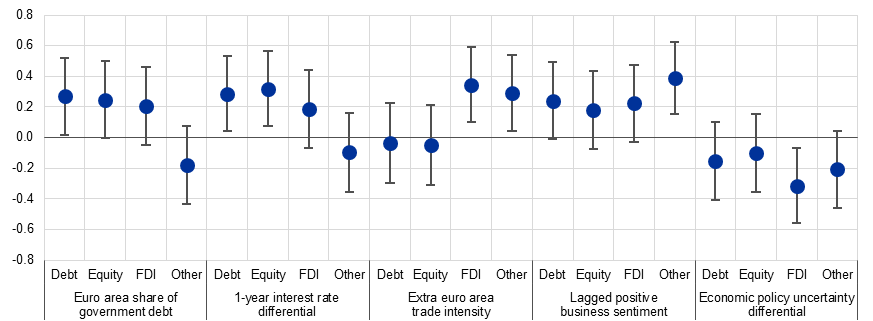
Notes: Correlations are estimated with respect to changes in the euro’s share in euro area cross-border liabilities across its IIP components (portfolio debt, portfolio equity, FDI and other investment) using quarterly data between the first quarter of 2015 and the fourth quarter of 2025. The dots refer to point estimates and the ranges show the corresponding 90% confidence intervals. “Euro area share of government debt” refers to the log change in the ratio of outstanding euro area government debt over the sum of euro area and US government debt. “Economic policy uncertainty differential” refers to the difference between the average value of the Economic Policy Uncertainty index for six euro area countries and the average value of 13 non-euro area countries for which indices are available; see Baker, S. R., Bloom, N. and Davis, S. J., “Measuring economic policy uncertainty”, Quarterly Journal of Economics, 2016. The “1-year interest rate differential” is calculated as the difference between the one-year euro area benchmark government bond yield and the average yield of non-euro area G10 currency issuers. “Lagged positive business sentiment” refers to the one-quarter lagged sentiment score associated with references to the terms “Europe”, “European Union”, “eurozone”, “euro area”, “EU” and “EA” in global companies’ earning calls, as provided by NL Analytics. “Extra euro area trade intensity” is the sum of extra-euro area imports and exports over the sum of global imports and exports.


