
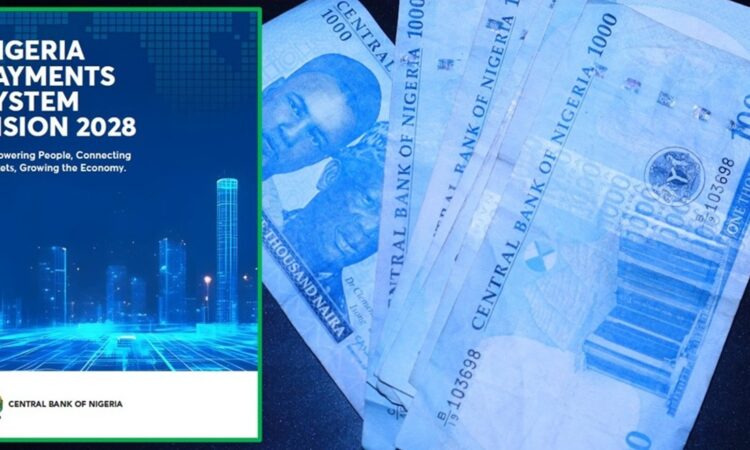

Nigeria’s central bank has identified using the eNaira for government payments as part of a fresh strategy to boost take-up of its struggling central bank digital currency (CBDC).
The Central Bank of Nigeria (CBN) launched the eNaira more than four-and-a-half years ago but acknowledges in a new payments-focused document that adoption has been ‘slow’.
The digital money initiative is being closely watched by finance ministries across Africa – Nigeria has the largest population on the continent – and beyond. It is one of the few ‘live’ CBDCs globally and part of a broader strategy to discourage use of traditional (paper) cash.
The CBN’s ‘Nigerian Payments System Vision 2028’ summarises why eNaira take-up to date has, however, been underwhelming and sets a plan for its ‘repositioning’, including its use for ‘G2P’ (government to person) payments. Such payments would typically be, for example, social-welfare payments, but could also mean civil servant salaries and pensions.
The 132-page document overall sets an ‘agenda to consolidate Nigeria’s position, deepen the efficiency and inclusiveness of our payments infrastructure, and strengthen the country’s role within the global financial system,’ CBN governor Olayemi Cardoso writes in its foreword.
RELATED ARTICLE Nigeria central bank partners local blockchain company to drive eNaira take-up – a news story (13 March 2023) on efforts to promote the eNaira
Barriers to adoption
Nigeria, which is Africa’s most populous country with a population of just over 232 million people (World Bank data – 2024), launched the eNaira in October 2021.
The central bank also appointed a blockchain company just over two years ago to ‘champion the adoption and utility’ of CBDC across the country. Convexity Technologies was tasked with helping the CNB to ‘deepen adoptions and sensitisation’ to the eNaira.
But the central bank’s new strategy document notes that barriers have to date included ‘limited stakeholder engagement and buy-in in design and implementation’; a ‘limited adoption and integration drive’; and ‘limited resources and capacities for retail CBDC implementation’; among other factors.
The central bank notes ‘low usage in real-economy use cases’, ‘limited merchant value proposition’ and ‘weak integration into banking/fintech apps.’
It therefore proposes to ‘reposition eNaira for G2P’, along with other proposed priority uses. They are: remittances; trade settlement; open APIs (application programming interfaces) for fintech integration; and ‘launch[ing] bilateral CBDC corridor pilots with priority trade/remittance partners.’
The eNaira has potential for cross-border use but is not yet interoperable with other CBDCs or regional corridors, the strategy document points out.
RETAIL CBDC: EXPLAINED A retail CBDC is for general population use; its sister concept is a wholesale CBDC, which is for interbank use
Cross-border possibilities
On the cross-border front, Nigeria wants to harmonise regulatory standards within the Economic Community of West African States (ECOWAS) and African Union (AU), ‘advancing bilateral CBDC corridors, upgrading digital infrastructure for secure real-time settlement, and deepening partnerships.’
The central bank states that Singapore’s 24/7 RTGS (Real-Time Gross Settlement) and CBDC rails ‘offer a blueprint for Nigeria’s next-gen settlement architecture’ through ‘NIP-eNaira integration’. NIP stands for NIBSS (Nigeria Inter-Bank Settlement System) Instant Payments – Nigeria’s primary account-number-based electronic transfer platform.
‘Low real-world uptake of the eNaira (a very small share of currency in circulation as of early 2024) indicates that domestic CBDC readiness has not yet translated into cross-border utility,’ the Vision states, adding that ‘without bilateral corridor pilots and interoperability standards, the eNaira cannot materially reduce remittance or settlement costs.’
It refers to ‘expand[ing] the CBN regulatory sandbox [test space] to include cross-border eNaira and stablecoin products (for example, trade finance tokens, programmable remittance flows, tokenized letters of credit)’; and the ‘develop[ment of] bilateral pilots between eNaira and other CBDCs’, specifying South Africa’s ‘Project Khokha’ and Ghana’s e-Cedi.
Also on international linkages, reference is made to ‘pilot[ing] eNaira–SWIFT corridor integration (e.g. UK–Nigeria remittance corridor) by Q3 2026’. SWIFT is the international messaging network that banks, financial institutions, and large corporate organisations use to communicate with each other securely about cross-border financial transactions.
STABLECOINS: EXPLAINED Stablecoins are cryptocurrencies designed to maintain a stable value by having their market value pegged to an external reference, typically fiat currency.
Global CBDC progress: mixed
Just a handful of nations – including the Bahamas and Jamaica – are fully live with a CBDC but none are proving popular.
China’s authorities continue to progress the rollout of a digital yuan, however, while India is moving towards full issuance of a digital rupee.
Elsewhere, the European Central Bank (ECB) is aiming for 2029 for the issuance of a digital euro. The ECB Governing Council’s final decision on whether to issue a CBDC for the 21-member eurozone will only be taken once legislation has been adopted.
In the UK, the Bank of England and HM Treasury are currently in a multi-year ‘design phase’ exploring the creation of a digital pound. No final decision has been made on whether to launch it.
In the US, a CBDC is currently off the table: president Donald Trump issued an executive order almost 18 months ago (January 2025) on digital financial technology stating that his administration would ‘tak[e] measures to protect Americans from the risks of CBDCs, which threaten the stability of the financial system, individual privacy, and the sovereignty of the United States, including by prohibiting the establishment, issuance, circulation and use of a CBDC within the jurisdiction of the United States.’


