
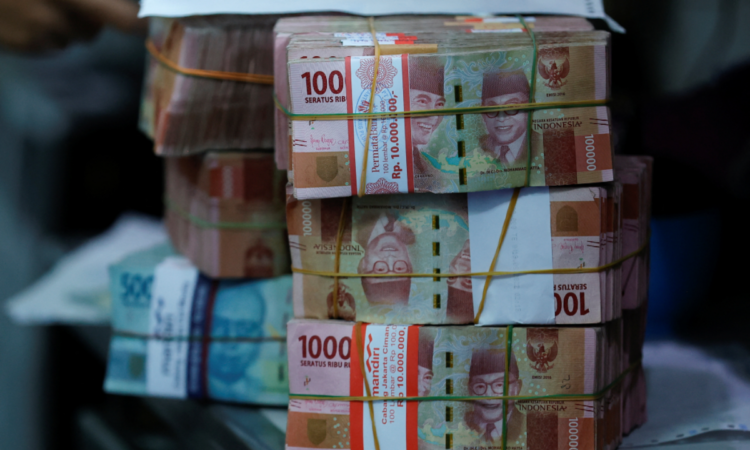
(July 2): The rupiah closed today’s trading session with a 0.26% weakening at Rp17,994/US$, after moving all day close to the psychological level of Rp18,000/US$.
The rupiah’s weakening eased slightly after the US dollar’s gains stalled ahead of the release of US nonfarm payrolls data . The US dollar index against a basket of six major currencies fell 0.21% to 101.18 from 101.4 earlier this morning.
The weakening US dollar brought a breath of fresh air to several Asian currencies. The Japanese yen recorded the sharpest strengthening, at 0.63%, followed by the Malaysian ringgit, Thai baht, Singapore dollar, Philippine peso, offshore yuan, Chinese yuan, and South Korean won. Meanwhile, the rupiah weakened the most, at 0.26%, followed by the Taiwanese dollar and the Hong Kong dollar.
Regional currencies welcomed the new Fed Chairman Kevin Warsh’s guidance, which offered no clear indication of whether the Fed would be more hawkish or dovish . Market speculation suggests the US central bank is unlikely to take a hasty hawkish stance after holding the Fed Funds Rate (FFR) at 3.5%-3.75%.
However, not all regional currencies enjoyed the euphoria. The rupiah, for example, weakened the most, stemming from the first trade deficit since April 2020.
Indonesia’s trade balance recorded a deficit of US$1.61 billion in May 2026. This was the first deficit since April 2020 and indicated a change in Indonesia’s trade structure.
This was due to a 22.16% increase in import value to US$24.81 billion, with oil and gas imports surging 70.78% to US$4.51 billion from US$2.64 billion a year earlier. Meanwhile, non-oil and gas imports also rose 14.89% to US$20.3 billion from US$17.57 billion.
Meanwhile, export value contracted 5.73% year-on-year to US$23.2 billion. The decline was widespread across both oil and non-oil and gas exports. Energy product shipments weakened sharply, with crude oil exports virtually non-existent, while natural gas exports plummeted by more than 44%.
Amidst this weakening economic fundamentals, market players are closely monitoring Indonesia’s foreign exchange reserves, which stand at US$144.9 billion, equivalent to 5.5 months of import and foreign debt payments.
This figure is indeed well above the international adequacy standard of around three months of imports. However, for market participants, the size of foreign exchange reserves is not only assessed by their adequacy but also by the speed at which they are depleted, especially if they are continuously used to stabilize the rupiah.
Fitch Ratings even estimates that Indonesia’s foreign exchange reserves in 2026 will only be able to cover around 4.9 months of the government’s external payment needs, slightly below the median of 5 months for BBB-rated countries.
If Indonesia’s foreign exchange reserves dwindle further, Fitch warned that it could downgrade Indonesia’s sovereign debt rating. The median foreign exchange reserves of BBB-rated countries, the same rating as Indonesia, are at 5 months of import and external debt payments.
Uploaded by Siow Chen Ming


