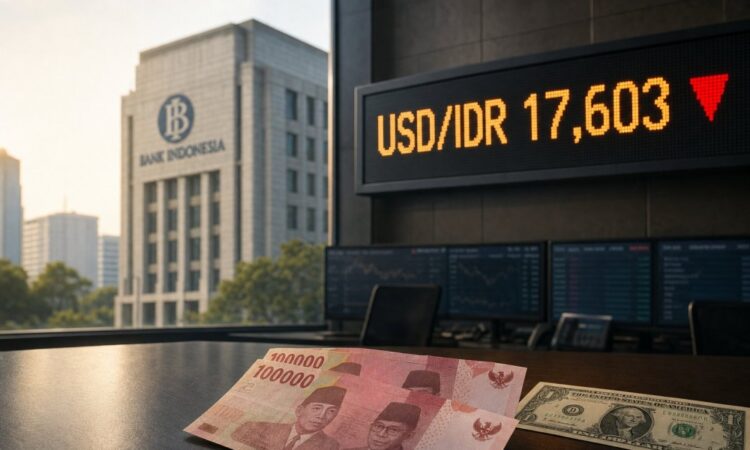
Gotrade News – The Indonesian rupiah, the country’s national currency, weakened past 17,600 per US dollar on Friday morning as a stronger greenback and rising oil prices pressured emerging Asian currencies. The rupiah traded at 17,603.20 per USD at 09:03 Jakarta time, after closing the previous session at 17,529, according to Google Finance data sourced from Morningstar.
The slide reflects a broader risk-off mood tied to Middle East tensions and renewed crude strength that has lifted the dollar index. Bloomberg data showed the currency reaching 17,606 by 09:35 local time, down 77 points or 0.44 percent on the day.
Key Takeaways
- Rupiah crossed 17,600 per USD, with intraday lows near 17,612 before settling around 17,579.
- Brent crude strength and Strait of Hormuz risk are driving dollar demand across Asia.
- Bank Indonesia is intervening in spot, DNDF, and NDF markets to stabilize the currency.
Drivers of the Rupiah Slide
According to Kompas, Josua Pardede, chief economist at Bank Permata, warned the rupiah could test 17,800 if Brent stays above USD 110 per barrel and foreign capital outflows persist. Lukman Leong of Doo Financial Futures added that regional currencies are weakening sharply against the dollar as crude prices climb again.
Investors hedging against further dollar strength have rotated into vehicles like the Invesco DB US Dollar Index Bullish Fund (UUP), which tracks the greenback against major peers. Energy exposure through the United States Oil Fund (USO) has also drawn flows as Brent rallies on supply fears.
As reported by Kumparan, Myrdal Gunarto, global markets economist at Maybank Indonesia, cited foreign equity selling ahead of an MSCI rebalancing, US-Iran tensions at the Strait of Hormuz, and long-weekend positioning as key drivers. Destry Damayanti, senior deputy governor at Bank Indonesia, the central bank, said rising Middle East conflict intensity is pushing oil prices and broader global uncertainty higher.
Bank Indonesia confirmed it is actively intervening across spot, domestic non-deliverable forward, and offshore NDF markets to limit volatility. The interventions aim to anchor expectations while the central bank navigates a Federal Reserve policy transition that continues to favor the dollar.
Risks Investors Are Watching
Per Liputan6, the rupiah touched an intraday low of 17,612 before settling near 17,579, with Sutopo Widodo of HFX International Berjangka flagging 17,550 as the next psychological level. He said the bearish bias remains intact amid external pressure and the Federal Reserve transition.
Roughly 20 percent of global oil transit moves through the Strait of Hormuz, and disruption fears continue to lift the dollar index. International investors tracking Indonesia exposure often watch the iShares MSCI Indonesia ETF (EIDO), which serves as a benchmark for the country’s equity sentiment.
For now, the combination of firm crude, geopolitical risk, and a hawkish dollar leaves the rupiah skewed weaker. Traders are watching whether central bank intervention can hold the 17,800 line if oil prices fail to retreat.