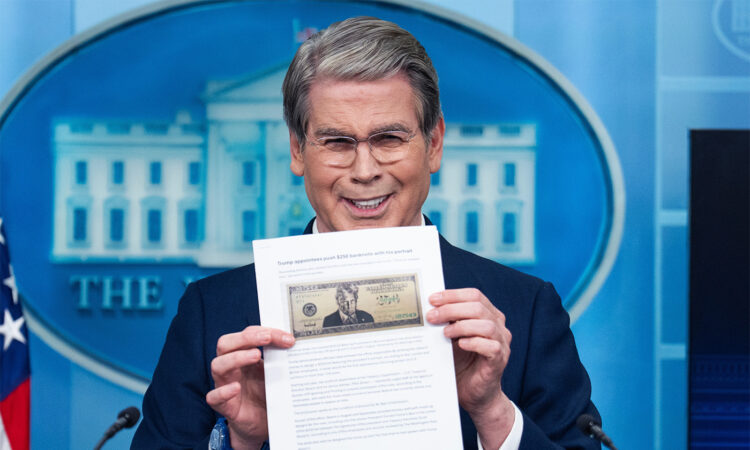
President Donald J. Trump has set a precedent of making unprecedented moves.
Aiming to become the first living person to appear on a U.S. bill after Congress banned the practice 160 years ago would make one more example.
Treasury Secretary Scott Bessent on Thursday announced a mockup of what a $250 commemorative bill featuring Trump’s face, designed for the nation’s 250th anniversary in July, could look like. When asked by a reporter during the press conference if this new currency was a “good idea” in the context of current high consumer prices, Bessent said he didn’t think there was “anything untoward” having Trump featured on the bill.
To make that mockup a reality, Congress would have to move to repeal what’s known as the Thayer Amendment, and Bessent noted that his department would not move forward without its consent.
Already, some Congress members are chiming in. Minority Leader Rep. Hakeem Jeffries said on X that he was a “hard no” on the bill. “The upcoming July 4th anniversary is not about a wannabe King. It’s about celebrating the American journey.”
Given the legal hurdles, Northeastern University experts questioned whether this was likely to happen, but they also wondered about the use for such a bill in everyday American life. The move, if approved, would also alter the significance of this commemorative tradition in the future.
It is common for a coin to feature a person posthumously, said Edward Miller, teaching professor of history at Northeastern. Those include the dime, released in 1946 with Franklin D. Roosevelt’s face after his death and the half dollar approved by Congress one month after John F. Kennedy’s death.
“It strikes you as very unusual to have a [living] president on paper money,” he said. “Any kind of aberration from that is probably going to raise some eyebrows.”
Other countries have had their living leaders printed on paper, including Syria, Thailand and Denmark, with Queen Elizabeth II featured on the currency in more than a dozen countries like England and Canada during her reign (King Charles III appears on British currency now).
The places where these living figure currencies exist “invariably are monarchies” or other places where an “undemocratic ascent to power was involved,” said Oscar Brookins, emeritus faculty in economics at Northeastern.
The U.S. tradition against including sitting lawmakers on currency dates back to 1864, when the portrait of then-Treasury Department official Spencer Clark appeared on the 5-cent banknote, causing outrage. The Bureau of Engraving and Printing said it was unclear how his portrait appeared on the note.
Two years later, Congress banned the portrait or likeness of any living person from appearing on currency notes, bonds or securities, according to the Bureau of Engraving and Printing, in what’s known as the Thayer Amendment.
After that ban, living people still appeared on U.S. money – but just on coins, not paper notes.
Three years into his presidency, Calvin Coolidge appeared alongside George Washington on the 1926 half dollar created to commemorate the 150th anniversary of the Declaration of Independence.
Other living figures have also appeared on coins, including Sen. Joseph Taylor Robinson for the 1936 Arkansas Centennial half dollar and Eunice Kennedy Shriver for the Special Olympics World Games silver dollar in 1995.
“You want a national consensus that there was a person in the past and they served their country well, and, regardless of which political side they were on, everyone recognizes they made an important contribution and want to look back with honor on what they did,” said Jeremy Paul, professor of law at Northeastern.
But when people are put on currency “in the thick of political combat,” Paul said, “you strip the meaning of what it means to honor someone in the first place.” Besides, “When polarization is very high, it’s very hard to win votes,” he said.
If the proposal does pass, Paul sees a possibility where future presidents would similarly want to make their mark, creating the potential for further division down partisan lines.
There’s also the issue of practicality, even though the $250 bill isn’t the largest that the U.S. has had in circulation.
Brookins noted that the U.S. used to have bills even larger than the $100, including $500, $1,000, even $10,000 bank notes. Those were issued until 1969. While they are still legal tender, they are circulated among collectors rather than in the economy.
But with some establishments across the country today not even taking $100 bills, “I don’t see any practical function that the $250 denomination would fulfill,” Brookins said.
“That denomination exceeds what most people would have as a typical daily transaction,” he said. “How many times do you go into the store and you spend something close to $250? Not very often.”
There’s also practicality on the part of the government. The U.S. stopped producing pennies in November citing costs: It cost 3.7 cents to create a 1 cent coin. It costs 4.1 cents to print $1 and $2 bills, up to 11.3 cents for a $100 bill, according to the Federal Reserve.
“It seems a long, costly process is usual, even when existing currency is simply tweaked, let alone an entirely new one,” he said.