
With the prolonged high exchange rate, foreign currency deposits at local deposit banks have risen t..
In the last five months, foreign currency deposits ranked 1st to 5th on average per month
Due to prolonged high exchange rates, foreign currency assets have spread
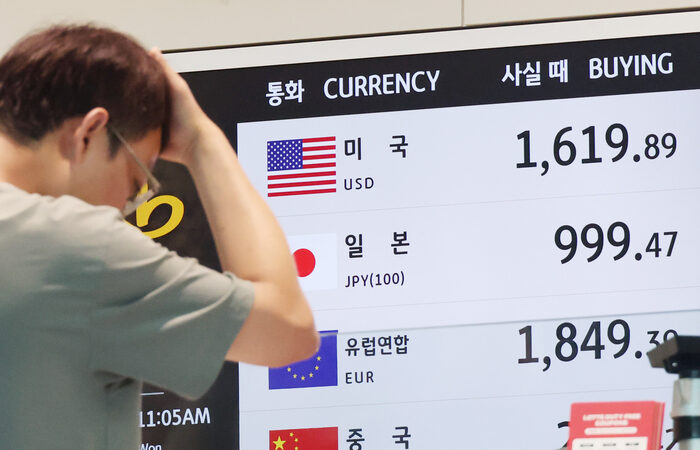
![Amid the continued high exchange rate due to the strong dollar, the won price per dollar is displayed at around 1,600 won at the bank's currency exchange counter at the departure hall of Incheon International Airport Terminal 2 on the 2nd. [Photo = Yonhap News]](https://wimg.mk.co.kr/news/cms/202607/13/news-p.v1.20260705.7e5a06ca2a9c4722a6052ed6a7b816fe_P1.jpg)
With the prolonged high exchange rate, foreign currency deposits at local deposit banks have risen to an all-time high. In particular, the top five records of the average monthly balance of foreign currency deposits have all been concentrated in the last five months, showing the first phenomenon in more than 30 years. In the market, analysts say that companies and investors are expanding their share of foreign currency assets in preparation for the “dollar new normal” era, in which the won-dollar exchange rate is structurally maintained at a high level rather than a temporary surge.
According to the Bank of Korea on the 13th, the average balance of foreign currency deposits at deposit banks from January to April this year was 174.3 trillion won. This is a 14.2% increase from last year’s annual average (152.6 trillion won), the highest level since 1992 when related statistics were compiled. The average balance of foreign currency deposits has steadily increased from 127.4 trillion won in 2022 to 135.9 trillion won in 2023, 137.8 trillion won in 2024 and 152.6 trillion won in 2025.
Records continued to break on a monthly basis. The average balance in January this year reached an all-time high of 179.5 trillion won, followed by February (177.3 trillion won), April (170.9 trillion won), March (169.4 trillion won), and December last year (165.8 trillion won). It is the first time since the statistics were compiled that the average monthly balance of foreign currency deposits was all concentrated in the last five months.
The increase in foreign currency deposits is interpreted as a result of a combination of the demand for settlement by import and export companies, the expansion of overseas investment, and the preference for dollar assets. Recently, as the won-dollar exchange rate continues to be high, companies and investors are also moving to secure foreign currency liquidity in advance.
Analysts say that this phenomenon is also coupled with structural changes in exchange rates. In a recent report, the Korea Financial Research Institute diagnosed that the won-dollar exchange rate has undergone three structural breaks since 2015, and the average level itself has risen gradually. In particular, the average exchange rate has recently moved upward to around 1,400 won, and even if there is no special external shock, the high exchange rate is likely to continue for a considerable period of time.
The institute cited the strong global dollar and the expansion of domestic investors’ investment in foreign securities as the main reasons. It is explained that the flow of funds itself has changed structurally rather than short-term exchange rate fluctuations as a long-term equilibrium relationship has been formed between the won-dollar exchange rate, the dollar index, and Koreans’ investment in overseas stocks since 2022.
In the financial sector, it is pointed out that the government should prepare for the possibility of a high exchange rate above a certain level rather than expecting the exchange rate to return to the 1,100~1,200 won range as quickly as in the past. Importers should strengthen their currency hedging strategy, and financial companies should also pay more attention to foreign currency liquidity and capital adequacy management.
The Korea Financial Research Institute said, “As the average level of the won-dollar exchange rate is higher than in the past, domestic financial companies need to closely examine the impact of the continued high exchange rate on profitability and capital adequacy.”


