
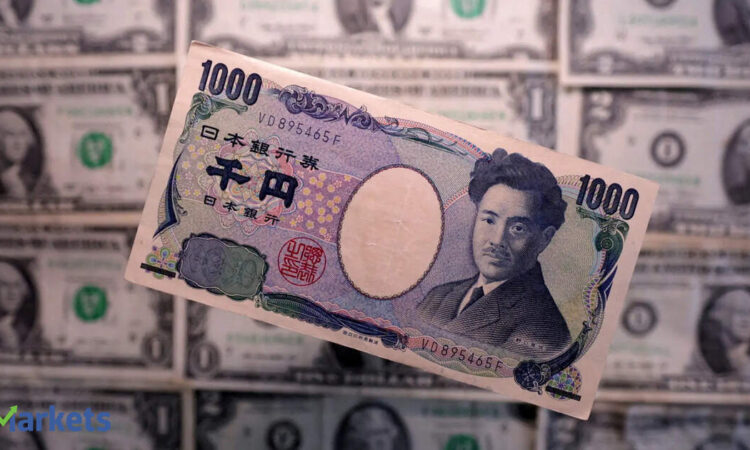
The dollar climbed as high as 161.8 yen late on Thursday, closing in on July 2024’s 161.96. Any higher would take it to its strongest against the yen since 1986.
It was last at 161.3 on Friday, steady on the day, but traders were still braced in case Japanese authorities stepped into markets directly to prop up the currency as they did in late April and early May.
The dollar has surged this week, rising 1% against a basket of other major currencies, to a 13-month top, largely thanks to Wednesday’s Federal Reserve meeting in which policymakers’ new quarterly projections showed nine of 19 of them now anticipate a rate hike by year end.
“In the near term, the dollar may enjoy post-Fed enthusiasm for a bit longer, with markets probably keen to fully price two hikes by December at the first strong data print,” said Francesco Pesole, currency strategist at ING.

He added in a note that the holiday in the U.S. meant there was “a lower-liquidity backdrop, a window during which Japanese authorities have previously shown a preference to intervene”.
“(Dollar/yen) is already deep into intervention territory … A lack of intervention today would leave scope for speculators to push towards 162-163 given the supportive (dollar) environment.”Weighing on the yen are Japanese interest rates, which are much lower than those elsewhere, even after the Bank of Japan hiked interest rates to a 31-year high this week.
Concerns around the spending plans of Japanese Prime Minister Sanae Takaichi have also undermined investor confidence and prompted speculation that more intervention could follow.
The safe-haven U.S. currency was also supported on Friday by jitters about the U.S.-Iran deal to end their war. Switzerland said U.S. talks with Iranian negotiators would not take place on Friday.
The dollar also gained on European peers earlier in the day, but that began to fade by mid-morning in Europe.
The euro hit a three-month low of $1.1418 before rebounding to trade flat at $1.1464.
The pound hit an over two-month low of $1.3164 but was last at $1.323, 0.2% higher on the day.
Sterling traders had much to digest with Friday data showing stronger than expected retail sales for May, separate figures showing a larger than expected budget deficit, and Labour mayor Andy Burnham decisively winning a parliamentary seat in northern England which could clear a path to ousting British Prime Minister Keir Starmer.
Elsewhere, the Swiss franc was softer, with the euro up 0.2% to 0.9238 francs, a day after the Swiss National Bank left its benchmark interest rate unchanged and repeated its increased readiness to step into markets to stop the currency appreciating.
The dollar climbed to 0.8091 francs, its highest since November 2025, and was last up 0.15%.


