
A Hedge Between Keeps Friendship Green: Could Global Fragmentation Change the Way Australian Investors Think About Currency Risk? | Speeches

Introduction
It is a privilege to be invited to address the Board of CLS – or Continuous Linked
Settlement in longhand – on what I believe is your first meeting in Australia since 2017.
CLS is hardly a household name. But what it lacks in rizz, it more than makes up in the
critical role it plays in the international financial architecture: massively reducing the risk of
settlement failure in the global foreign exchange (FX) market.
As you all know, but is worth repeating for a wider audience, settlement risk is a particularly important
issue in FX markets because of the time differences between the major currency blocs. It would be all too
easy to pay away one leg of FX transactions during the business hours of that currency, in anticipation
of the return leg being paid when the other country wakes up – only to find that second leg
interrupted, leaving large, unsettled liabilities. Exactly that happened when the Cologne-based Bankhaus
Herstatt was liquidated in 1974 at the end of German banking hours – after Deutsche Mark payments
had been made, but before the return US dollar legs had settled. Chaos ensued.
The sums involved in FX markets are truly massive – over US$7.5 trillion a day in 2022, and set
to have grown substantially since then. So getting this right matters critically for financial
stability. The CLS solution seems obvious today: ensure that payments on both legs are made
simultaneously, in central bank money, in each national real time gross settlement system. But it was
22 years after Herstatt before the international community settled on this plan, and
another six before CLS opened for business in 2002.
From the start, Australia has been a close partner in CLSs development. The Australian dollar was
one of the seven founding CLS currencies – so weve had an operational relationship with you,
every day, since the very beginning. On the regulatory side, too, CLS is categorised as a systemically
important international payment system in Australia; and we sit on the regulatory college for CLS,
chaired by the Federal Reserve Bank of New York.
The Australian dollar itself has long punched above its weight in global markets. It had the
sixth highest daily turnover of any currency in the 2022 BIS Triennial survey, despite Australia ranking
only 11th by nominal GDP at the time (Table 1). None of the other top 10 currencies in
Table 1 has that level of outperformance while operating a completely free float.
| Currency | FX turnover share(a) | Nominal GDP share(b) (rank in parenthesis) |
CLS eligible(c) ? |
|---|---|---|---|
| US dollar | 89.5 | 27.5 (1) | Yes |
| Euro | 30.9 | 15.3 (3) | Yes |
| Japanese yen | 16.9 | 4.5 (4) | Yes |
| British pound | 13 | 3.3 (6) | Yes |
| Chinese renminbi | 7.1 | 19.4 (2) | No |
| Australian dollar | 6.5 | 1.8 (11) | Yes |
| Canadian dollar | 6.3 | 2.3 (8) | Yes |
| Swiss franc | 5.3 | 0.9 (16) | Yes |
| Hong Kong dollar | 2.6 | 0.4 (30) | Yes |
| Singapore dollar | 2.5 | 0.5 (23) | Yes |
| Swedish krona | 2.3 | 0.6 (21) | Yes |
| Korean won | 1.9 | 1.9 (10) | Yes |
| Norwegian krone | 1.7 | 0.6 (20) | Yes |
| New Zealand dollar | 1.7 | 0.3 (35) | Yes |
| Indian rupee | 1.6 | 3.5 (5) | No |
| Mexican peso | 1.5 | 1.6 (12) | Yes |
| New Taiwan dollar | 1.1 | 0.8 (17) | No |
| South African rand | 1 | 0.4 (27) | Yes |
| Brazilian real | 0.9 | 2.1 (9) | No |
| Danish krone | 0.7 | 0.4 (29) | Yes |
| Polish zloty | 0.7 | 0.7 (18) | No |
| Thai baht | 0.4 | 0.5 (25) | No |
| Israeli new shekel | 0.4 | 0.6 (22) | Yes |
|
(a) Share of global average daily turnover, measured on a net-net basis against all
|
|||
That special status reflects three main things:
- As a major commodity exporter, Australias economic conditions are sensitive to the outlook for
global growth; Australian dollar assets have therefore been seen as a good way for investors to
manage their risk, gaining risk on exposure by going long, or hedging risk by going
short. - Australias geographical position, its openness to capital and its developed FX hedging markets,
mean it was historically used to gain proxy-exposure to Asian economies whose currencies are harder
to invest in, or where it is harder to issue debt. - Australias superannuation (or pension) funds are investing an ever-increasing amount overseas.
Even today, the sums are huge: Australian retirement savings are the fourth largest in the world,
with assets equivalent to around 150 per cent of Australian GDP, half of which are
offshore. And that is set to grow further: within a decade the sector will be the second largest
globally, with assets rising to around 180 per cent of GDP, and an overseas portfolio share
approaching three-quarters.
All of this may be great news for Australian dollar volumes! But it also puts us bang at the heart of a
quite exceptional period of uncertainty about the future direction of the global economic and financial
system. Some argue we are on the verge of a fundamental shift, with the world breaking into rival,
fragmented trading blocks, and a collapse in US dollar hegemony. Others wonder if this may all be a
bit overblown, with the global trading system proving more robust, and the US dollars role too
embedded, to see a serious challenge – for now, at least.
I cannot hope to resolve these profound questions today, but I do want to look at what this uncertainty
may mean for Australian investors, and particularly the super funds, as they look out into a turbulent
world – and how it could affect the ways they think about managing currency risk in their global
portfolios, both now and in the years ahead.
Through a hedge backwards: Australias natural advantage?
Australians have always been big overseas investors, both for standard diversification reasons, and
because the onshore asset base is relatively small. But they have typically taken only modest levels of
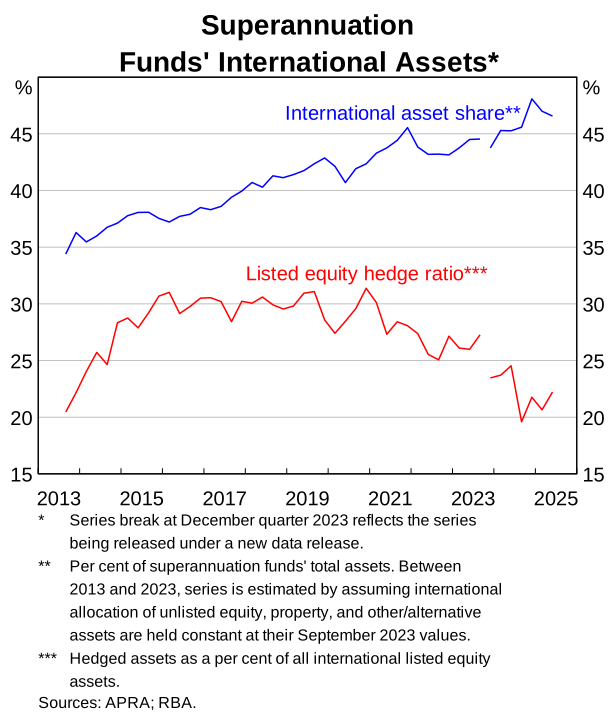
protection against FX movements on their riskier overseas asset holdings. The superannuation sector as a
whole is estimated to hedge only around one-fifth of the value of its overseas listed equity positions,
for example (Graph 1).
Graph 1
To see why that might be, lets start by reminding ourselves that, other things equal, Australian
investors holding US dollar denominated equities are worse off when the Australian dollar
appreciates (or equivalently the US dollar depreciates). They can insure
against this risk by using FX swaps or forwards to take short positions in the US dollar (against
long positions in their own currency). But buying derivatives is often costly – so the benefit from
doing so has to justify the cost.
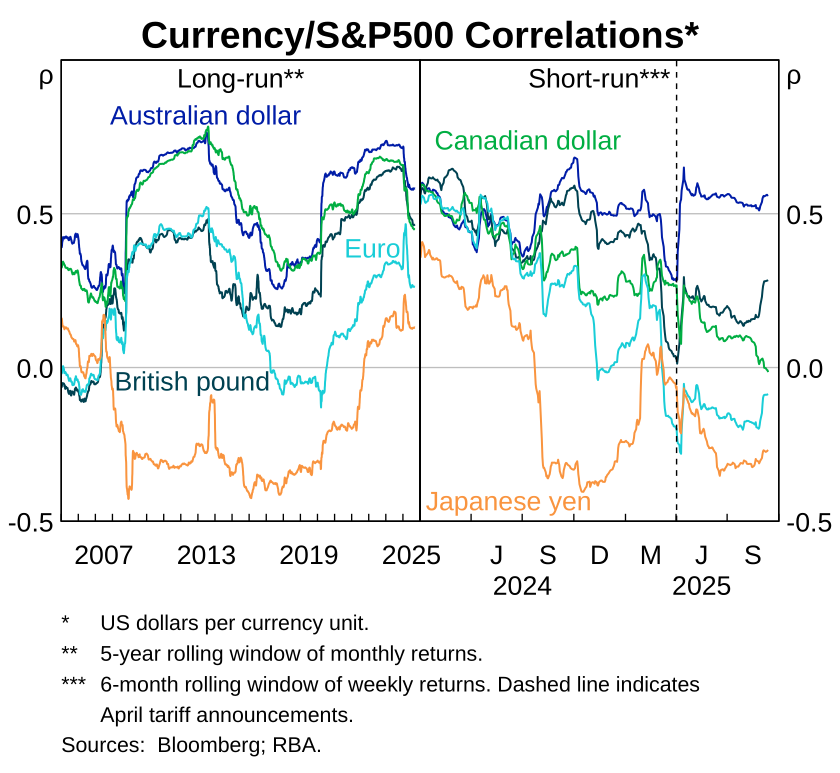
One factor reducing that benefit is the extent to which FX movements can be expected to provide a kind of
natural hedge against the equity holdings. That would happen in our example if the Australian
dollar tended to depreciate against the US dollar when US equity prices fall, offsetting some of the
offshore capital losses when converted back to domestic currency. But historically that is exactly what
has happened: first, because the US dollar has typically been viewed as a safe haven or risk
off currency that rises when global conditions are bad; and second, for the reasons I mentioned
earlier, the Australian dollar has been seen as one of the standout risk on currencies that
tend to depreciate when global economic prospects weaken and/or risk-sentiment deteriorates. On that
score, the Australian dollar has historically provided a pretty decent natural hedge
(Graph 2, left hand panel).
Graph 2
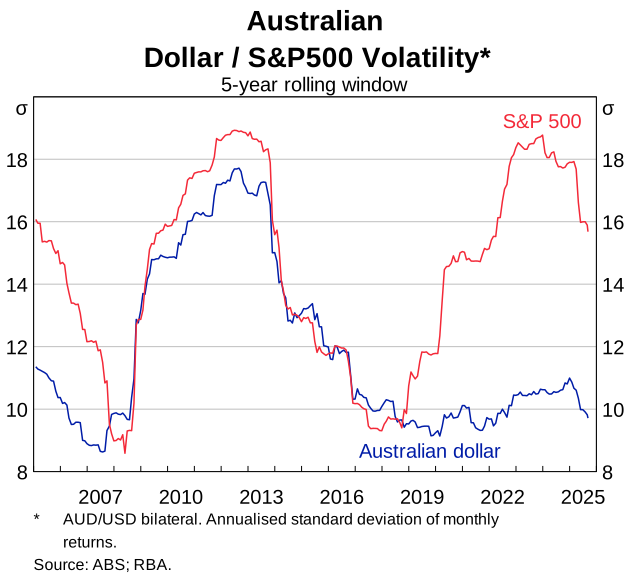
If the volatility in the Australian dollar is lower than that in overseas equity returns – as it has
been in recent years (Graph 3) – that also reduces the need to take out an explicit hedge,
because it just doesnt form a large part of overall portfolio volatility.
Graph 3
There are several different ways to factor these considerations into a specific quantified hedge ratio.
One approach is to calculate the hedge needed to minimise the variance of portfolio returns. I wont
plough through the formalities of how to do that here – and the calculations can be sensitive to
assumptions. But the punchline is that – historically speaking – the Australian dollars
strong correlation with US equities, and its low relative volatility, mean the minimum variance equity
hedge ratio has been pretty low. Indeed on some measures it comes quite close to the average levels
actually chosen by Australian industry super funds.
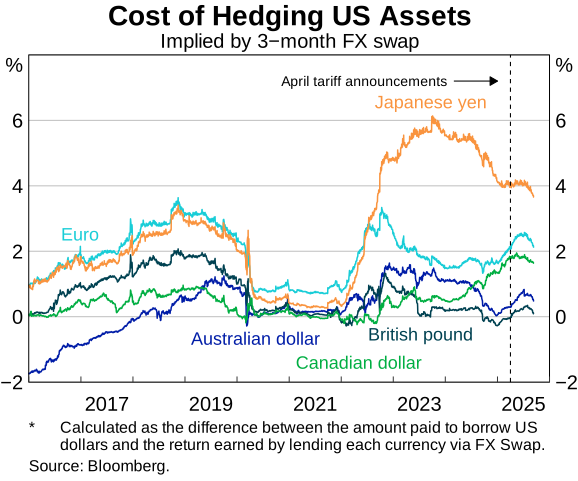
For some currencies, such as the Japanese yen, low hedge ratios for US assets have also been driven by
high hedging costs, reflecting material differentials in short-term interest rates
. But this has not been a dominant factor in Australia
(Graph 4).
Graph 4
The times, are they a-changin?
The debate on everyones mind is whether the paradigm underpinning those correlations Ive just
been through is now shifting.
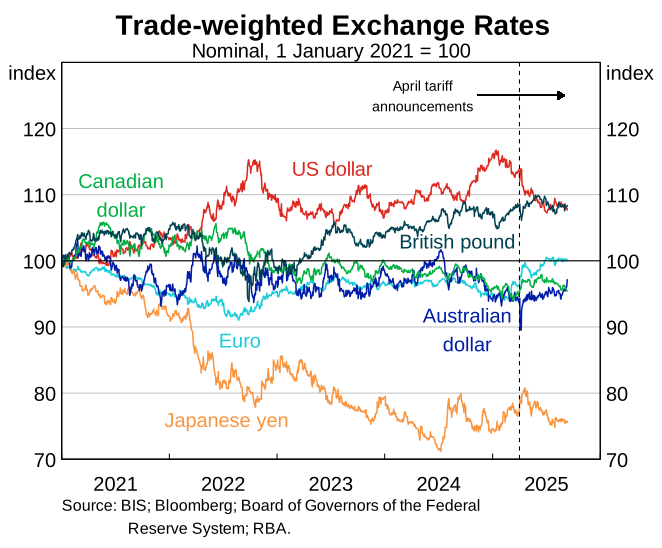
The oft-cited case for the prosecution is that, amidst the huge increase in market uncertainty earlier in
2025 – a situation in which the US dollar would normally be expected to act as a safe haven
– the dollar in fact depreciated: falling by around 8 per cent on a trade weighted basis
relative to its January peak, with a little under half of this coming in the weeks following the
announcement of the Liberation Day tariffs (Graph 5). Dire predictions abounded, including a
rumoured mass exodus from US assets, and fears of the end of dollar hegemony in international capital
markets.
Graph 5
Uncertainty obviously remains high, and there is still a great deal of water to flow under the bridge.
But, to paraphrase Mark Twain, predictions of the death of the US dollar and the Australian hedging
model appear somewhat premature, for four main reasons:
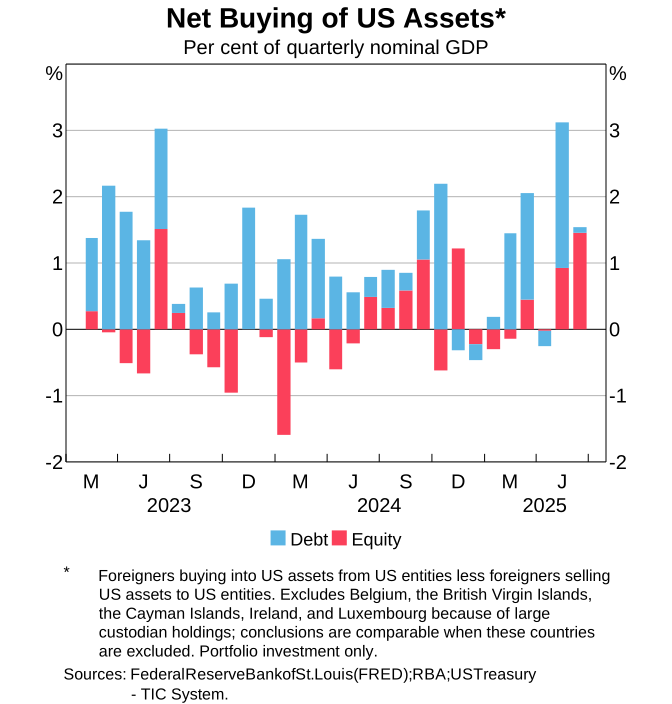
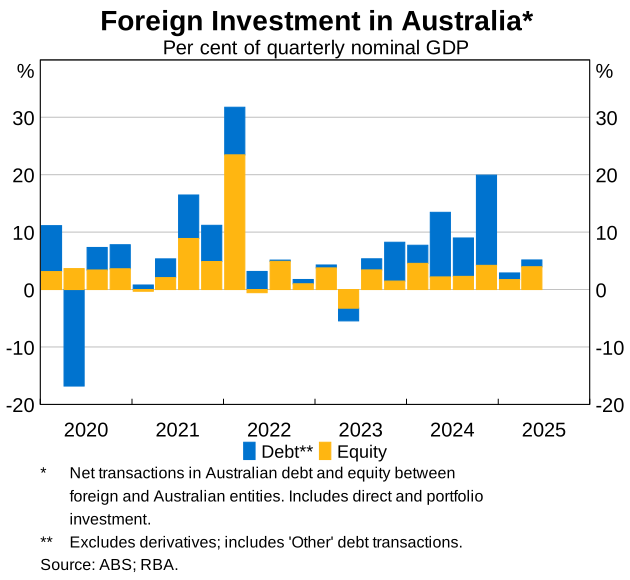
- There is little evidence yet that international investors have substantially reduced their holdings
of US assets: indeed the latest data suggest that foreign capital continues to flow into
the US (in net terms), particularly on the equity side (Graph 6). Capital inflows into Australia
did pick up a little in the June quarter – but the numbers so far do not look materially out of
line with historical averages (Graph 7).
Graph 6
Graph 7
- The correlation between movements in US equity prices and the Australian dollar remained close to its
historical average through the recent market turmoil, with the Australian dollar initially
depreciating sharply alongside falling equity prices. That is quite different to correlations with
some of the other major currencies (Graph 2, right panel). - Implied volatility in the exchange rate between the Australian dollar and the US dollar has
remained lower than that in US equities. - The cost of hedging against FX risk for Australian investors has been little changed (Graph 4).
Investors in some other countries do appear to have increased their hedging ratios in response to
Liberation Day, with market attention focused on institutional investors in Europe and parts of Asia.
Those additional hedging flows may have played some role in amplifying the US dollars decline
for a period earlier in the year. In Australia, the super fund sector also increased its
equity hedges in the June quarter (Graph 2) – but the pick-up was only small, and market
participants report little current expectation of a more material increase in the near term.
Some more structural challenges for super funds FX hedging
But none of this means we should be complacent about the scope for a more material regime shift over time.
Uncertainty remains elevated, and we are yet to see the full economic implications of the changes to US
tariffs play out. It is encouraging therefore that many super funds are strengthening their capacity to
think through and manage FX and other liquidity risks.
That also matters because, even if super funds average hedge ratios change little in the near term,
the size of the market-wide FX hedge book is set to grow significantly over longer horizons, for three
reasons:
- As I noted at the start, total super fund assets are projected to grow from around
150 per cent to 180 per cent of GDP over the next decade. - The share of this larger pie devoted to overseas assets is set to rise, given the size of the super
fund pool relative to the stock of domestic financial assets. - As super funds members age over time, they are likely to demand greater certainty of returns,
driving super fund portfolios away from equity and towards fixed income. But FX hedge ratios for
foreign currency fixed income assets are typically much higher than those for equities, reflecting
the very different shape of asset returns and correlations.
The first of these factors alone could see the superannuation sectors total FX hedge book, currently
estimated to be of the order of AUD½ trillion, to double over the next decade. The other two factors
will increase this number by some further multiple over the coming years.
Such changes would of course reflect prudent risk management on the part of individual firms. And they
would barely touch the sides of a global FX swaps market that exceeds US$100 trillion in stock
terms.
But they are large relative to the current size of the Australian dollar FX swaps market. And
the terms on which FX hedges are typically offered to super funds today are relatively capital-intensive
for the swap providers. So it is likely that super funds will have to extend and diversify their pool of
hedge providers over time to avoid hitting concentration limits. They may also be asked to meet increased
margining and collateral requirements on their hedging positions.
Many super funds are already thinking hard about what these changes could mean for their future liquidity
management. One aspect is ensuring they have sufficient resources
to meet potential short-run liquidity needs – for example, to cover increased replacement costs for
maturing FX hedges if the Australian dollar depreciates. Those potential liquidity needs appear
manageable today under most scenarios. But they will grow over time as the hedge book increases in size.
And the practice of using relatively short-term derivatives to hedge much longer term investment –
though common amongst many institutional investment communities – means super funds are reliant on
continuous access to functioning FX derivatives markets. If these markets were to become impaired such
that rolling these hedges became difficult or prohibitively expensive, as occurred during episodes of
US dollar funding stresses in both 2008 and 2020, super funds would either need to sell foreign
assets or face unhedged foreign currency exposures for a period, both of which could be undesirable in a
period of market volatility.
Australian banks also rely on the smooth functioning of such markets – in particular, to hedge their
foreign-currency denominated funding back to Australian dollars to fund their (mostly) Australian dollar
assets. However, their exposure is somewhat mitigated by the fact that their hedges are typically
duration-matched to their funding.
System-wide liquidity risks are being explored in APRAs inaugural system stress test, and we look
forward to seeing the results of this work.
Staying on top of FX settlement risk in the region
All of this increased FX activity may seem like good news for FX markets and hence for CLS – and
well it may be. But against the backdrop of such a big increase in scale and a huge range of uncertain
and unpredictable macro risks, the need to ensure we retain a laser focus on mitigating settlement risk
has never been greater.
The first priority, clearly, is to ensure that as many eligible transactions as possible go through CLS. I
look forward to seeing the results of the new global survey on FX settlement data, designed by my old
colleague Philippe Lintern and team at the Bank of England, and carried out as part of the BIS 2025
Triennial exercise. And I would be interested to hear your estimates of
how widely Australian firms active in FX use your service. Five years ago, CLS estimated that around
75 per cent of Australias 20 largest super funds used CLS to settle their FX trades
– which sounded good but left me wondering what the remaining 25 per cent did, and how
this number has evolved since then. Perhaps you can enlighten me today! Given the growth
expected in that sector it is important to pursue this issue with gusto.
Just as global fragmentation poses risks to the macro outlook, so it also poses risks to the ongoing goal
of eliminating FX settlement risk. As Table 1 shows, a number of key currencies in the Asia Pacific
region remain outside CLS – specifically the Chinese Renminbi, the India Rupee, the New Taiwan
Dollar and the Thai Baht. I do not underestimate the challenges involved, but we should do all we can,
where we can. Extended cutoff times for CLS settlement could help with greater global reach too.
Fragmentation, and the geopolitical risks that come with it, poses heightened cyber and operational risks
– issues that I know have preoccupied you as a Board for some time.
And of course there is always the possibility that rival payment systems, built on less sound principles
could cannibalise transactions that currently go through CLS. I sympathise with you that it can be hard
to keep up with the hype cycle on this front – from Distributed Ledgers to Central Bank Digital
Currencies to todays topic du jour, stablecoins. But it is important that you do,
because we must ensure that whatever emerges from this process is as robust as what preceded it. That is
why, here in Australia, we are experimenting with new ways of enabling central bank money to circulate on
innovative payments platforms through Project Acacia. I look forward to hearing an update of
CLS own work in this area.
Conclusions
Let me conclude.
Your visit comes at a critical moment in the history of the global economic and financial system.
Uncertainty is at an all-time high – and many of the principles on which we have long relied are in
flux.
Against that backdrop, I have devoted much of my remarks today to reviewing how fragmentation could change
the way Australian investors approach currency risk management. So far, little fundamental seems to have
changed – the Australian dollar has remained a well-functioning natural hedge for
global risky assets, and hedging costs are relatively low. But that could all change rapidly – and
the structural trends towards growing super fund balances, much of which will have to be invested
overseas, makes it ever more important that super funds in particular scale up their risk management and
scenario planning capacity. Done successfully that should further add to other resilient features of the
system – including the fact that super funds are mostly defined contribution (not defined benefit)
schemes, are not levered, and have access to those deep and liquid FX markets that I described earlier.
As a founder currency of CLS, a co-regulator and a leading global currency, we care deeply about
furthering the mission of eliminating FX settlement risk. In that context, it is wonderful to see the
progress CLS has made, and we look forward to continuing to do all we can to help in that endeavour.


