
Concerns mount over won’s rapid weakening amid Koreans’ offshore investment surge
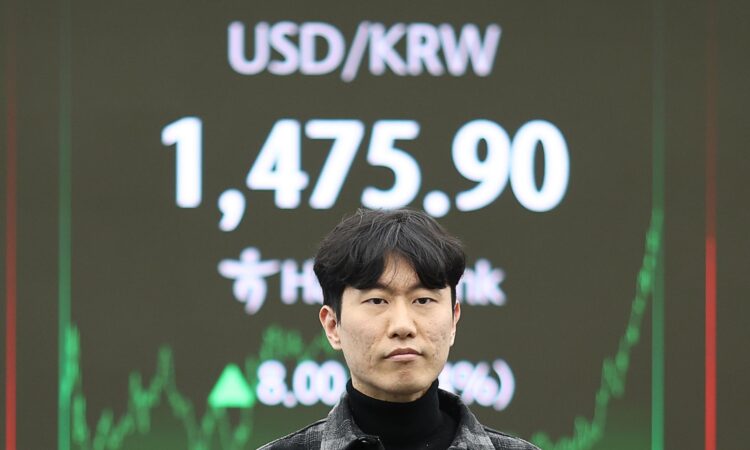

An electronic board shows the Korean currency trading at 1,475.9 won per dollar in the dealing room of Hana Bank in Seoul, Friday. Yonhap
Korea faces rising concern over the won’s rapid decline against the U.S. dollar, amplified by record overseas investments by Korean investors while the currency’s real value hits levels unseen since the global financial crisis of the late 2000s, analysts said Sunday.
A currency’s real value is measured by the real effective exchange rate, which compares it against a basket of trading partners’ currencies and adjusts for differences in prices or inflation. This shows the currency’s purchasing power and competitiveness in global trade.
Multiple analysts say the combination of sustained capital outflows, U.S. dollar strength and exporters’ delay in converting foreign earnings into won is creating a foreign exchange (FX) environment whereby government intervention may be insufficient to limit won depreciation.
Some say the won could weaken further to 1,500 won against the dollar, pressured further by Korea’s growing U.S. equity holdings, a more hawkish-than-expected stance of the U.S. Federal Reserve and Japan’s new administration’s stimulus pushing down the value of the yen, a proxy currency for the won.
“The Korean won could slide to as low as 1,540 won against the dollar next year,” an NH Investment & Securities report said.
The grim view is explained by a growing number of retail and institutional investors increasing their overseas equity holdings, as well as exporters dragging their feet in having their U.S. income converted into the falling Korean currency, according to Wi Jae-hyun, the report’s author.
“Overall, the Korean currency is expected to face downward pressure, amid growing structural exposure to U.S. capital markets and retreating domestic demands,” the report said.
The won has already fallen more than 2.6 percent against the dollar this month, far faster than the yen, euro, pound and other major currencies. The currency slid to a midday low of 1,476 won Friday, the weakest since April 9 when it hit 1,487.6 won.
The won’s trajectory is concerning, as measured by the currency’s real effective exchange rate.
According to the Bank for International Settlements (BIS), the rate dropped to 89.09 in October, the lowest level in 16 years and weaker than during the political turmoil following then President Yoon Suk Yeol’s short-lived martial law imposition last December.
The figure is the lowest since August 2009 when it hit 88.88 amid the global financial crisis.
A reading above 100 means the currency is stronger than in the base year, while a reading below 100 means it is weaker.
Korea’s figure hovered above 100 through 2021, but has since slipped into the 90s range as investors poured money into overseas markets and the country’s inflation stayed relatively stable.
Among 64 economies tracked by the BIS, Korea posted the third-lowest rate level in October, behind only Japan and China.
The monthly decline in Korea’s rate was the second-sharpest globally, trailing only New Zealand.
“The won weakening was more pronounced than other currencies, influenced by risk-off investor sentiment leading to the strengthening of the U.S. dollar, as well as Korean investors’ consistently heavy demand for the U.S. currency to invest in American stocks,” Wi said.
The assessment is backed by Korea’s offshore investment having jumped about 10-fold in just five years.
Data from the Korea Securities Depository showed that Koreans’ overseas stock trading volume stood at $530.84 billion last year, up from $40.99 billion in 2019.
As of September, the figure came to $466.19 billion.
Also rising are foreign currency deposits held at brokerages, a gauge of retail investors’ overseas stock purchase funding. It stood at 11.4 trillion as of June, double from 2021’s 5.7 trillion won.
Korean investors’ U.S. equity holdings accounted for 93.7 percent of all Korean overseas stock holdings as of September, up from 43.8 percent in 2017.


