
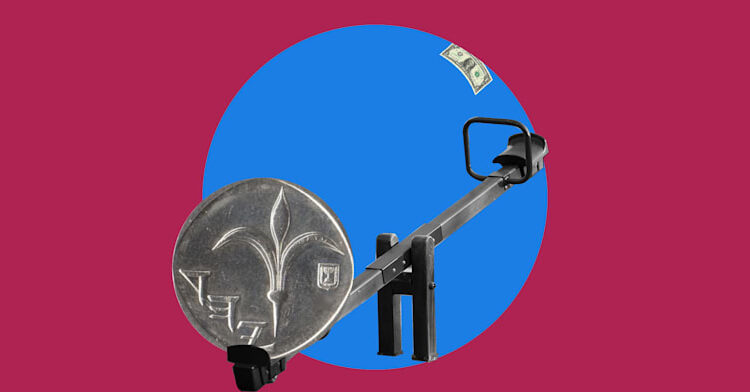
The shekel is consolidating beneath the NIS 3/$ threshold, which it breached yesterday for the first time since 1995. In morning inter-bank trading the shekel is 0.54% lower against the US dollar at NIS 2.984/$.
For Israeli savers, the sharp appreciation of the shekel over the past 18 months (more than 20%) has become a major economic trend that offsets a significant portion of the gains on Wall Street and turns investing in the S&P 500 dollar tracks into a yield trap.
The strength of the Israeli currency is not limited to the index against the dollar. The shekel is demonstrating extraordinary strength against the entire basket of currencies, including currencies such as the euro and UK sterling, supported by consistent capital flows from exports, the positive trend in world markets, and market expectations for a more optimistic geopolitical future. In fact, the shekel in real terms is at record levels against the basket of currencies as well, and not just against the dollar, which has also weakened globally. The experts tell “Globes” whether the shekel has reached its strongest point and what are the chances that the Bank of Israel will intervene.
Looking at the table of returns of investment funds for the 12 months ending in February (the latest data from the institutions), there are huge gaps between the returns of those who invested in the S&P 500 tracks that are 100% exposed to the dollar, and those who invested in the (managed) stock tracks – 3.4% compared to 29.4%. Even in the general tracks, which are considered less risky, the return is much higher than the US index and stands at 17%. The main reason is the strengthening of the shekel, which wipes out most of the returns, since the S&P 500 rose by almost 30% in the past year.
Ayalon Insurance and Finance SVP and investment division director Tamir Hershkovitz explains that the strength of the shekel is the result of deep economic currents and geopolitical changes. The strengthening of the shekel against the dollar leads Hershkowitz to issue a sharp warning against one of the most popular investment paths in recent years – the path that tracks the S&P 500 index with dollar exposure.
He says, “For many years, I have been claiming that this is a terrible path for the Israeli saver. It is important to make clear that I believe that investing in the S&P 500 index is excellent, only its linkage to the dollar is a disaster.” The reason for this, he says, lies in the mismatch between the saver’s assets and liabilities. “An Israeli saver lives in shekels, spends in shekels, and all their savings are denominated in shekels. “So, why are they allocating significant portions to dollar-linked channels?” Hershkovitz calls on investors to reexamine their mix of exposure to foreign exchange, to avoid erosion of returns due to the weakening dollar. “I recommend that these savers move to diversified and balanced stock tracks, with foreign exchange exposure of up to 15%,” he concludes.
RELATED ARTICLES
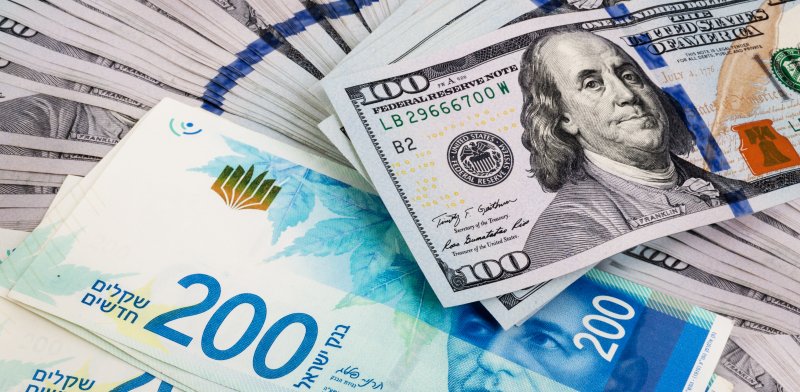
The forces that will decide the direction
First International Bank trading room manager Idit Moskovich also points to the sharp damage to investors who are 100% exposed to foreign exchange, such as in S&P 500 dollar tracks. She says, “The significant appreciation must be taken into account. In the last 12 months, the index rose by 30%, but the dollar’s 20% decline cut Israelis’ profits to 10% or less.” In her assessment, in the absence of a geopolitical escalation, the US dollar will remain around the NIS 3/$ level, and a political breakthrough will strengthen the shekel even further. “Savers in overseas channels must consider currency hedging,” she concludes, “as a sharp appreciation could significantly erode returns.”
The foreign exchange market is considered particularly complex, and is influenced by a long list of factors: from macroeconomic matters, through market sentiment to changes in the geopolitical arena.
“Defense exports and gas agreements will continue to inject huge amounts of foreign exchange into Israel, which will be converted into shekels, and will continue to support the strengthening of the shekel,” explains Hershkovitz. However, he stresses it is not just an internal Israeli story, “It is important to understand that the shekel is strengthening due to the strength of the Israeli economy, but also as a result of the weakness of the dollar in the world.” In the global context, Hershkovitz thinks that US policies will continue to weigh on the dollar. “I believe that as long as Trump is in office, there will be forces that will weaken the dollar.”
He adds, “Even when guns are roaring, financial and real investors continue to pour money into the Israeli capital markets. I believe that Israel’s risk profile has decreased and will continue to decrease in the coming years due to the events of the past year.”
Harel Insurance and Finance chief economist Ofer Klein analyzes the movement in foreign exchange rates in two time ranges. “We need to divide the forces at work into two types: long-term forces – import and export flows, productivity issues and inflation gaps. In the short term – geopolitics and a sense of the end of the war, and the US stock market rising and causing institutional investors to sell dollars.” According to him, a “perfect storm” of factors has been created: “Recently, all of these factors have been acting in the same direction and supporting the strengthening of the shekel.”
Is the trend likely to reverse?
Despite the appreciation trend, Klein warns against complacency and emphasizes the high volatility. “Short-term trends can change very quickly. If, for example, the US stock market drops significantly, the shekel will weaken. There is no question about it. The same goes for if the geopolitical situation deteriorates. Therefore, there is no point in getting excited about one number or another. NIS 3.01/$ or NIS 2.99/$ is the same thing and is mainly a psychological matter,” he says.
The real damage, according to Klein, lies in the speed of the appreciation. “There is a cumulative effect – a strong shekel hurts our exporters. In the past year, the shekel has strengthened by more than 20% against the dollar. Think of a factory with a profit margin of 15% – this is the point that turns that margin into a loss. Such a rapid and significant appreciation has implications for the economy in the end.”
He believes that the market’s self-correcting mechanism is already on the horizon: “These are the same factors that will change the direction in the end. It will be more difficult for exporters to export, it will be easier for importers to import, and we will see a new equilibrium. I think we are not far from there.” Bottom line, Klein concludes that the current situation is not an “insurance policy” for the future. “We have to remember that it is very fragile and can change sharply in both directions,” he says.
“The Bank of Israel has a tool that has not yet been realized”
One of the questions that arises every time a strong appreciation trend is recorded is whether the Bank of Israel will take action and intervene to make things easier for exporters. The consensus among economists is that, unlike previous years, this time the answer is negative, at least in terms of direct intervention. Simply put, the Bank of Israel holds huge foreign exchange reserves of over $230 billion, but it is not expected to realize some of them to change the trend (as it did, for example, until 2022).
Klein says, “The Bank of Israel has a significant tool – lowering interest rates – that has not yet been realized. If it wants to intervene, it will do so through the interest rate tool and not through foreign exchange sales.” He mentions that in the past the policy was different due to other circumstances: “Buying and selling foreign exchange is used in exceptional cases, such as a speculative attack. In the Covid pandemic, for example, the intervention was when the interest rate was zero.”
Published by Globes, Israel business news – en.globes.co.il – on April 16, 2026.
© Copyright of Globes Publisher Itonut (1983) Ltd., 2026.


