
Thailand’s digital gold mega investors hit by central bank’s rush to control the baht
Investors described as too old for crypto and too young for shopfront dealing are being swept up in the crackdown
[BANGKOK] A crackdown on online gold trading in Thailand risks dimming a rare bright spot for investors, platforms have warned, with the central bank floating further curbs.
As gold rallied globally in 2025, the Thai currency climbed alongside it, hitting a five-year high and causing a headache for the export-driven, tourism-dependant economy. The central bank blamed online gold speculators whose rapid-fire transactions worth millions of US dollars at a time amplified swings in the baht – some days by as much as 30 per cent.
To rein in the runaway currency, the bank imposed a daily online limit of 50 million baht (S$2 million) per person from the start of March, in a bid to force top-end investors to trade in US dollars. It has left open the possibility of further slashing the daily cap by 40 per cent to 30 million baht.
“We’ve built an ecosystem that makes gold accessible to everyday investors – one that’s the envy of the world,” said Pawan Nawawattanasub, chief executive officer of YLG Bullion International, one of Thailand’s largest gold traders. “Instead of nurturing it, they’re trying to dismantle it.”
Pawan maintains that to see a significant impact, the entire digital gold trading system would need to move to US dollar-based platforms, shifting the burden of currency exchange onto investors.
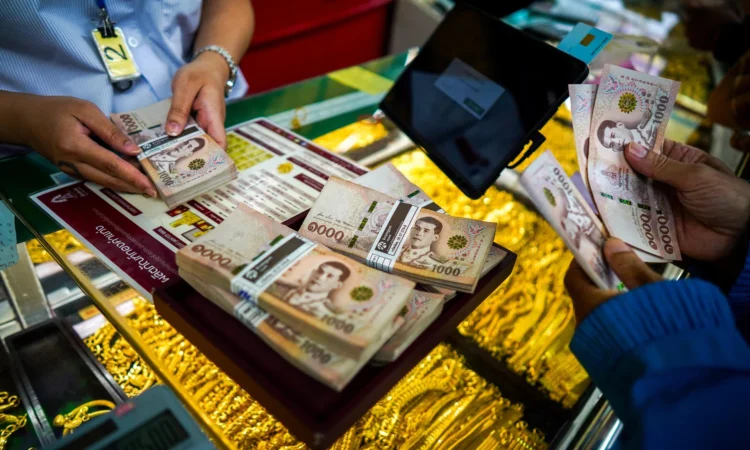
In Thailand, gold is embedded in daily life: it gilds Buddhist temples and glints from shopfronts in the narrow alleys of Bangkok’s Chinatown, farmers store it in countertop safes and families present it to newborns and brides. Thais buy more gold per capita than even China or India – the world’s two most populous countries.
Navigate Asia in
a new global order
Get the insights delivered to your inbox.
Such affinity for the safe-haven investment seamlessly migrated online, with all 14 major gold trading companies offering at least one app. The digital market offers unusual direct access to a global asset with no trading hours. Thais can buy and sell in their own currency and in any fraction, without the frictions of foreign markets.
The link between gold trading and the baht is, in part, mechanical. Gold is priced in US dollars and tends to rise when the US currency weakens. When Thai traders sell, US dollar proceeds are converted back into baht, boosting demand for the local currency. Large investors can unwind positions in bursts, converting US dollars into baht and amplifying gains – especially in thin overnight markets.
Last year the baht surged by almost 8 per cent, which the government said was out of line with sluggish economic fundamentals, including modest GDP growth, weakening consumption and an underperforming stock market.
SEE ALSO


Bank of Thailand Deputy governor Piti Disyatat, in an interview in March, said the bank had been discussing a shift to US dollar-based platforms with gold shops for years. “The aim is to nudge, to create incentives for trading to become denominated in US dollars,” he said. “We couldn’t wait much longer.”
India’s government has also stepped in to shield the rupee from surging gold prices. Reliance on imports of the precious metal has pushed the currency in the opposite direction to Thailand, contributing to a swelling import bill that has weakened the rupee. This week, authorities more than doubled gold and silver import taxes to about 15 per cent from 6 per cent to preserve foreign exchange reserves for oil.
Policymakers in Bangkok, under pressure from business groups, have few options to rein in the baht. Aggressive currency interventions would earn the ire of the US, Thailand’s largest trading partner, and rate cuts carry significant risks.
Targeting large gold traders is a pragmatic move for the Bank of Thailand, given their outsized role in driving currency swings, according to Kausani Basak, an economist at Australia & New Zealand Banking Group. She said by focusing on a small group, policymakers can curb volatile, high-value flows without disrupting the broader market.
Platform managers Bloomberg News spoke with wouldn’t reveal the investors behind the large-scale transactions, but said they numbered in the hundreds, often too old for crypto and too young for shopfront dealing. They described them as business owners with substantial cash flows, such as rubber plantation operators earning about 200 million baht a year or apartment owners managing tens of thousands of units with a monthly income exceeding 100 million baht.
Kritcharat Hiranyasiri, president of MTS Gold Mae Thongsuk Group, said the central bank is trying to curb currency moves largely beyond its control, such as a weakening US dollar and increased foreign currency inflows, and cast gold traders as scapegoats. “We have always insisted that we’re not the main culprit,” Kritcharat said. “There may be days when these activities contributed to the volatility, but we’re not driving the long-term appreciation.”
A report by the London Bullion Market Association described Thailand as “one of the most vibrant retail trading environments across Asia.” Unlike most countries where gold is considered a long-term holding, consumers frequently engage in short-term buying and selling, with half of gold transactions online.
Influencer Sittipong Sirimaskasem is one investor who has charted his shift from crypto to gold for his nearly 200,000 TikTok followers. He doesn’t trade at the highs targeted by the central bank, but his behaviour mirrors those who do.
“Seeing profits in real time beats stock trading,” he said. “The money is always there – no exchange rates, no fees, nothing complicated. Even small moves can pay for your coffee.”
The central bank has said early signs suggest some migration to US dollar platforms, though officials caution it’s too soon to draw firm conclusions on the impact of their intervention.
An analysis by Bloomberg Intelligence found that the US dollar-baht correlation with gold weakened after the central bank’s moves, though a renewed gold rally would still likely support the baht. While the baht has fallen from its 2025 highs, however the eruption of the Middle East war and the ensuing energy crisis has been the most significant driving factor behind the currency.
For platforms, the bigger worry is whether the Central Bank will cast its net wider to control lower value transactions. Although gold traders are racing to build US dollar-based platforms for affected clients, it could take months.
“All of us have good intentions and no one wants to hurt the economy for personal gain,” said Teerarat Jutavarakul, managing director of InterGold Gold Trade, which also runs its own online platform. “We pray everyday for the baht to weaken.” BLOOMBERG
Decoding Asia newsletter: your guide to navigating Asia in a new global order. Sign up here to get Decoding Asia newsletter. Delivered to your inbox. Free.


