
Editorial Note: While we adhere to strict
Editorial Integrity, this post may contain references to products from our partners. Here’s an explanation for
How We Make Money. None of the data and information on this webpage constitutes investment advice according to our
Disclaimer.
The top 6 Forex currency ETFs to invest in 2026:
-
Invesco DB US Dollar Index Bullish Fund (UUP)
-
WisdomTree Bloomberg U.S. Dollar Bullish Fund (USDU)
-
Invesco CurrencyShares Swiss Franc Trust (FXF)
-
WisdomTree Emerging Currency Strategy Fund (CEW)
-
Invesco CurrencyShares Japanese Yen Trust (FXY)
-
Invesco CurrencyShares Euro Trust (FXE)
As we step into 2026, investors keen on diversifying their portfolios and exploring opportunities in the foreign exchange market should have their eyes on Forex currency ETFs. These Exchange-Traded Funds (ETFs) offer an accessible and strategic gateway to currency trading, allowing investors to leverage the movements of major global currencies. In this review, the experts at TU delve into the top six Forex currency ETFs that stand out as investment options for the year 2026.
Invesco DB US Dollar Index Bullish Fund (UUP)
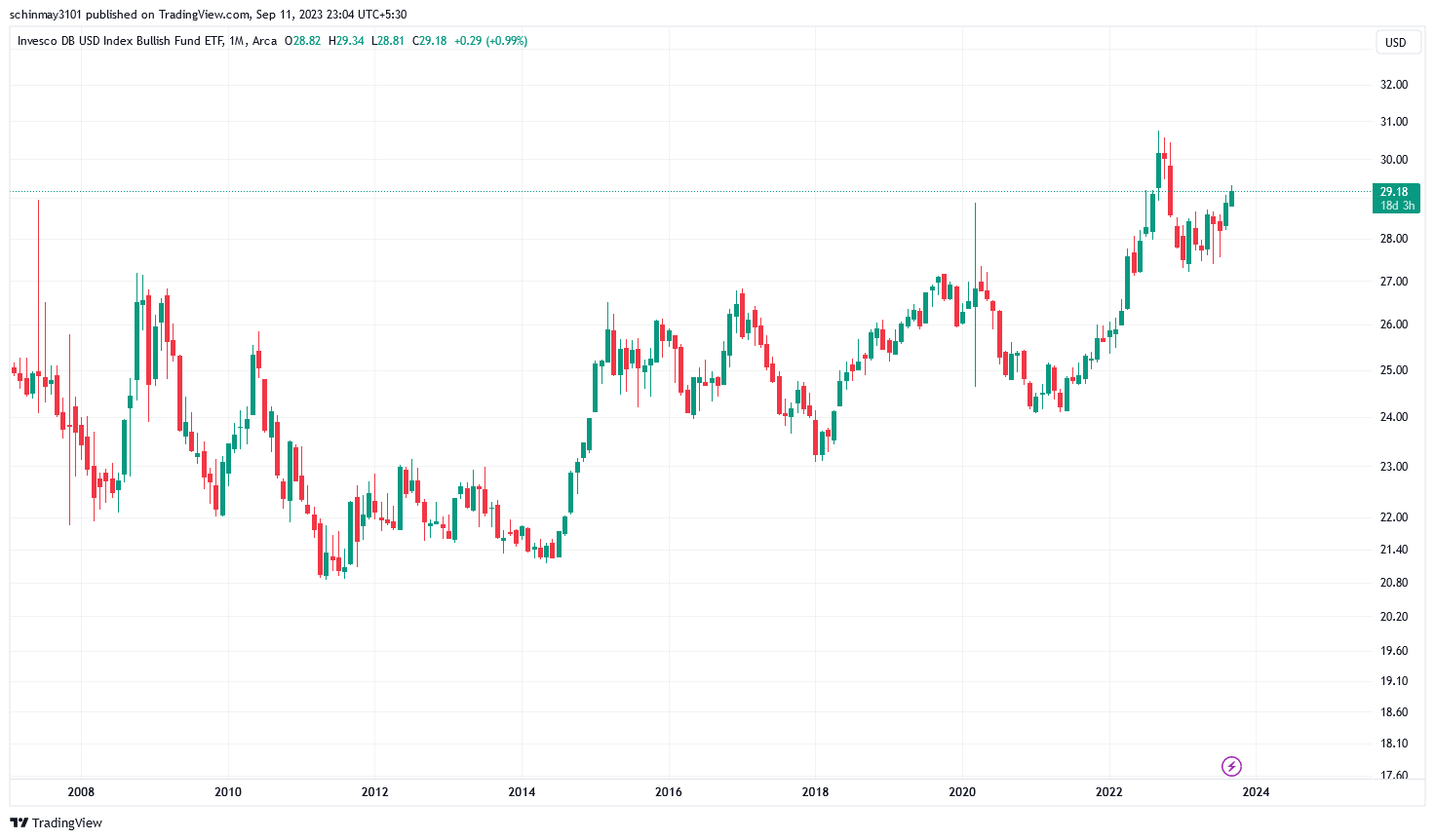 UUP Performance Since Inception
| YTD | 5.36% |
| Expense Ratio | 0.78% |
| Focus | Long USD, Short G10 Basket |
| 1 Year Return | 0.63% |
| 3 Year Return | 5.65% |
| 5 Year Return | 3.83% |
| Source | etfdb.com |
The Invesco DB US Dollar Index Bullish Fund stands as the largest currency ETF in terms of assets under management. It tracks the fluctuations in the U.S. dollar’s value against major global currencies, including the euro, Japanese yen, British pound, Canadian dollar, Swedish krona, and Swiss franc.
This fund comprises a diverse range of U.S. Dollar Index futures contracts. Its recent strong performance reflects the dollar’s robustness against international currencies. It’s an excellent choice for active traders who seek to capitalize on trends and employ strategies reliant on short trading and futures contracts.
UP tracks the DB Long USD Currency Portfolio Index ER, which reflects alterations in the U.S. dollar’s value relative to a selection of global currencies. It sets itself apart from this benchmark by maintaining a higher-than-average exposure to the euro. In particular, the fund takes short positions against the euro (EUR), Japanese yen (JPY), British pound (GBP), Canadian dollar (CAD), Swedish krona (SEK), and Swiss franc (CHF). Recently, UUP has exhibited stronger performance compared to other currency funds, driven by the overall robustness of the U.S. dollar and the Federal Reserve‘s commitment to maintaining a tighter monetary policy stance.
WisdomTree Bloomberg U.S. Dollar Bullish Fund (USDU)
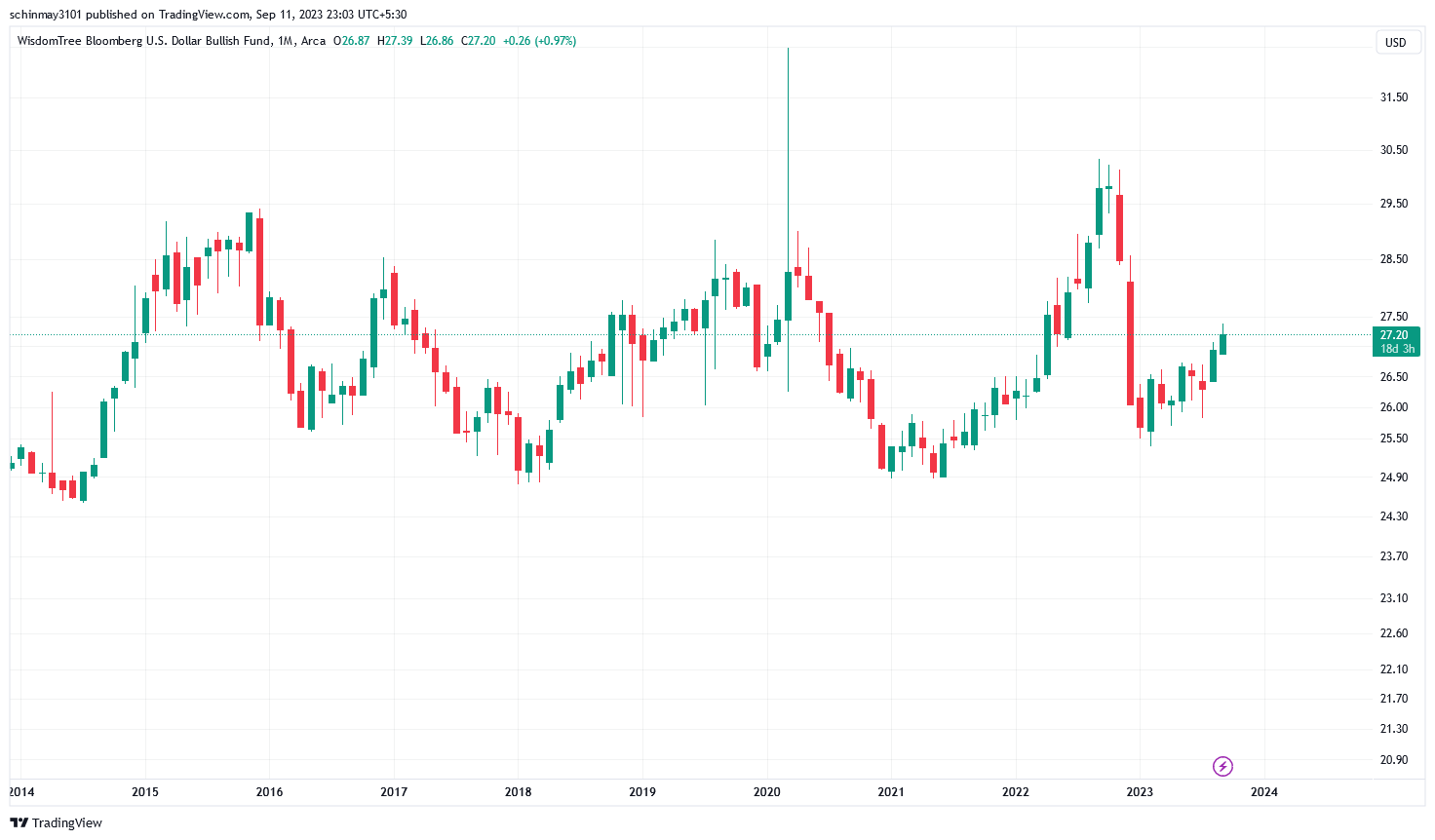 USDU Performance Since Inception
| YTD | 4.91% |
| Expense Ratio | 0.50% |
| Focus | Long USD, Short Global Basket |
| 1 Year Return | 1.44% |
| 3 Year Return | 4.28% |
| 5 Year Return | 2.76% |
| Source | etfdb.com |
As the name suggests, the WisdomTree Bloomberg U.S. Dollar Bullish Fund is an attractive option for investors who hold a bullish outlook on the U.S. dollar. This fund can diversify traditional stock and bond portfolios due to its negative correlation with international stock and bond returns.
USDU invests in short-term currency futures and U.S. Treasury securities, focusing on liquid currencies to provide total returns surpassing the Bloomberg Dollar Total Return Index. It enables investors to leverage an appreciating dollar against foreign currencies effectively.
USDU offers broad exposure to the U.S. dollar against a basket of 10 global currencies. It aims to benefit from a strong U.S. economy, rising interest rates, and geopolitical uncertainties. Its value proposition centers on the U.S. economy’s strength and stability, making it an appealing choice for risk-averse investors.
Invesco CurrencyShares Swiss Franc Trust (FXF)
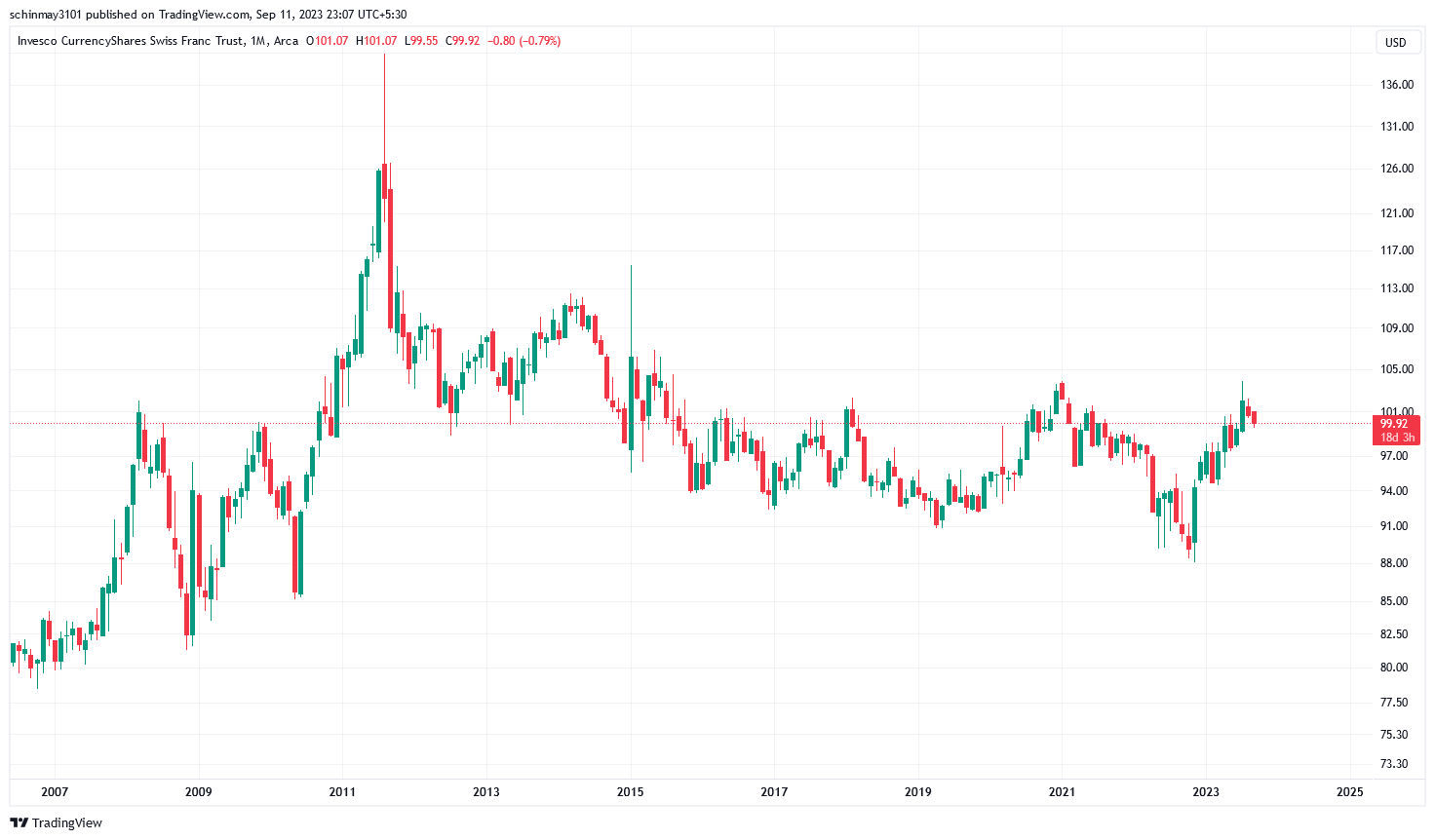 FXF Performance Since Inception
| YTD | 3.25% |
| Expense Ratio | 0.40% |
| Focus | Long CHF, Short USD |
| 1 Year Return | 8.18% |
| 3 Year Return | -0.21% |
| 5 Year Return | 0.62% |
| Source | etfdb.com |
The FXF ETF provides investors with the opportunity to participate in the Swiss franc’s performance relative to the U.S. dollar, with its value rising when the franc gains momentum and falls when the dollar rises. FXF is an apt choice for investors looking to safeguard themselves against potential currency exchange rate fluctuations or those who are betting on a decline in the U.S. dollar’s value. It uniquely stands out as the exclusive ETF option for individuals interested in gaining exposure to the CHF/USD exchange rate. The Trust‘s primary objective is to mirror the Swiss franc’s price in U.S. dollars, offering both institutional and retail investors a straightforward and cost-efficient means of reaping investment advantages akin to holding Swiss francs.
WisdomTree Emerging Currency Strategy Fund (CEW)
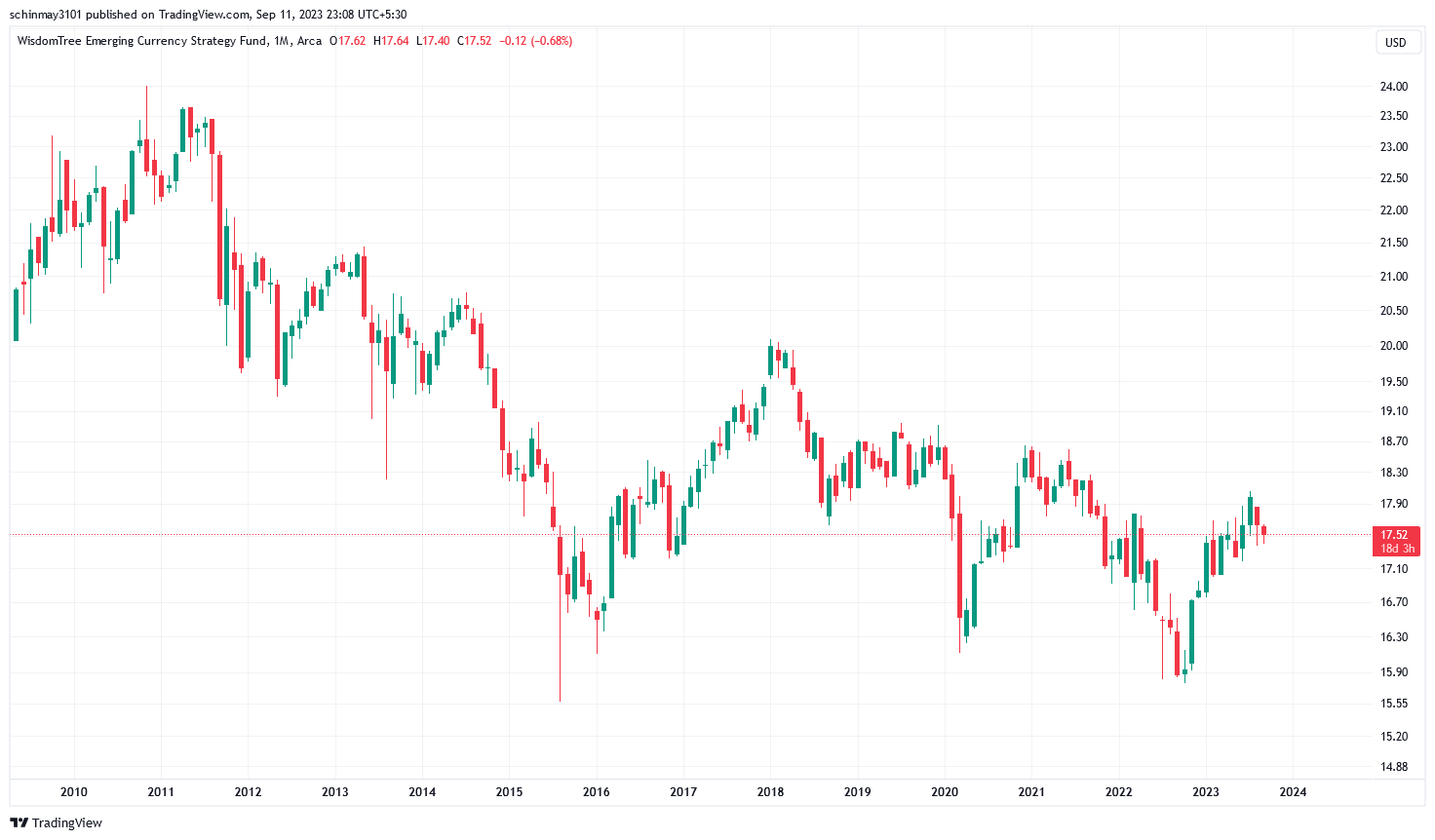 CEW Performance Since Inception
| YTD | 3.52% |
| Expense Ratio | 0.55% |
| Focus | Long Emerging Markets Basket, Short USD |
| 1 Year Return | 7.30% |
| 3 Year Return | 0.23% |
| 5 Year Return | 0.70% |
| Source | etfdb.com |
The WisdomTree Emerging Currency Strategy Fund is an actively managed fund targeting a selection of currencies from emerging market nations across Latin America, Asia, emerging Europe, and the Middle East/Africa Region. Although the fund’s contracts have an ultra-low duration, many of the currencies within it remain highly volatile. Nevertheless, CEW serves as a high-quality choice for investors seeking comprehensive exposure to emerging foreign currencies worldwide.
Invesco CurrencyShares Japanese Yen Trust (FXY)
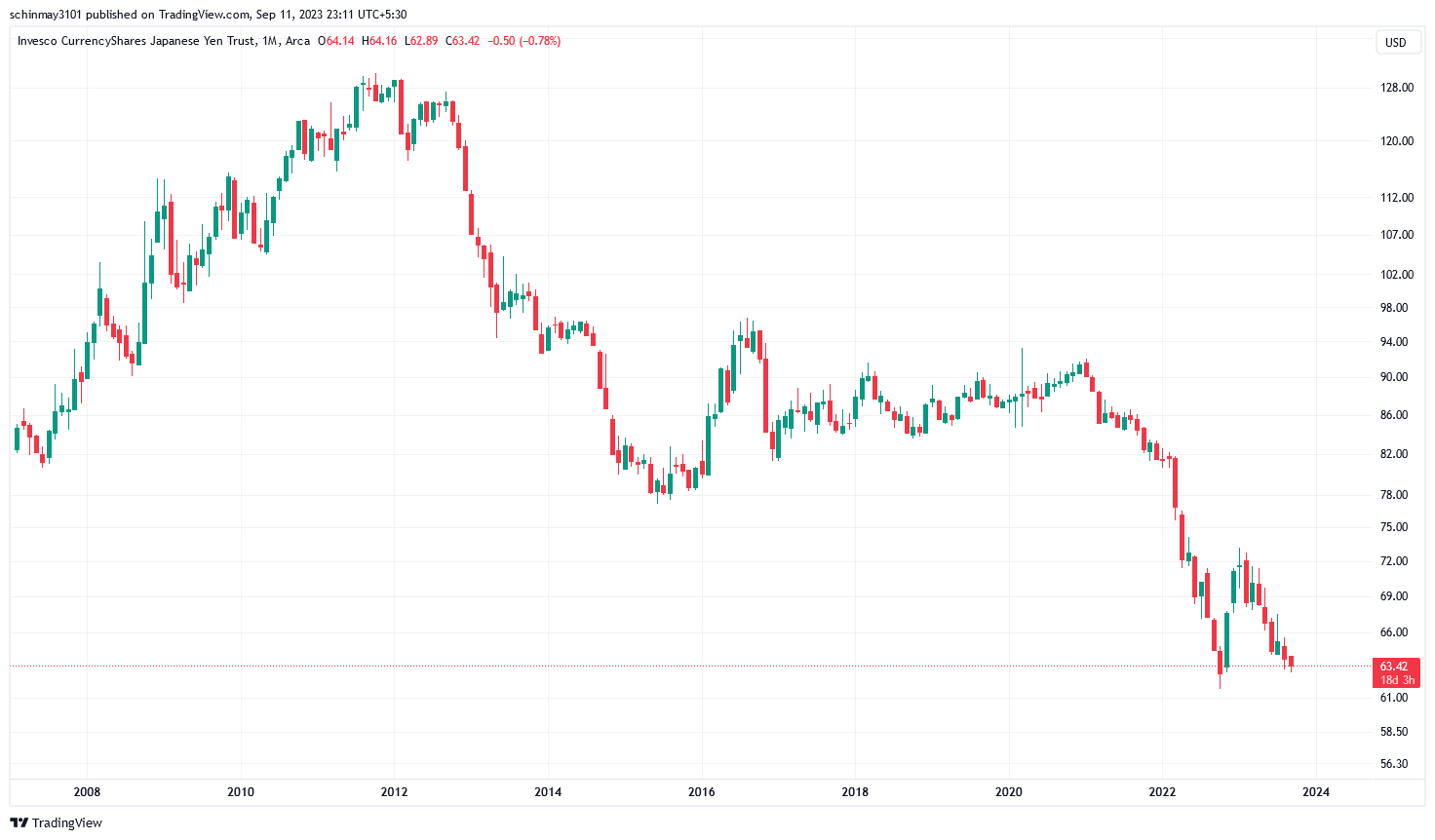 FXY Performance Since Inception
| YTD | -11.25% |
| Expense Ratio | 0.40% |
| Focus | Long JPY, Short USD |
| 1 Year Return | -3.13% |
| 3 Year Return | -10.94% |
| 5 Year Return | -6.09% |
| Source | etfdb.com |
For those keen on tracking the Japanese yen’s price in U.S. dollars, the Invesco CurrencyShares Japanese Yen Trust provides a convenient solution. FXY demonstrated a robust 10%+ gain in the last quarter of 2022 and the first month of 2023, aligning with J.P. Morgan‘s bullish yen outlook, making it a promising option for Forex investors seeking new opportunities.
FXY offers exposure to the Japanese yen, making it valuable for investors interested in Asian markets amid Japan’s economic innovation and adaptation. With a market value of $178 million as of July 14, 2023, FXY holds potential for appreciation, particularly if the yen strengthens due to factors such as Japan’s economic recovery, fiscal stimulus, or geopolitical tensions. It earns its spot on the list as the yen is perceived as undervalued against the dollar, and FXY offers a cost-effective and liquid avenue to enter the Japanese currency market.
The underperformance of this ETF, as suggested by its negative compounded returns, is attributable to the weak JPY. This weakness is largely contributed by the interest rate gap between Japan and US. The potential for this ETF is strengthened by the hope of rebound and recovery in the Japanese Yen.
Invesco CurrencyShares Euro Trust (FXE)
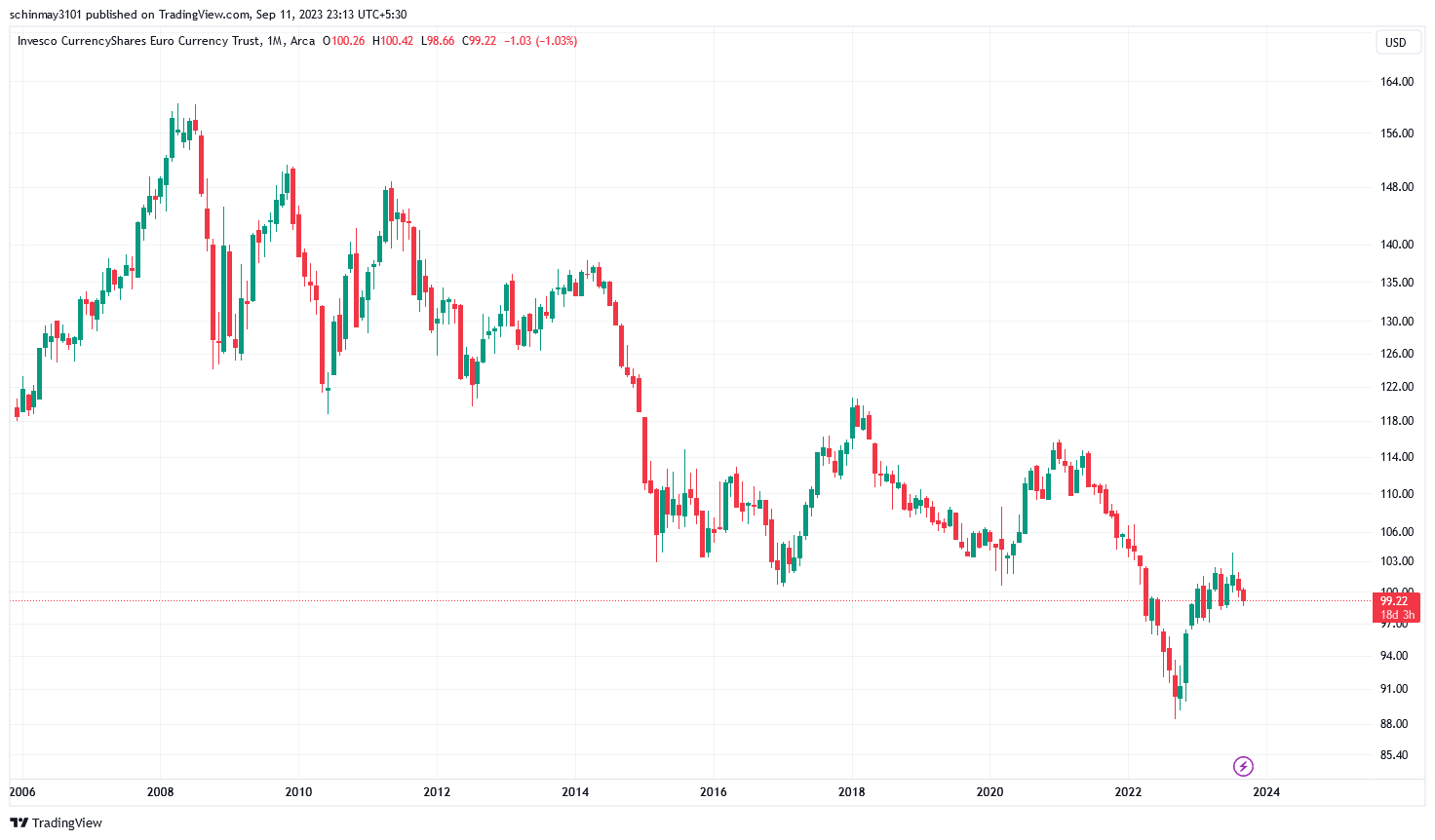 FXE Performance Since Inception
| YTD | 0.86% |
| Expense Ratio | 0.40% |
| Focus | Long EUR, Short USD |
| 1 Year Return | 8.02% |
| 3 Year Return | -3.66% |
| 5 Year Return | -2.07% |
| Source | etfdb.com |
The Invesco CurrencyShares Euro Trust focuses on tracking the euro’s price in U.S. dollars. What sets FXE apart from the other funds on our list is that it directly holds euros instead of using derivatives like futures contracts. If you anticipate that the euro could strengthen in comparison to the U.S. dollar, this ETF presents a strategic choice to enhance a diversified portfolio.
Like most currency ETFs, FXE is not intended for long-term holding. It’s a suitable choice for investors who believe that the euro is undervalued when measured against the dollar. In the event of euro appreciation, FXE‘s value is likely to rise. Likewise, recent losses in the fund can be attributed to the dollar’s recent strength.
FXE provides exposure to the European currency without requiring you to open a foreign currency account or engage in Forex market trading. As of July 14, 2023, it boasts a market value of $300 million, indicating a strong market presence and growth potential, especially with Europe’s ongoing economic recovery. This option enriches your portfolio by offering a diversified and liquid means to access the euro, one of the world’s most widely traded and influential currencies.
What are Forex currency ETFs?
Forex currency ETFs, or exchange-traded funds, are investment vehicles that offer individuals exposure to foreign exchange markets and various currencies. These ETFs enable investors to participate in currency movements and exchange rate fluctuations, just like trading individual currencies. They function much like traditional ETFs, allowing investors to buy and sell shares on stock exchanges, but instead of holding stocks or bonds, they track the performance of foreign currencies.
Currency ETFs can represent single currencies or a basket of multiple currencies, and their portfolios often consist of currency futures contracts. These investments are both a means of diversifying one’s portfolio and a way to speculate on currency movements, with potential risks and rewards. Currently, the currency ETF market is relatively small, with a limited number of options available, and it includes both traditional currency ETFs and cryptocurrency-focused ones.
How do currency ETFs work?
Currency ETFs operate as financial instruments that combine characteristics of both stocks and Mutual Funds. Like stocks, these exchange-traded funds are traded on stock exchanges, allowing investors to buy and sell shares. However, similar to Mutual Funds, they pool investors’ funds to create portfolios that track specific asset classes, sectors, or benchmark indexes.
Essentially, ETFs are designed to provide an efficient and cost-effective means for investors to trade currencies during regular market hours. They offer a way to gain exposure to the foreign exchange market, which is the largest global market. Such ETFs are essentially managed portfolios focused on currency investments, and they come in various forms, some backed by foreign currency bank deposits and others not.
Investors turn to currency ETFs for their Forex market exposure, as well as to reduce risks and transaction costs associated with currency trading. These funds primarily derive their value from changes in spot exchange rates, making them integral for currency investors.
Currency ETF managers employ diverse strategies to achieve their fund objectives. These strategies may include holding cash/currency deposits, short-term debt in specific currencies, and Forex derivative contracts. ETFs have democratized access to foreign exchange markets, making them more accessible to a broader range of investors.
Currency ETFs often serve as diversification tools within traditional investment portfolios and offer opportunities for arbitrage between currency pairs. They can also act as hedges against macroeconomic events. Depending on the product chosen, investors can gain exposure to different currencies or diversified baskets of currencies, each presenting distinct risk-reward profiles. The principles of diversification and risk management, fundamental in modern finance, are equally relevant when participating in currency markets through these ETFs.
Now that you clearly understand what currency ETFs are and how they function, the next step is choosing the right broker to access them. A solid brokerage platform can make the difference between seamless participation and unnecessary cost or friction. Below is a comparison of trusted brokers that support access to Forex-focused ETFs and global currency strategies.
| Plus500 | eToro USA | eOption | Fidelity | Revolut | |
|---|---|---|---|---|---|
|
Demo |
Yes | Yes | Yes | Yes | No |
|
Account min. |
EUR500 | 50 | No | No | No |
|
Bonds Fee |
Not specified | Not specified | $3/$5/$39 | $0 – $250 | No |
|
Basic stock/ETF fee |
$0.006 | No | $0 | No | 0.12%-0.25% |
|
Basic options fee |
Not specified | No | $0.10 + $1.99 | $0,65 | No |
|
Deposit Fee |
No | No | Not specified | $0 | No |
|
Withdrawal fee |
No | No | Not specified | $0 | No charge up to a limit |
|
Inactivity fee |
No | No | Not specified | $0 | Not specified |
|
TU overall score |
8.8 | 8.69 | 8.27 | 8.7 | 8.6 |
|
Max. regulation level |
Tier-1 | Tier-1 | Tier-1 | Tier-1 | Tier-1 |
|
Open an account |
Go to broker
80% of retail CFD accounts lose money. |
Go to broker | Study review | Study review | Study review |
Pros and cons of investing in currency ETFs
Investing in currency ETFs comes with its own set of advantages and disadvantages, which are important to consider. Here’s a list of the pros and cons:
- Diversification and hedging
Currency ETFs offer an avenue to diversify your investment portfolio geographically and financially. They can also act as a hedge against currency risk, providing stability when currencies fluctuate. - Accessibility
These ETFs simplify access to foreign exchange markets. Investors can gain exposure to global currencies without delving into complex Forex trading strategies. - Flexibility and liquidity
Currency ETFs are traded on exchanges just like stocks, which means they are highly liquid and flexible. Buying and selling them is straightforward and efficient. - Limiting currency risk
Currency-hedged ETFs are available for investors looking to minimize currency risk while investing in foreign currencies. These ETFs help protect against unfavorable currency movements.
- Exchange rate risk
Currency ETFs are sensitive to fluctuations in currency exchange rates. Adverse movements can negatively impact the value of these funds and eliminate returns. - Inflation impact
Currency value can decrease due to inflation in a foreign country. This can diminish the returns on investments held in that currency. - Geopolitical risk
Political instability and shifts in economic policies within a country can influence the value of its currency. Such events can pose risks to currency investments. - Tracking error
Currency ETFs may not always mirror the exact price movements of the underlying currency. Factors like fees, expenses, market disruptions, or other variables can lead to differences in performance, introducing tracking errors.
What are the factors that affect currency ETFs?
Several factors influence the performance of currency ETFs, and understanding these factors is crucial for investors. Let’s delve into the key factors that can affect currency ETFs:
-
Economic indicators such as a country’s economic growth, government debt levels, trade balances, and commodity prices like oil and gold can influence a currency’s value. Economic stability and strength often bolster a currency’s attractiveness.
-
Interest rates play a pivotal role in currency ETF performance. Higher interest rates can attract foreign investors seeking better returns, leading to increased demand for a currency and a potential rise in its value.
-
Geopolitical events like trade agreements, sanctions, and political instability can have significant impacts on currency ETFs. Negative developments in these areas can lead to declines in currency values.
-
Currency-hedged ETFs are designed to mitigate currency risk when investing in foreign stocks. These ETFs aim to protect against unfavorable currency movements, providing a shield for investors.
-
Factors such as national debt levels, inflation rates, and broader economic conditions can exert pressure on currency ETFs, introducing risks that investors should monitor.
-
Currency ETFs are closely tied to the performance of their underlying assets, whether stocks, bonds, or other investments. The health of these assets can impact the overall value of the currency ETF.
-
Exchange rates between currencies can significantly affect the value of currency ETFs. Fluctuations in exchange rates can lead to value swings in currency ETFs.
-
The outlook of the broader investor class, known as market sentiment, can sway the performance of currency ETFs. Positive sentiment can drive up their value, while negative sentiment can lead to declines.
-
Currency ETFs can be more volatile compared to other ETF types due to the inherent volatility of currency markets. Currency fluctuations can also introduce price swings.
-
The liquidity of a currency ETF can impact its value. ETFs with low liquidity may face challenges in buying and selling, potentially affecting their value.
How to find the best currency ETF to invest in?
Experts suggest the following steps to fund the best currency ETF to invest in
-
Research multiple options
Begin your quest by researching the available currency ETFs in the market. Explore a range of options to understand the landscape. -
Currency exposure
Identify currency ETFs that align with your desired currency exposure. If you intend to invest in a specific currency, focus on ETFs that track that currency’s performance. -
Expense ratio
Evaluate the expense ratio of each ETF. This figure represents the annual fee charged by the fund for managing its operations. Opt for ETFs with lower expense ratios to maximize your potential returns. -
Liquidity matters
Liquidity plays a crucial role. Seek out ETFs with high liquidity, as these are characterized by substantial trading volumes and offer ease of buying and selling. -
Performance analysis
Analyze the historical performance of ETFs over different timeframes, such as one year, three years, and five years. Prioritize ETFs with consistent track records of performance. -
Risk assessment
Understand the risk associated with each ETF. Look for funds that align with your risk tolerance and investment objectives. ETFs with lower risk profiles may be suitable for conservative investors.
Currency ETFs work best when they complement a clear macro view
Looking back at my own experience, currency ETFs became truly valuable to me only after I stopped treating them as simple “side bets” on major currencies. Early in my career, I made the mistake of choosing ETFs based solely on recent performance charts. It didn’t take long to learn that strong short-term returns can be misleading when you don’t understand the underlying economic forces driving those moves.
Over time, I started paying closer attention to central bank policies, interest-rate differentials, and geopolitical risk – the same factors that influence many of the ETFs discussed in this review. For example, when I first added exposure to the Swiss franc, it wasn’t because FXF had a good month, but because I’d seen how resilient the franc remained during broad market stress. That position ended up protecting a part of my portfolio when equities sold off sharply later that year.
Similarly, when I invested in a USD-bullish ETF, it was a deliberate decision based on tightening monetary policy rather than momentum alone. That experience taught me a critical lesson: currency ETFs work best when they complement a clear macro view, not when they’re used reactively.
My recommendation for 2025 is to approach these products with intention. Think about what each ETF adds to the structure of your portfolio – stability, diversification, hedging, or targeted speculation. When your strategy is grounded in real macroeconomic reasoning rather than noise, these instruments can become some of the most effective and versatile tools you use.
Conclusion
In summary, investing in Forex currency ETFs presents a strategic avenue for diversification and global exposure in 2026. By focusing on carefully selected funds such as the Invesco CurrencyShares Euro Trust or the WisdomTree Bloomberg U.S. Dollar Bullish Fund, investors can efficiently hedge against currency risk while accessing new growth opportunities. The key takeaway is that currency ETFs offer flexibility and liquidity, making them ideal tools for both risk mitigation and return enhancement. As global economic dynamics continue to shift, incorporating top-performing currency ETFs into your portfolio could be the edge that sets you apart. Remember, in a rapidly evolving market, informed ETF choices can turn volatility into opportunity.
FAQs
Forex currency ETFs can be structured differently: some use futures contracts to gain exposure to currency movements, while others hold actual currency deposits. ETFs using futures may experience tracking differences due to rolling of contracts and market liquidity, whereas those holding actual currency, such as ETFs that directly hold euros, tend to track the spot exchange rate more closely but may have different risk and cost profiles.
Macroeconomic events—like changes in interest rates, inflation, trade balances, and geopolitical developments—can significantly impact currency values, which in turn affect Forex currency ETFs. ETFs focused on particular currencies may rise or fall depending on the perceived strength or weakness of a country’s economic outlook, monetary policy decisions, and political stability.
Volatility is inherent in currency markets and can lead to substantial price swings in Forex currency ETFs. Funds that focus on emerging market currencies or those with low liquidity tend to be more volatile. While this creates opportunities for higher returns, it also increases risk, making these ETFs potentially less suitable for conservative investors.
While Forex currency ETFs can be useful for short- and medium-term exposures and specific macroeconomic strategies, they are generally not intended for long-term holding. Factors like tracking error, management fees, and prolonged currency trends can erode returns over time, making them better suited for tactical allocation rather than core, long-term investments.
Did you like the article?
Editors’ Top Picks and Insights
Related Articles
Team that worked on the article
Andrey Mastykin is an experienced author, editor, and content strategist who has been with Traders Union since 2020. As an editor, he is meticulous about fact-checking and ensuring the accuracy of all information published on the Traders Union platform.
Dan Blystone began his trading career in 1998 as an arbitrage clerk on the floor of the Chicago Mercantile Exchange (CME). He later traded bond and Eurex futures at proprietary firms such as Altea Trading, gaining valuable experience in high-frequency trading and risk management.
Chinmay Soni is a financial analyst with more than 5 years of experience in working with stocks, Forex, derivatives, and other assets. As a founder of a boutique research firm and an active researcher, he covers various industries and fields, providing insights backed by statistical data.
Short selling in trading involves selling an asset the trader doesn’t own, anticipating its price will decrease, allowing them to repurchase it at a lower price to profit from the difference.
Forex trading, short for foreign exchange trading, is the practice of buying and selling currencies in the global foreign exchange market with the aim of profiting from fluctuations in exchange rates. Traders speculate on whether one currency will rise or fall in value relative to another currency and make trading decisions accordingly. However, beware that trading carries risks, and you can lose your whole capital.
Risk management in Forex involves strategies and techniques used by traders to minimize potential losses while trading currencies, such as setting stop-loss orders and position sizing, to protect their capital from adverse market movements.
A futures contract is a standardized financial agreement between two parties to buy or sell an underlying asset, such as a commodity, currency, or financial instrument, at a predetermined price on a specified future date. Futures contracts are commonly used in financial markets to hedge against price fluctuations, speculate on future price movements, or gain exposure to various assets.
An investor is an individual, who invests money in an asset with the expectation that its value would appreciate in the future. The asset can be anything, including a bond, debenture, mutual fund, equity, gold, silver, exchange-traded funds (ETFs), and real-estate property.


