
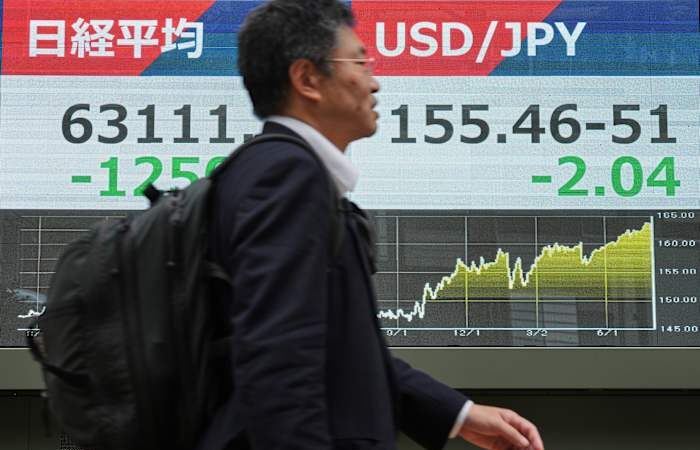
BANGKOK – Asian shares were mixed Monday after the U.S. and Japan confirmed they had acted to prop up the value of the Japanese yen against the U.S. dollar, causing the yen to rise to its highest level since late last year.
Oil prices fell sharply after U.S. President Donald Trump said he would order U.S. forces to refrain from attacks against Iran, claiming a deal to end the fighting in the Middle East was close.
The dollar fell as low as 155.20 against the yen after Trump and Japanese officials confirmed they had intervened last week to curb the U.S. currency’s rise to 40-year highs against the yen. Last week it was trading near 164 yen.
A weak yen helps to boost the profits of Japanese companies with big operations overseas, increasing their value in yen terms. It also has drawn foreign tourists who have enjoyed their strong purchasing power in Japan.
But a cheap currency also weakens Japan’s purchasing power overall, pushing up costs for the imports of oil and other goods needed to run its economy.
The euro rose to $1.1533 from $1.1528.
In share trading, Japan’s Nikkei 225 index lost 1.9% to 63,140.68 early Monday, while the Kospi in South Korea dropped 4.5% to 6,298.75.
The Kospi soared 17.9% on Friday for its best day in history after losing even more of its value earlier in the week. The index is dominated by two tech giants, Samsung Electronics and SK Hynix, both of whose shares gained more than 25% on Friday. However, early Monday Samsung was trading 8% lower while SK Hynix had fallen 7.8%.
Hong Kong’s Hang Seng index gained 0.6% to 26,038.92 and the Shanghai Composite index lost 0.5% to 3,812.97.
In Australia, the S&P/ASX 200 slipped 0.2% to 8,961.30.
Taiwan’s Taiex gained 0.7%.
The lull in fighting in the Middle East helped take oil prices down about 5%. Early Monday, U.S. benchmark crude was down 4.8% at $80.58 per barrel. Brent crude, the international standard, was down 5% at $83.87 per barrel.
On Friday, U.S. stocks rose to finish a wild July for Wall Street.
The S&P 500 climbed 0.7% and the Dow Jones Industrial Average added 0.5%. The Nasdaq composite rallied 1% after briefly losing all of an early 1.3% jump.
The U.S. stock market has lurched up and down as oil prices shot higher because of the war with Iran and growing worries over whether Big Tech’s massive investments in artificial-intelligence technology will translate into profits and whether chipmaker stocks have soared too high in the euphoria around AI.
Friday’s gains sent the S&P 500 to its first winning week in three.
Amazon led the market with a leap of 15.3% after reporting much stronger profit for the latest quarter than analysts expected. Its profit more than tripled from a year earlier, thanks in part to an acceleration of growth in its cloud computing business.
Analysts said that could be a signal Amazon’s huge AI investments are paying off, and Amazon increased its forecast for how much it will spend on investments this year.
The reaction was similar to what Microsoft got a day before, when its stock soared to its best day in nearly 18 years on signals that its AI investments may also be yielding higher profits.
Chip companies selling the processors and computer memory that such “hyperscalers” are scrambling to buy swung sharply again on Friday. Micron Technology, for example, went from an early jump of 6.4% to a loss of 6.5% before finishing with a fall of 5.9%.
But Apple dropped 7.4% despite reporting stronger profit for the latest quarter than expected. Its forecast for revenue growth in the current quarter fell short of expectations, which executives pinned on a supply crunch in components getting vacuumed up in the AI boom.
Copyright 2026 The Associated Press. All rights reserved. This material may not be published, broadcast, rewritten or redistributed without permission.


