
Every Market Crash Warning Signal Is Flashing Red — and the S&P 500 Is Up 12% Anyway. History Says the Alarmists Are Wrong More Often Than You Think.

Should investors be worried right now? If you consulted a Magic 8 Ball, it might respond: “Signs point to yes.”
Practically every market crash warning signal is currently flashing red. Meanwhile, the S&P 500 (^GSPC -0.17%) continues to climb the proverbial “wall of worry,” with the index up by a solid double-digit percentage so far this year.
However, perhaps the best Magic 8 Ball answer to the question might be “ask again later.” History shows that the most widely followed market crash warning signals are wrong more often than you think.

Image source: Getty Images.
Real warnings
Let’s first look at the warning signs that a stock market crash could be on the way. One of the most compelling examples is the S&P 500 Shiller CAPE (cyclically-adjusted price-to-earnings) ratio.
The Shiller CAPE ratio ranks among the most respected market valuation metrics. This ratio currently stands near its highest level since early 2000, when it reached an all-time high.
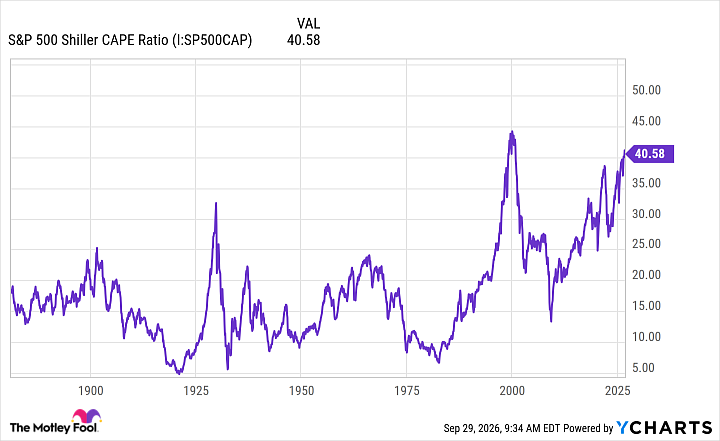
S&P 500 Shiller CAPE Ratio data by YCharts
Many investors remember what happened after the CAPE ratio surged 26 years ago. The dot-com bubble burst soon afterward, with the S&P 500 plunging and failing to fully recover for years.
Likewise, the ratio of total stock market capitalization to GDP (known as the Buffett indicator) is above 235% — its highest level ever. Warren Buffett stated in 2001 that when this ratio approaches 200%, investors are “playing with fire.”
He wasn’t kidding. The Buffett indicator indeed approached 200% in 1999 and 2000, just before the aforementioned dot-com bubble burst.
We can’t leave out skyrocketing margin debt, either. In August 2026, investors’ borrowings totaled $1.45 trillion. There’s a clear pattern between surging margin debt and subsequent market downturns.
Margin debt spiked in 1999 and early 2000, with the stock market crashing soon afterward. Margin debt reached another high in 2007, not long before the financial crisis and market plunge of 2008 and 2009. Margin debt again peaked in late 2021, right before the 2022 bear market.
The sky isn’t always falling.
If we only looked at these historical examples, it would be easy to conclude that another stock market crash is a slam dunk. However, the record isn’t quite so clear-cut.
For example, the S&P 500 Shiller CAPE ratio reached an all-time high of 25 in 1996. That set off alarms. In December 1996, former Federal Reserve Chair Alan Greenspan warned about investors’ “irrational exuberance.” But guess what the stock market did? It kept climbing. If you had sold in 1996, you would have missed out on the S&P 500 doubling over the next four years.
The S&P 500 Shiller CAPE ratio has been above its historical average for nearly the entire 21st century. And the S&P 500 has risen more than 420% during the period.
Similarly, the Buffett indicator has remained elevated for years. Meanwhile, the stock market has continued to rise. Margin debt has also trended significantly upward over the last three decades, with no obvious impact on the stock market.
Don’t ignore the signals, but don’t fret about them
Is everything sunshine and roses with the stock market and the economy? Of course not. There are real challenges, including persistently high inflation and the prospects of further rate hikes. However, this does not mean that a stock market crash is imminent.
Although it’s usually foolish to utter the phrase “this time is different,” there is at least one key factor that does differentiate the present from the past. S&P 500 earnings are rising faster than valuations. That’s a good sign that the market’s momentum could continue.
Investors shouldn’t ignore the warning signs today. The high market valuation metrics and margin debt levels could portend choppy waters ahead. However, it’s premature to fret about them too much. The warning signs that signal market crashes can flash red for a long time before a downturn occurs.


