
If a Stock Market Crash Is Coming, History Says This Is the Best Move Investors Can Make
Major market indexes have been soaring lately, with the S&P 500 (^GSPC -0.69%), Nasdaq Composite (^IXIC -1.33%), and Dow Jones Industrial Average (^DJI -0.22%) up by 6%, 9%, and 4%, respectively, since late July alone.
However, no bull market can last forever, and multiple indicators are sounding the alarm over a potential stock market downturn: The S&P 500 Shiller CAPE ratio and the Buffett indicator are both showing patterns last seen during the dot-com bubble.
While no market indicator can say with 100% certainty what will happen, investors may want to prepare for volatility. Here’s what history says investors should do right now.
Image source: Getty Images.
How likely is a stock market crash in 2026?
As tech companies reach new heights, many investors and experts are growing concerned about an AI bubble. In fact, around 45% of fund managers believe an AI bubble is the biggest tail risk facing the market in 2026, according to Bank of America’s most recent Global Fund Manager Survey.
The data also suggests that investors may want to tread carefully. The S&P 500 Shiller CAPE ratio measures the S&P 500’s price against its 10-year inflation-adjusted earnings, providing a snapshot of the market’s valuation over time.
In the late 1990s, the CAPE ratio peaked at around 44. Until recently, that was the only period in history when this metric remained above 40 for months at a time. However, the CAPE ratio has now been hovering above 40 since May 2026.
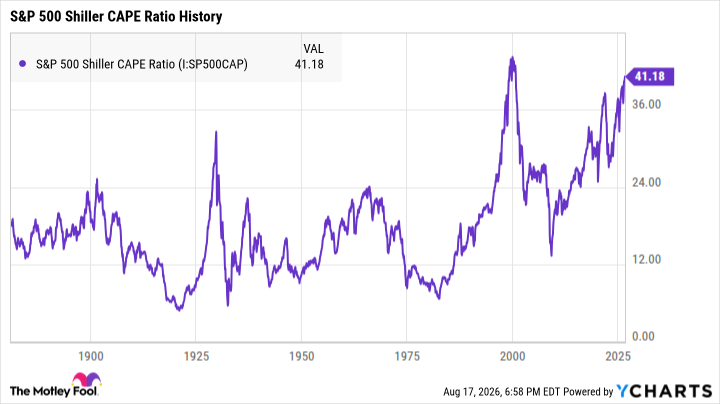
S&P 500 Shiller CAPE Ratio data by YCharts
The Buffett indicator, which was nicknamed after Warren Buffett when he used the metric to warn investors about sky-high valuations during the dot-com boom, also currently sits at a record high of around 232%.
This metric measures the relationship between the total value of U.S. stocks and GDP, and a high percentage suggests that the market may be overvalued. In a 2001 Fortune essay, Buffett warned that when this metric nears 200%, investors are “playing with fire.”
History says this is the best move investors can make right now
Perhaps the biggest downside of metrics like these is that, while they can provide information about the market’s overall valuation, they can’t predict when a downturn will begin.
The Buffett indicator, for example, has been above 200% since July 2025. Since then, though, the S&P 500 has earned total returns of more than 27%. In other words, investors who sat out of the market at the first sign of trouble would have missed out on significant gains.
The best thing investors can do right now, then, is continue investing consistently. Even if a crash is around the corner, history suggests that those who stay in the market for the long haul will reap the rewards.
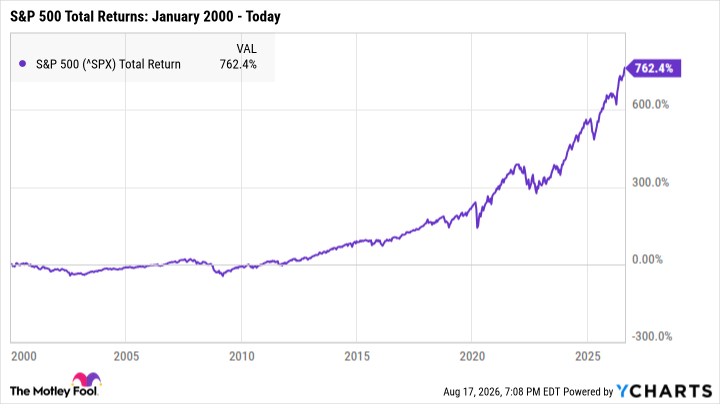
For example, say you’d invested in an S&P 500 ETF or index fund in January 2000. The dot-com bubble officially popped in March, resulting in a bear market that lasted roughly two and a half years. By today, however, the S&P 500 has earned total returns of more than 760%.
It’s equally important, however, to ensure you’re investing in quality stocks with robust underlying business fundamentals — like a sustainable business model and healthy finances.
In the late 1990s, Warren Buffett warned that stock prices were on the verge of a decline. He also noted that while many people were excited about the internet’s growth potential, what really matters to investors is the health of individual companies.
“The key to investing is not assessing how much an industry is going to affect society, or how much it will grow, but rather determining the competitive advantage of any given company and, above all, the durability of that advantage,” he said in an essay for Fortune.
Nobody can say exactly where the market is headed in the coming months. But history has repeatedly shown that buying quality stocks and staying invested for the long haul is key to generating life-changing wealth.


