
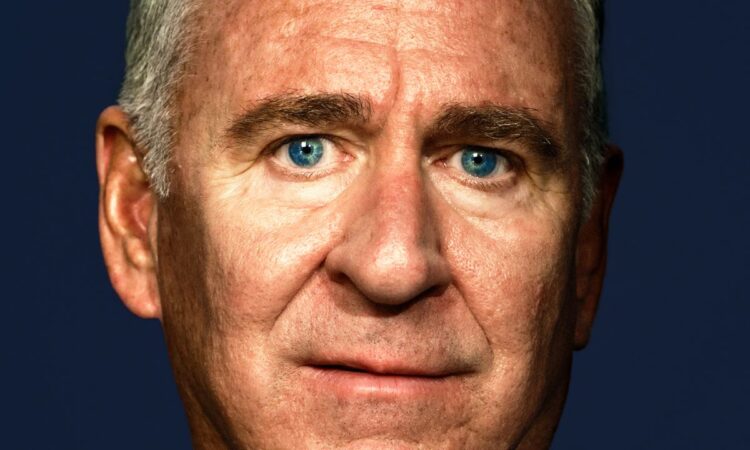
There are many precursors Griffin could have cited. In the nineties, George Soros became famous for shorting the British pound. At the time, Soros, along with the financiers Julian Robertson and Michael Steinhardt, defined the public image of hedge-fund managers as investment wizards who made fortunes through huge bets, contrarian calls, iron stomachs, and a willingness to operate close to—or over—the regulatory line. Griffin became a leader of the next generation in part by aggressively automating college-level math to analyze trades. But he knows that he’s not a mathematical genius on the order of Jim Simons or David Shaw—pioneering “quants” who harnessed computing power to extract money from the markets. Nor did Griffin mention the other phylum of modern Wall Street, the descendants of Warren Buffett and Charlie Munger: the virtuosos of the long-term pick who identify stocks trading at sensible prices and let them compound for years.
Griffin has never pretended to be a radical innovator or a savant. His mission has always been different: to build finance businesses that update their strategies and infrastructure so relentlessly that they beat rivals not just today but over decades. Paradoxically, maintaining a consistent edge requires constant, unsentimental internal change—of processes, technology, and people. Citadel takes ideas that are just beginning to circulate and improves them, with math or technology or data that others haven’t thought to use. As Griffin once acknowledged, “If there are a thousand things that make Citadel special, there will be very few that are actually truly unique and bespoke to Citadel.” Before the millennium, for example, Citadel embraced the emerging technique of “event-driven” trading—strategies crafted to take advantage of major corporate news such as merger deals, bankruptcies, or regulations. In 2014, after many other traders had adopted event-driven trading, Citadel paused the practice.

“To keep your body from touching the same surface as previous bodies, we cover the table with this strip of paper that is narrower than all bodies.”
Cartoon by Asher Perlman
All this churn has been guided by Griffin’s fear that everything he’s built is fragile—the most impressive sandcastle on the beach. His longtime deputy, James Yeh, who is now retired, told me, “If you talk to a hundred executives, ninety per cent of them will tell you, ‘We’re never satisfied with what we’ve done before, we always want to do better, you can’t rest on your laurels, and you’d better constantly try to improve.’ But ninety-nine per cent of them don’t actually mean it. Ken actually means it.”
Given that Griffin lacks a signature trading or investing style, his achievements can feel both confounding and imitable. But nobody has duplicated his monetary success—or built two separate businesses that are so wildly profitable. Citadel’s fund now manages sixty-eight billion dollars, more than nineteen billion of which is Griffin’s and his colleagues’ own money. Although Griffin doesn’t directly run Citadel Securities, he is its non-executive chairman and owns at least seventy-five per cent of it. That business trades more than a hundred and seventy trillion dollars a year for institutional clients and retail investors. In 2025, it generated $12.2 billion in revenue on those trades and $5.4 billion in net income. Bloomberg estimates that Citadel Securities accounts for nearly half of Griffin’s net worth, which has tripled in the past six years. (Being the top man on Wall Street makes him only the world’s thirty-seventh-richest person, according to Forbes—well behind the six tech giants who top the chart.)
In an era in which income inequality is a source of increasing political and social concern, Griffin is an unabashed big spender. For him, half a billion dollars is a basic unit of currency. He spent that much for twenty-seven acres in Palm Beach; for the joint purchase of a Jackson Pollock and a Willem de Kooning; in gifts to Harvard; and in political contributions, mostly to conservative candidates. He dropped a mere forty-five million on a stegosaurus skeleton, called Apex, which is now on loan to the American Museum of Natural History (though “the dream,” Griffin told me, “is one day she’ll be in Miami”).
Griffin may decide that running for political office is a bet he’s not willing to make: a Harvard man with a hedge fund and a house on the French Riviera might unite people across parties in distaste. Then again, he has the cunning and the means to update his image, and he remains ambitious. He told me, “I take great joy in problem-solving. If there was a moment that came to pass where those skills would be of crucial importance for our country, of course I would look to be involved.”


