
95% versus minus 10%.
Those figures capture the sharply divergent fortunes of South Korea’s two equity markets this year: the benchmark Kospi has surged 95%, while the smaller, growth-oriented Kosdaq has fallen about 10%.
The Kospi has climbed from around 4,000 to above 8,000, propelled by a chip-led rally in Samsung Electronics Co. and SK Hynix Inc. The Kosdaq, by contrast, has slipped from the 900 level into the 800s.
The divergence is the widest on record between South Korea’s two principal equity markets, underscoring investors’ overwhelming preference for the country’s heavyweight memory-chip makers over the biotech, battery and smaller growth companies that dominate the Kosdaq.
The gap has made for a subdued 30th anniversary for the Kosdaq, which opened in July 1996 with ambitions of becoming South Korea’s answer to Nasdaq.
During the technology boom of 2000, the Kosdaq at one point stood nearly 1,900 points above the Kospi. Since the dot-com bust, however, it has spent much of its life in the shadow of its larger counterpart.
This month, that shadow has grown longer.
An analysis by The Korea Economic Daily of historical closing prices showed the gap between the two indexes widening to between 7,000 and 8,000 points.
It reached a record 8,146.15 points on June 22, when the Kospi closed at 9,114.55 and the Kosdaq at 968.40.
Both indexes fell sharply on June 26, but for different reasons.
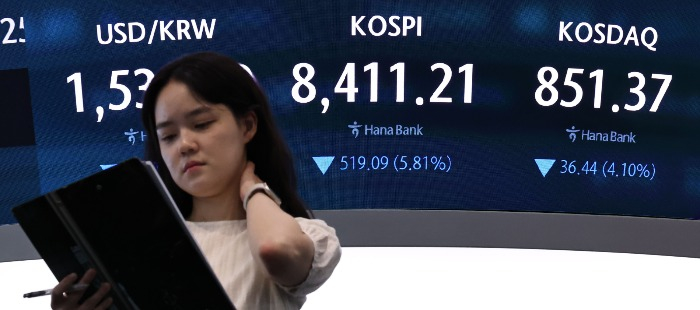
The Kospi declined 5.8%, largely reflecting profit-taking after a steep run-up. The Kosdaq dropped 4.1%, extending a retreat in a market that had largely missed the Kospi’s first-half rally.
The Kosdaq closed at 851.37 on Friday, down 30.6% from its late-April high of 1,226.18. That was its deepest peak-to-trough decline since 2024, when the market was battered by a slump in battery-related shares amid weaker electric vehicle demand.
The scale of the retreat approached the roughly 38% decline seen during the market turmoil of March 2020 in the aftermath of the COVID-19 crisis.
For local investors, the contrast has become a familiar complaint: The Kosdaq fails to rise when the Kospi rallies, but falls alongside it when the market turns lower.
CHIP PROFITS, NOT A BROAD RALLY
The widening divide reflects the narrowness of South Korea’s equity rally.
The Kospi’s ascent has been driven by the earnings power of Samsung Electronics and SK Hynix, the country’s two leading memory-chip makers and key beneficiaries of the global buildout in artificial intelligence infrastructure.
An investor who put 10 million won ($6,502) into each of the 10 largest Kospi stocks at the beginning of the year would have seen that 100 million won portfolio rise to 192.94 million won by June 26.
Samsung Electronics and SK Hynix alone would have accounted for 49.37 million won of those gains after their shares rose 183.2% and 310.6%, respectively.
The same bet on the 10 largest Kosdaq companies would have produced a very different outcome.
A 100 million won portfolio would have fallen to 89.13 million won, dragged down by biotech names such as Alteogen Inc., down 23.6%, and ABL Bio Inc., down 55.7%.
The divergence also stands out internationally.
In the US, the small-cap Russell 2000 index has risen 19.9% this year, outpacing the 7.3% gain in the large-cap S&P 500.
In China, the ChiNext index, which has a heavier weighting in smaller technology companies, has gained 27.3%, compared with a 3.2% rise in the CSI 300.
South Korea’s Kosdaq has moved in the opposite direction because its sector mix has left it on the wrong side of the market’s current earnings trade.
The exchange is crowded with biotechnology and battery-materials companies, including Alteogen and EcoPro BM Co., while the Kospi rally has centered on a handful of semiconductor giants with rapidly rising earnings forecasts.
Some Kosdaq-listed semiconductor equipment and materials suppliers have posted sharp profit gains. Wonik IPS Co. is expected to report operating profit of 186.2 billion won this year, up 152.3% from a year earlier, while Jusung Engineering Co. is forecast to post 71 billion won, up 127.1%.
But their market capitalizations and trading weight are too small to pull the broader Kosdaq higher, analysts said.
Samsung Electronics and SK Hynix, by contrast, have become the market’s main earnings engines.
According to Seoul-based AI-powered investment platform Epic AI, the consensus estimate for this year’s operating profit stands at 362 trillion won for Samsung Electronics and 265 trillion won for SK Hynix.
The disparity is even clearer at the market level.
Consensus forecasts put 2026 net income for Kospi-listed companies at about 727 trillion won on Friday, up from roughly 713 trillion won a week earlier. The comparable estimate for Kosdaq-listed companies is just 10 trillion won.
That leaves the Kospi with an expected profit pool more than 70 times the size of the Kosdaq’s.
The gap could widen further if semiconductor exports continue to set monthly records, driving earnings expectations higher for the large-cap chip companies that dominate the Kospi.
Biotech and battery companies on the Kosdaq are still posting solid export growth, but not at a pace that comes close to the chip industry.
A MARKET WITH A TRUST PROBLEM
The Kosdaq’s problem is not simply a lack of semiconductor exposure.
It also carries a reputation problem that has weighed on investor confidence for years.
As of June 26, 86 of the 105 companies on the Korea Exchange’s watch list, a warning designation that can precede delisting, were listed on the Kosdaq.
Of the 883 companies kicked out of the markets since 2021, 491, or 55.6%, were Kosdaq companies.
Market participants say financially troubled companies and issuers cited for inadequate disclosures have damaged the market’s broader reputation, contributing to lower valuations even for otherwise healthy growth companies.
The macro backdrop has added another obstacle.
Shin Hyun Song, governor of the Bank of Korea, has signaled that interest rates could rise.
That prospect tends to hurt long-duration growth stocks more than mature companies with strong current earnings.
The dynamic matters especially for the Kosdaq, where investors often value companies on expected profits rather than current cash flow, said analysts.
Higher interest rates reduce the present value of those future earnings and place additional pressure on stocks trading at high price-to-earnings multiples.
Retail investors have responded by shifting money toward the Kospi.
Mom-and-pop investors have bought a net 128 trillion won of Kospi-listed shares this year while unloading nearly 6 trillion won of Kosdaq shares, according to the Korea Exchange.
“The environment is likely to continue favoring the Kospi in terms of both earnings and interest rates,” said Lee Jae-won, an analyst at Yuanta Securities Korea Co.
“The Kosdaq is likely to remain relatively weak until its earnings estimates show a clear recovery.”
A QUESTION FOR POLICYMAKERS
The decline has complicated the Korean government’s effort to revive the Kosdaq as a financing market for innovative companies.
Officials promoted “Kosdaq 3000” at the start of the year, a long-term aspiration to push the index to 3,000. But with the benchmark now below 900, even a return to 2,000 looks distant.
“Talk of Kosdaq 3000 has disappeared from meetings chaired by government ministries,” one financial industry official said.
The government plans to introduce a new tiered system for Kosdaq-listed companies in the second half and accelerate the removal of penny stocks to improve market quality and restore investor confidence.
But some market participants worry that an excessive focus on screening and regulation could undermine the Kosdaq’s core purpose to help younger, higher-risk companies raise capital and grow.
A tiered system could stigmatize companies placed outside the top group and create what critics describe as a second Konex market, referring to South Korea’s junior exchange for early-stage companies.
The prolonged weakness also threatens to curb the Kosdaq’s ability to foster new growth companies.
Only eight companies completed technology-special listing offerings in the first half of the year, according to the Korea Exchange.
“The semiconductor cycle will eventually pass,” said the chief executive of a listed company.
“What is needed is a broader revival plan that helps growth companies become the next big winners once this chip-driven market is over.”


