The Korea Exchange will launch real-time aftermarket trading Monday, giving investors two additional hours to trade most Kospi and Kosdaq stocks.
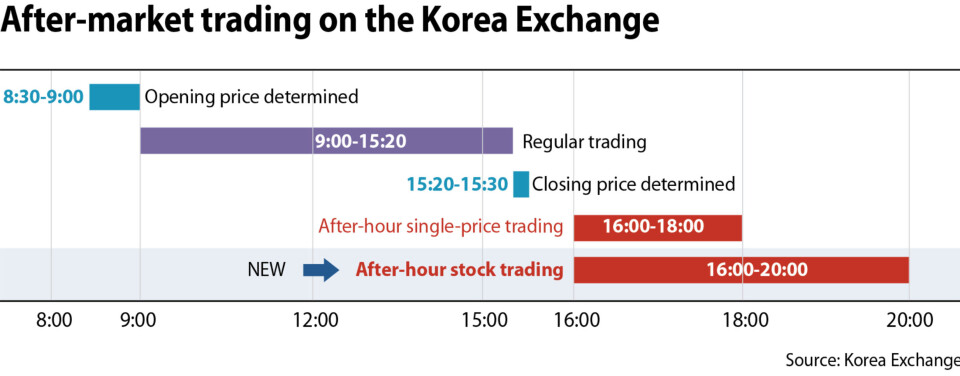
The Korea Exchange (KRX) will operate an after-market session from 4 p.m. to 8 p.m. starting Monday. The existing after-hours single-price trading session from 4 p.m. to 6 p.m. will be abolished.
Currently, orders are collected and executed every 10 minutes after the regular session closes at 3:30 p.m., but starting Monday, trades will be executed immediately when matching buy and sell prices are found until 8 p.m.
Under the single-price system, orders are collected every 10 minutes and executed at a single price. In the aftermarket session, trades will be executed in real time when buyers’ and sellers’ desired prices match, as they are during the regular session. The trading period will also be two hours longer than the existing after-hours session.
Most stocks listed on the Kospi and Kosdaq, excluding those on the Konex, as well as depositary receipts (DR), will be eligible for trading. Stocks that were not traded during the regular session that day will be excluded, along with stocks designated for administrative supervision, investment warnings, extremely low liquidity or liquidation trading.
A total of 38 securities firms are expected to participate, which represents 95.2 percent of the market by trading value. This means most investors will be able to access the aftermarket session through the securities firms they already use.
The allowable range of stock price movements will not be narrower just because trading takes place at night. As in the regular session, prices will be allowed to rise or fall by as much as 30 percent from the previous day’s closing price.
Market orders, in which investors do not specify a desired price, will not be permitted. Only limit orders, in which a price is specified in advance, including best-limit and priority-limit orders, will be allowed. Volatility interruption mechanisms will be applied to prevent sudden price swings, while short selling will be subject to the same regulations as during the regular session. Settlement will also take place two business days after the transaction, or T+2, as in the regular market.
Exchange-traded funds (ETF) and exchange-traded notes (ETN) will initially be excluded from the aftermarket session. The decision reflects concerns in the securities industry that nighttime trading could further amplify price fluctuations in ETFs and ETNs amid heightened stock market volatility.
“ETF investors also need to be able to respond when the underlying stocks move,” a KRX representative said. “We believe their eventual inclusion is only a matter of time from the standpoint of protecting investors’ rights, and we are gathering opinions from the industry.”
Competition with alternative trading system Nextrade (NXT), which already operates an after-market session until 8 p.m., is also set to intensify. NXT offers trading in around 600 stocks, primarily large-cap shares, while the KRX will offer most Kospi- and Kosdaq-listed stocks except those requiring special market oversight.
For stocks traded on both markets, investors will not need to choose between the KRX and NXT themselves. Securities firms will compare factors including prices and the likelihood of execution before routing orders to the market offering more favorable conditions for investors.
The disclosure submission window will remain unchanged from 7:30 a.m. to 6 p.m. Extending disclosure hours in line with trading hours could encourage more so-called owl disclosures, in which companies delay releasing unfavorable information until late in the day.
Trading in a stock may still be suspended after 6 p.m. if circumstances that could lead to delisting are identified, such as embezzlement, breach of trust or an adverse audit opinion.
“We plan to monitor moves by global exchanges to extend their trading hours and consider further extensions in stages,” a KRX spokesperson said.
BY PARK YU-MI [yoon.soyeon@joongang.co.kr]