
Prediction: A Stock Market Crash Is Coming. Here’s What Investors Should Do Based on Almost 70 Years’ Worth of History.

History suggests the stock market tends to trend higher over the long term, but it’s hard to ignore the growing chorus of risks right now. First of all, oil prices are soaring due to the ongoing geopolitical conflict in the Middle East, stoking an inflation spike that prompted the U.S. Federal Reserve to raise interest rates last week.
Second, artificial intelligence (AI) labs such as Anthropic, OpenAI, and xAI want to slow the pace of development to minimize any potential risks to humanity. This could spark a pullback in semiconductor stocks, which have propped up the broader market for the last few years.
All of this comes as the benchmark S&P 500 (^GSPC +1.49%) index trades at its second-highest valuation in history, behind only the peak of the dot-com internet bubble in the year 2000. This could leave the market extremely vulnerable to a crash, but several decades of history say there’s a way investors can capitalize.

Image source: Getty Images.
Rising interest rates are bad news for the stock market
We can speculate about the pace of AI development all day long, and while it’s absolutely a factor for semiconductor stocks like Nvidia and Micron Technology, interest rates might be a much bigger story for the stock market right now. After all, most tech giants are borrowing billions of dollars to fund their AI data center infrastructure projects, so higher interest costs could deal a crushing blow to their earnings.
The U.S. and Iran have been locked in a geopolitical conflict since late February. Iran has effectively closed the Strait of Hormuz, through which 25% of the world’s seaborne oil supply normally transits each day, wreaking havoc on global energy markets. West Texas Intermediate crude traded as high as $105 per barrel this month, significantly above its 2026 opening price of $57.
The average price of diesel has surpassed $6 per gallon across U.S. states, driving up the cost of every product that travels by truck across the country. The cost of other refined fuels for planes and ships has also skyrocketed, so every imported product is also bearing a higher price tag at the moment. This is stoking inflation, with the Consumer Price Index (CPI) climbing at an annualized rate of 3.4% in August, much higher than the Federal Reserve’s 2% target.
As a result, the Fed raised interest rates by 25 basis points at its September meeting last week, and it indicated that another hike could be on the horizon. The central bank’s last rate-hiking cycle spanned from March 2022 to August 2023, and it triggered a decline of more than 20% in the S&P 500, marking a technical bear market.
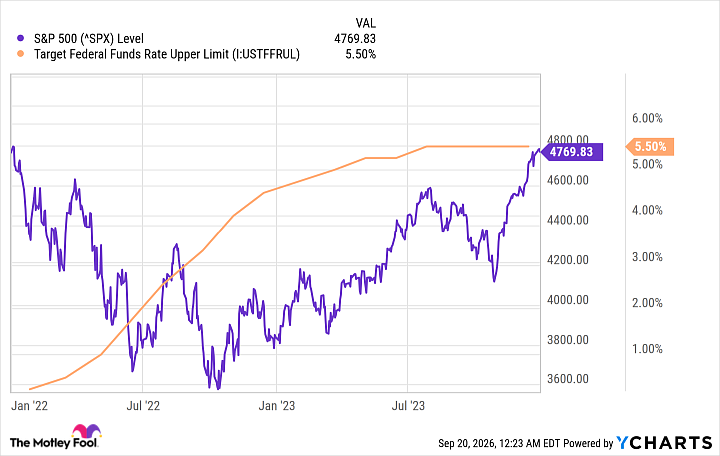
Rising rates are bad for stocks for a couple of reasons. First, they force consumers to allocate more of their household budgets to debt repayment, leaving them with less money for discretionary spending. This feeds through to corporate earnings, and earnings drive stock prices over the long term.
Second, companies usually don’t borrow as much when interest costs are high, which stifles their ability to invest in growth and expansion. This could be especially painful right now, given the sheer scale of AI infrastructure spending.
Here’s what investors should do if the stock market crashes
If interest rates continue to rise into 2027, I think a bear market in the S&P 500 will become a very real possibility, particularly because of its elevated valuation. The index currently sits at a Shiller Cyclically Adjusted Price-to-Earnings (CAPE) ratio of 40.9, which isn’t far below its all-time high of 44.2, set at the peak of the dot-com internet bubble in 2000.
But it’s important to remember that volatility is a normal part of the investing journey. It’s the price of admission for the opportunity to earn significant long-term returns. After all, according to Capital Group, the S&P 500 typically experiences a bear market decline of 20% or more every six years or so, and we’re already four years removed from the start of the last bear market, which kicked off in 2022.
So, what should investors do? The S&P 500 has delivered a compound annual return of 10.7% since it was established in 1957, even after accounting for every sell-off, correction, and bear market over the last 69 years. Therefore, even if an investor buys an S&P 500 index fund at the absolute peak of the current bull market, history suggests they will eventually come out ahead. They simply have to stay the course.
Today’s Change
(1.49%) +114.20
Index Level
7,764.70
Key Data Points
Day’s Range
7,691.19 – 7,779.22
52wk Range
6,316.91 – 7,816.70
In the past, selling stocks would have been the absolute worst move. In fact, buying during the scariest moments would have yielded spectacular results, and that will almost certainly be the case again during the next market crash.


