
Stock Market

Six reasons why America’s stock market rally could keep going


Donald Trump
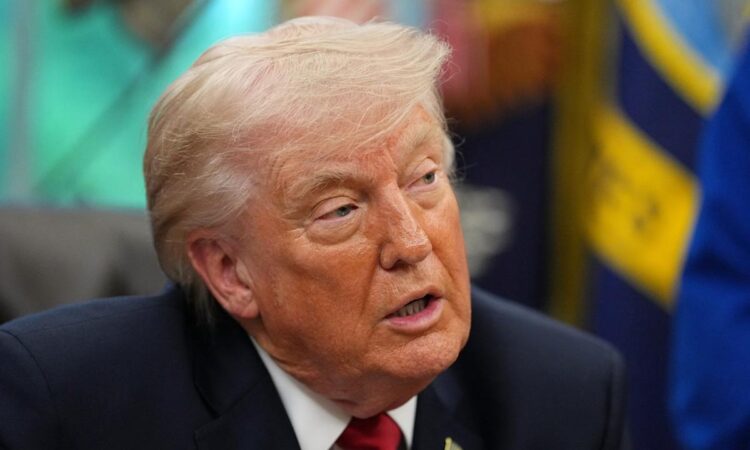
Donald Trump has expressed surprise at how well share prices have held up despite his war – AP Photo/Matt Rourke

“Sell in May and go away; buy again St Leger’s day,” is one of the oldest stock market sayings in the book. Does it work?

Analysis by Deutsche Bank suggests that, aggregated over the last 39 years, it has indeed paid to be out of the stock market during the summer months. But as is usually the case with such strategies, it depends crucially on precisely when you sell, and when you buy back in.

If you had invested in the strategy since 1987, it would have theoretically outperformed a “buy and hold” approach quite significantly.

But selling at the end of May and buying at the end of September delivered a markedly better return than selling at the beginning of May and buying at the start of September.

In any case, the whole thing is something of a statistical illusion. In 25 of the 39 years since 1987, the strategy underperformed a straight buy-and-hold approach. Its success over time has depended crucially on strong equity market underperformance in just three of the intervening years – 1998, 2001 and 2002. Without these years, it would have underperformed a basic buy-and-hold approach.

All of this is a long-winded way of asking whether this is one of the years in which the saying might come into its own. You might think it is, with stock markets – particularly US-based indices – showing remarkable resilience in the face of renewed war in the Middle East and an accompanying energy price crisis that threatens to plunge the global economy into recession.

For many observers, this looks like complacency verging on the delusional. Even Donald Trump, who regards stock market performance as a proxy for his own success, has expressed surprise at the staying power of share prices, saying he had expected at least a 20pc correction.

The list of negatives is indeed daunting – renewed war in the Middle East, stalemate in the already four-year-old war in Ukraine, Nato under threat as the US pulls its troops out of Germany, spiking energy prices and surging inflation, fiscally broken governments with crushing debts, US consumer confidence at its lowest level since records began and looming supply shortages across a whole range of products vital for connectivity and economic activity… I could go on.

And yet the S&P 500 hit another all-time high last week. It is 5pc up for the year to date. Non-US markets have fared less well, but even the UK’s FTSE 100 is only 6pc off the high it achieved on the eve of the war. It’s pretty similar for the STOXX Europe 600 – a broadly based measure of the performance of European equities – which is just 3.5pc off its pre-conflict high.

As a cub financial journalist, I once asked an old-timer why the stock market was going up. “More buyers than sellers,” he replied. This seemed a deliberately fatuous answer at the time, but in fact it contains much wisdom, for stocks are subject to so many, often conflicting, influences that it is never possible to define exactly why, in aggregate, they are going either up or down beyond the basic law of supply and demand.

There are, however, at least six standout reasons why buyers of the US stock markets might continue to outnumber the sellers.

First and foremost is excitement about prospects for AI and other emerging technologies, where US companies enjoy a strong lead.

This is often described as a “bubble”, but if that’s what it is, then it shows few signs of bursting. Extrapolating from recent announcements, the major US hyperscalers are set to spend more than $700bn (£517bn) on enabling infrastructure this year, substantially more than last year and more than double the year before.

The bubble aspect of this investment is that it is not yet clear whether or how it is to be monetised in a way that justifies the staggering sums being spent. What’s more, not everyone can be a winner. These very high levels of investment are being driven by a race between multiple players for first-mover advantage.

All the same, for the moment, it’s adding significantly to overall economic growth. Collectively worth around 2pc of total US GDP, hyperscaler capital spending provides a powerful counter to the impact on consumer sentiment of rising gas prices.

This is a “picks and shovels trade” as much as a mania – the idea that those who make the most money from any gold rush are not the prospectors themselves, but the providers of essential enabling tools, infrastructure and services.

Renewed interest in the so-called “Magnificent Seven”, the big tech companies at the forefront of the AI revolution, has further powered the latest surge in stock prices.

Collectively, they account for an oversized chunk of total stock market value and are far and away the dominant weighting in the exchange-traded, or index-tracking funds, where investors increasingly put their money.

0605 The Magnificent Seven

By its very nature, passive investing of this type increases distortionary, herd-like behaviour in markets, resulting in momentum-driven volatility and undue concentration of funds in a small number of mega-stocks.

The upshot is a situation in which the US, with its deep and liquid capital markets, accounts for around 60pc of the total global value of traded equities even though the country is less than 25pc of global GDP. Go figure.

The third factor supporting US stock prices is the belief that energy self-sufficiency makes the US relatively immune to supply shortages stemming from the closure of the Strait of Hormuz. Unlike much of Europe, for which the current closure is an unmitigated disaster, the US gains some upside from higher oil prices to offset the negative impact on consumer spending.

Fourth, corporate profits are booming and are expected to keep growing, at least for a time. And if they do, valuations don’t look as stretched as they seem.

Lack of alternatives provides a fifth reason for buoyant share prices. Where else do you put your money? With rising inflation, not in government debt, that’s for sure. Cash, likewise, provides little protection in a more inflationary world.

Finally, there is the belief that the war in the Middle East will be relatively short-lived, allowing trade through the Strait of Hormuz to resume. Besides, say the optimists, the world economy has shown itself to be very good at adapting to negative supply shocks of this type, as witnessed by Russia’s invasion of Ukraine and, indeed, Trump’s “liberation day” tariff war. Investors who sold into these events will be bitterly regretting it today.

Bottom line: the sell-in-May trade may still not be the way to bet, regardless of current events. But it depends vitally on how things pan out. If Trump remains unwilling to compromise, then it may be a different story altogether.

Try full access to The Telegraph free today. Unlock their award-winning website and essential news app, plus useful tools and expert guides for your money, health and holidays.


Source link

Leave a Response