
SOFI Stock Got Hit With Price-Target Cuts After Q2 Earnings, But One Contrarian Says Market Is Missing Bigger Story

Shay Boloor, chief market strategist at Futrum Equities, said in a post on X that the market is overpricing credit risk and underpricing the platform even as its expanding platform turns each new member into multiple financial relationships.
- “SoFi now has twice as many products as members, with existing users driving 51% of new product openings, proving the ‘everything app’ flywheel is accelerating,” he said.
- Multiple Wall Street analysts have recently lowered the price target on the fintech firm after its Q2 results, with Mizuho being the latest one to lower the price target on the company to $22 from $29.
- SoFi reported record Q2 revenue of $1.21 billion, a 43% increase from a year earlier, while diluted earnings per share came in at $0.12.
Shares of SoFi Technologies Inc. (SOFI) have lost about 38% of their value since the start of the year, slumping more than 11% in July alone.
Following its second-quarter (Q2) earnings results last week, the stock tumbled 9% at close after keeping its full-year profit (EBITDA) guidance flat despite raising revenue forecasts.
However, Shay Boloor, chief market strategist at Futrum Equities, said in a post on X on Sunday that “the market is overpricing credit risk and underpricing the platform” of SoFi Technologies.
SoFI: The Contrarian View
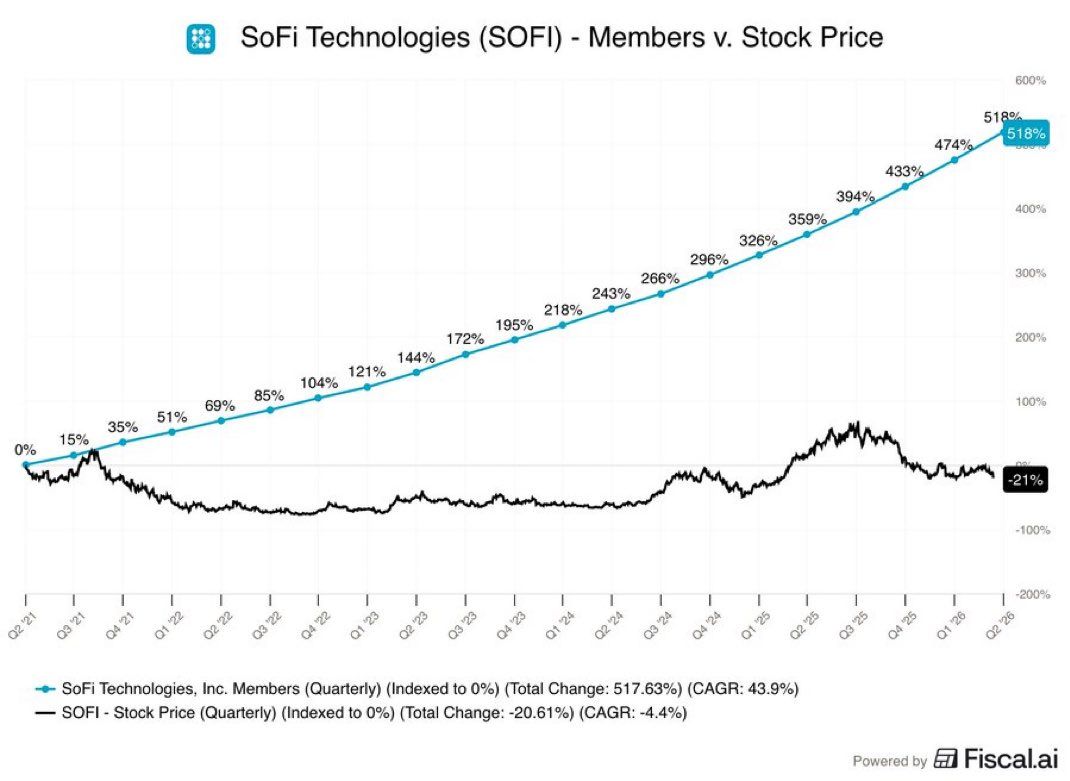
Boloor noted that in the last five years, SoFi members have grown 518% while the stock is down 21%. As per the strategist, the market is penalizing the stock even as its expanding platform turns each new member into multiple financial relationships.
“SoFi now has twice as many products as members with existing users driving 51% of new product openings proving the ‘everything app’ flywheel is accelerating,” he said.
SOFI Stock: What’s Wall Street Saying?
Multiple Wall Street analysts have recently lowered the price target on the fintech firm after its Q2 results, with Mizuho being the latest one to lower the price target on the company to $22 from $29, while keeping an ‘Outperform’ rating on the shares on Friday.
According to The Fly, the analyst noted that SOFI stock dropped post-earnings despite raising its fiscal year sales target as investors worried about a lack of upside to EBITDA and a lower Common Equity Tier 1 (CET1) ratio, a measure of a bank’s financial strength based on the amount of high-quality capital it holds. The firm added, however, that SoFi’s incremental margins remain strong at 31%, so no upside to margin reflects a “deliberate investment in new, high-potential lines.”
Morgan Stanley also lowered the price target on SoFi last week to $15 from $16 and maintained an ‘Underweight’ rating on the shares, saying that while the Q2 revenue beat by 7%, growth is becoming more capital intensive.
BofA analyst Mihir Bhatia lowered the price target on SoFi to $16 from $17 and kept an ‘Underperform’ rating on the shares, as per The Fly.
Needham lowered the firm’s price target on SoFi Technologies to $24 from $25 and maintained a ‘Buy’ rating on the shares, citing muted loan platform volumes even as the company continues to put more loans on its own balance sheet to optimize earnings and capital ratios. Goldman Sachs and Wells Fargo also lowered their targets on SoFi.
SOFI Q2 Earnings Snapshot
SoFi reported record Q2 revenue of $1.21 billion, a 43% increase from a year earlier, while diluted earnings per share came in at $0.12.
SoFi raised its revenue guidance for the full year to $4.75 billion to $4.85 billion, indicating growth of 32% to 35% year-over-year. However, the company maintained adjusted earnings before interest, tax, depreciation, and amortization (EBITDA forecast of $1.6 billion, adjusted net income of about $825 million, and adjusted EPS of $0.60 for 2026.
Management also emphasized that its expectation for total member growth of at least 30% year over year remains.
SOFI Stock: Retail Stance
On Stocktwits, retail sentiment for SOFI was ‘extremely bullish’ at the time of writing amid ‘high’ message volumes.
One user said, “$SOFI member growth is still moving fast, and the banking side is finally starting to show real leverage. The market still sees a bank, but the bigger picture is a growing financial platform.”
Another user echoed the sentiment, saying, “$SOFI The business banking side is getting more interesting. Digital asset firms, trading platforms, and fintech networks are already tapping into the infrastructure. If this segment keeps scaling, it could become a much bigger revenue driver over time. The market may still be underestimating this part of the story.”
For updates and corrections, email newsroom[at]stocktwits[dot]com.
Also Read: SOFI Vs HOOD: Which Fintech Stock Came Out On Top After Q2 Earnings?



