
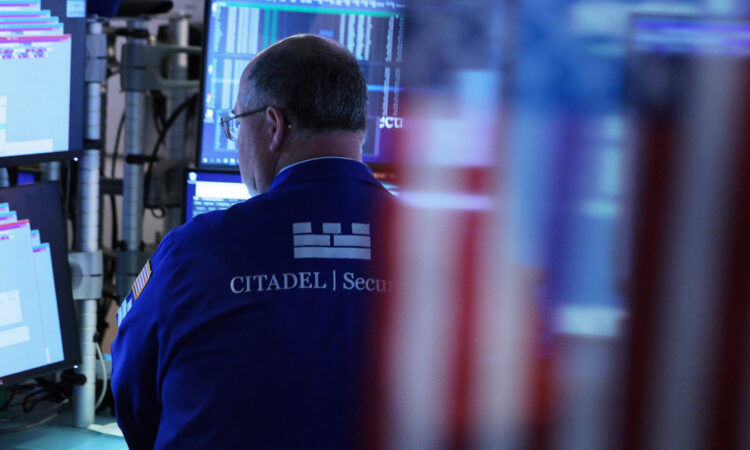
The S&P 500 hit a new all-time high Wednesday, a remarkable turnaround for the broad-based stock index while the war with Iran continues and rising energy costs threaten global growth prospects.
Subscribe to read this story ad-free
Get unlimited access to ad-free articles and exclusive content.

The S&P 500 closed higher by 0.8% pushing the benchmark past its previous record high of 7,002.28, which it had notched Jan. 28. The index closed at 7,022.95.
U.S. equity markets have been on a roller coaster since the start of the year. After its January high, the S&P 500 plunged 9.8% to a low of 6,316.91 on March 30, driven by the U.S.-Israel war on Iran and the soaring price of oil.
But in the two weeks since, markets appear to have adjusted to the constant uncertainty of the war.
“As far as the stock market is concerned, the war is over until further notice,” Ed Yardeni, president of Yardeni Research, said.
“It has also been another momentum-led rebound, similar to last year’s explosive rally that started on April 9, when President Donald Trump postponed his Liberation Day tariffs,” Yardeni said.
The momentum Yardeni pointed to is a sharp rise in the shares of the biggest tech companies. Since the S&P’s low on March 30, a fund that measures only the “Magnificent 7” mega-cap tech stocks is up nearly 18%. A fund measuring the S&P 500 absent those seven companies is up about 8%.
The “Magnificent 7” companies are Apple, Microsoft, Alphabet, Amazon, Nvidia, Meta and Tesla.
The Nasdaq Composite, which contains many of the largest tech firms, also rose to a new record high Wednesday, surpassing the last all-time high it set on Oct. 29.
Trump has extended his own war-related deadlines several times, paused some of the heaviest bombing, and most recently sent officials to Pakistan for talks with the Iranian regime. While the talks did not result in a deal, the war remains in the midst of a ceasefire that doesn’t expire until next Wednesday.

FORSUBSCRIBERS

What to do with your tax refund this year
02:05
While much of the world has been focused on the fighting in the Middle East, traders have been looking elsewhere, eager for positive signals about the U.S. economy and a potential end to the war.
Wednesday’s rally was partly a reaction to comments Trump made Tuesday night about the war. “I think it’s close to over,” he said on the Fox Business Network.
In the same interview, however, Trump also said that “we’re not finished” with the war yet.
The rally has also defied conventional wisdom about the impact of energy prices on stocks. Since the start of year, U.S. crude oil has risen by nearly 60%, while international Brent crude oil has jumped about 55%.
As a result, prices have skyrocketed at the gas pump. As of Wednesday morning, the average price of gas per gallon nationwide was $4.10, up more than 37% since the war started.
Economists, meanwhile, continue to warn that high fuel prices will slow the global economy this year.
On Tuesday, the International Monetary Fund cut its global growth forecast to 3.1% in 2026 from its prior estimate of 3.3%. In 2025, the global economy expanded by 3.4%.
The IMF also raised its inflation forecast for 2026 to 4.4% from its prior 4.1% projection.
Yet, over the 10 trading sessions leading up to Wednesday, the S&P 500 rose 9.8%.
“For reference, that’s now even faster than the bounceback after Liberation Day last year, and we haven’t seen a run of gains that quick over 10 sessions since the post-Covid bounceback in April 2020,” Deutsche Bank Research macro strategist Henry Allen wrote in a note Wednesday.
Amid all the optimism, some experts think the markets could be getting ahead of themselves.
“Markets are increasingly pre-empting a positive outcome as the U.S. and Iran prepare for a new round of talks,” analysts at ING said overnight. “We still think caution is warranted.”
A new round of in-person talks between the United States and Iran could be held as early as this week, two people familiar with the ongoing negotiations told NBC News.


