
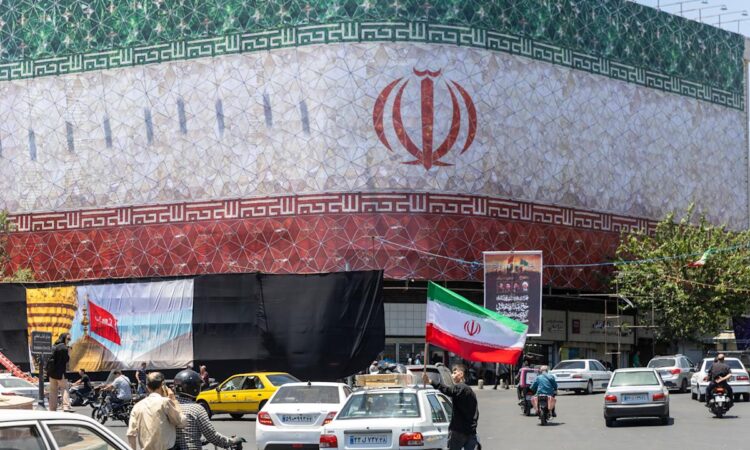
US stocks climbed on Thursday, with tech stocks pacing gains as investors digested the signing of the interim US-Iran peace deal and the latest Federal Reserve decision on interest rates.
The tech-heavy Nasdaq Composite (^IXIC) surged 1.5%, while the S&P 500 (^GSPC) moved up 1% and the Dow Jones Industrial Average (^DJI) gained 0.7%, coming off sharp closing losses for Wall Street stocks.
President Trump and his Iranian counterpart on Wednesday signed the memo outlining their countries’ peace agreement, a move previously expected for Friday. The deal went into effect on Thursday, potentially speeding up the timeline for reopening the Strait of Hormuz to commercial traffic and lifting sanctions on Iranian oil. Negotiations on more protracted issues, including Tehran’s nuclear program, are expected to take place over the next 60 days.
Brent crude futures (BZ=F) sank as much as 3% after the news, chipping away at most of its war-time gains. But oil prices pared losses somewhat amid the first crossings of the strait, with Brent at around $78 a barrel and West Texas Intermediate (CL=F) just above $74.
Meanwhile, investors eyed the chances that rates will stay higher for longer after more Fed officials signaled a hike is on the table for later this year, after standing pat on policy in their decision on Wednesday.
The central bank’s hawkish tilt comes as inflation has remained elevated and the job market steady amid conflict with Iran. Data from the Labor Department on Thursday showed initial jobless claims were slightly hotter than estimates but cooled over the week prior.
Thursday will be the last day of trading for Wall Street stock markets, which will close on Friday to observe the Juneteenth holiday.
LIVE 7 updates
-
US stocks advance into the green at the opening bell
Tech led a swing in US stocks into the green on Thursday as investors digested news of a US-Iran deal signing in France and the Fed’s hawkish tilt toward rate hikes.
The tech-heavy Nasdaq Composite (^IXIC) led gains to pick up 1%, while the S&P 500 (^GSPC) gained 0.9%. The Dow Jones Industrial Average (^DJI) moved up 0.7%.
Oil prices sank on Thursday after President Trump and his Iranian counterpart on Wednesday signed a memorandum of understanding overnight, accelerating the previously planned Friday timing. Brent crude futures (BZ=F) fell to trade just barely above $78 per barrel, while US WTI crude (CL=F) held at $74.
Labor Department data released on Thursday showed initial jobless claims cooled week-on-week, in a positive sign for the labor market. In another item of positive news for Americans, the national average gasoline pump prices fell $4 per gallon, per AAA.
-
Initial jobless claims cool from last week
Initial jobless claims fell 4,000 to 226,000 in the week ended June 13, according to data released by the Department of Labor on Thursday. That was slightly above expectations but a cooling from the previous week.
New claims for unemployment benefits were expected to be marginally lower at 225,000, per Bloomberg consensus estimates. Last week’s tally was revised to 230,000.
The four-week moving average of initial claims rose to 223,250 from 219,250 the week prior.
Continuing claims, which track the unemployed population still seeking work, rose to 1.810 million in the week ended June 6, from the prior week’s revised count of 1.786 million.
Economists had been looking for 1.789 million continuing claims.
-
SpaceX, nuclear, and the return of the return of the 2020 thematic ETF boom
The 2020 playbook is back on Wall Street, but with a different cast, writes Yahoo Finance’s Jared Blikre in today’s Chart of the Day.
He writes:
Flows into thematic ETFs — funds built around big investing ideas like space, nuclear power, quantum computing, robotics, and crypto infrastructure — are surging in a way Strategas ETF Research compares to the ARK-era boom.
“The environment and leadership are different, but flows to Thematic ETFs are accelerating akin to 2020,” Strategas ETF Research’s Todd Sohn wrote in a recent note.

Strategas ETF Research There are a few critical differences.
The last boom was led by stay-at-home stocks, profitless tech, and Cathie Wood’s ARK complex. This one is being pulled toward harder-tech trades, where the story is less about apps and software and more about rockets, reactors, chips, computing power, and energy demand.
SpaceX (SPCX) is the spark.
-
BOE votes to hold target interest rate steady at 3.75% in 7-2 vote
The Bank of England voted to hold its benchmark lending rate unchanged at 3.75% in a split 7-2 vote, citing potential easing in Iran war price pressures and a weakened UK labor market.
“The risk of material second-round effects in price and wage-setting, against which policy needs to lean, is greater the longer higher energy prices persist,” the Monetary Policy Committee wrote in a statement. “But the labor market continues to loosen, and signs of a weakening economy could contain inflationary pressures.”
The UK central bank’s decision comes after similar rate holds from the Federal Reserve on Wednesday and the Reserve Bank of Australia on Tuesday. The European Central Bank last week and Bank of Japan on Tuesday both issued quarter-point rate hikes, looking to curb inflation stoked by the Middle East conflict.
Echoing the Federal Reserve’s Kevin Warsh, the BOE’s Monetary Policy Committee stated Thursday that “monetary policy cannot affect global energy prices.” It als said: “Our job is to make sure that higher inflation does not persist and have long-lasting effects on the economy.”
Warsh, in his first press conference as Fed chairman on Wednesday, said the central bank “cannot have a very significant effect on particular prices.” Instead, it’s the Fed’s job to “make sure that those changes in oil or beef or eggs or milk don’t broaden in the economy,”
-
-
-


