
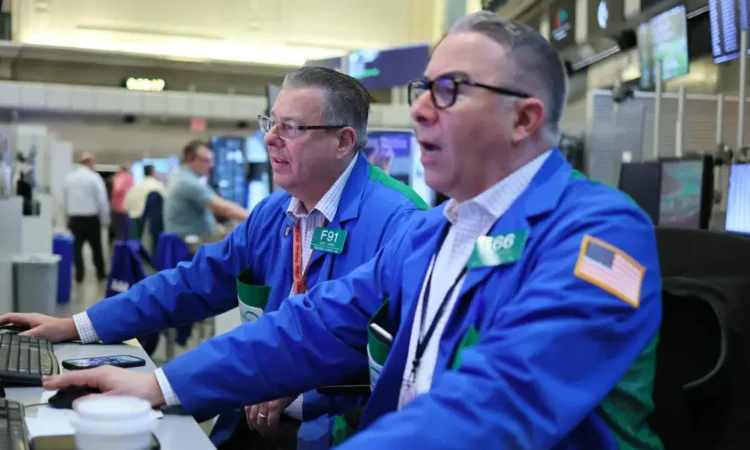
The stock market was in party mode on Friday after Iran announced the Strait of Hormuz was open again.
The development came as a massive relief to investors who had been fretting that a prolonged obstruction of energy flows could keep oil prices elevated and stoke a new bout of inflation.
Now, things are looking up for the economy again, and Wall Street pros think that a lower risk of inflation clears the way for Federal Reserve rate cuts this year.
“With the Strait of Hormuz now reopening, there’s renewed optimism that broader economic momentum can re‑emerge,” said Charles Rinehart, chief investment officer at Johnson Investment Counsel.
But besides the broader stock market, where are the best places to put your money to benefit from an economic resurgence if the reopening of the Strait holds? We asked a few Wall Street pros for their highest-conviction calls. Here are the three are
Small-caps
Mike Reynolds, Glenmede’s VP of investment strategy, said small-caps are primed to jump for a few reasons.
One is that smaller stocks are cyclical, meaning they tend to move with economic growth trends.
Another is that the Fed is more likely to slash rates now, and smaller firms are more sensitive to borrowing costs.
Third, they should benefit from the One Big Beautiful Bill Act by being able to deduct research and development costs from their tax liability more immediately.
“We think all signs point toward small caps having a really banner year in 2026,” he said.
Funds that offer exposure to this trade include the Vanguard Small-Cap ETF (VB), the iShares Core S&P Small-Cap ETF (IJR), and the Dimensional US Small Cap ETF (DFAS).
Emerging markets
When the Strait of Hormuz closed in March, emerging market stocks were among the hardest hit by the conflict, particularly stocks in Asia. That’s because their economies are heavily reliant on oil coming out of the Middle East.
With the Strait reopened, Asian EM stocks should be primed to pop, according to Stephen Parker, JPMorgan Private Bank’s co-head of Global Investment Strategy.
He told Business Insider that Asian EM stocks tied to the AI trade still have strong fundamentals, and have been thrown out with the bathwater during the recent sell-off.
“The fundamental story in Asia, specifically tied to the tech sector, the supply chain related to AI hardware story in places like Korea, Taiwan, and China creates a really interesting opportunity, particularly when you think about valuations which still look heavily discounted compared to the US,” Parker said.
Some funds that offer exposure to this trade include iShares MSCI Emerging Markets Asia ETF (EEMA) and the Schwab Emerging Markets Equity ETF (SCHE).
The Magnificent Seven
Lance Roberts, the chief strategist at RIA Advisors, which oversees around $2 billion, said that it’s a perfect time to buy the Magnificent Seven stocks—Nvidia, Meta, Microsoft, Amazon, Apple, Alphabet, and Tesla.
Valuations for the group of mega-cap tech titans, which investors have tended to pay a premium for, have fallen in recent weeks to levels on par with the rest of the market — the cheapest they’ve been since 2015.
“I think the Mag Seven are back, because they have the most earnings growth and they had a big reduction in valuation,” Roberts said.
Funds that offer exposure to the Magnificent Seven stocks include the Roundhill Magnificent Seven ETF (MAGS) and the Vanguard Mega Cap Growth ETF (MGK).


