
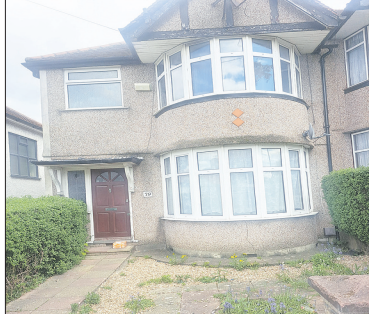
WALE ELEGBEDE reports from London, United Kingdom, on the legal dispute surrounding a modest North London property linked to the late former Minister of the Federal Capital Territory (FCT), General Jeremiah Useni, and the tribunal proceedings that rejected an application to transfer ownership of the house to Chief Mike Ozekhome (SAN).
How it began
The dispute began with an application filed on August 17, 2021, before His Majesty’s Land Registry in the United Kingdom for the transfer of ownership of a property located at 79 Randall Avenue, North London, to senior lawyer and human rights activist, Chief Mike Ozekhome.
The application was filed through a TR1 transfer form by one Mr. Tali Shani, who stated that the transfer was “not for money or anything that has a monetary value” but was intended as a “gift” and “out of gratitude” for legal services allegedly rendered by Ozekhome.
However, the transfer was not approved after objections were raised by solicitors representing another claimant identified as “Ms. Tali Shani,” who challenged the application and disputed the ownership claims.
The conflicting claims led to extensive proceedings before the UK First-tier Property Chamber Tribunal, where issues relating to identity, ownership and documentation became central to the case.
After more than two years of proceedings, Judge Ewan Paton ruled that neither “Ms. Tali Shani” nor Chief Ozekhome established a legal right to ownership of the property.
The tribunal ultimately found that the property formed part of the estate of the late General Jeremiah Useni, the retired military officer and former minister, who died in January while the proceedings were ongoing.
A quiet London property at the centre of controversy
The property at 79 Randall Avenue, Neasden, London NW2 7SX, is a modest semi-detached house situated within the Borough of Brent.
When The Nation visited the address, the brick-built structure appeared ordinary and largely unremarkable from the outside, although delivery packages at the entrance suggested the house remained occupied.
The property is located on a quiet residential street lined with similar houses built mainly between 1912 and 1935. The neighbourhood consists largely of families, renters and long-term homeowners.
According to details presented during the proceedings, the property was purchased in 1993 for £110,000 under the name “Tali Shani.” It is now estimated to be worth significantly more following renovations.
The tribunal heard conflicting accounts concerning the ownership structure of the property and the identity of the individuals linked to the name “Tali Shani.”
The tribunal proceedings
During the proceedings, a man identifying himself as “Mr. Tali Shani” supported the application to transfer the property to Ozekhome and claimed that he had authorised General Useni to manage the property on his behalf.
At the same time, solicitors representing “Ms. Tali Shani” argued that she was the true owner of the property.
The proceedings became complicated after “Ms. Tali Shani” failed to appear before the tribunal despite several adjournments.
A solicitor, Kingsley Efemuai, informed the tribunal at different stages that she had been hospitalised and later claimed that she had died.
Her alleged son, Ayodele Damola, subsequently sought to represent her interests and submitted documents relating to her reported death.
Another witness, Anukwe Marcel Obasi, claimed to be related to “Ms. Tali Shani” and also testified before the tribunal.
However, the tribunal noted inconsistencies in portions of the evidence presented during the proceedings.
Before his death, General Useni appeared before the tribunal via video link and stated that he purchased the property for his family. He denied claims that the property had been transferred away from him.
Chief Ozekhome, who represented himself during part of the proceedings, maintained that the property had been validly transferred to him in 2021 by “Mr. Tali Shani.”
The tribunal, however, concluded that the evidence presented did not sufficiently establish the transfer claim.
Judge Paton held that “Ms. Tali Shani” was not established as a genuine identity based on the evidence before the tribunal and that several supporting documents were unreliable.
The judge also found that although “Mr. Tali Shani” existed, the evidence presented did not support the claim that he purchased the property in 1993.
The tribunal consequently directed the Land Registry to reject the transfer application and held that the property formed part of General Useni’s estate.
The ruling stated that there was no finding that Ozekhome attempted to unlawfully take the property.
Questions over identity records
The proceedings also featured evidence from Nigerian agencies concerning identity-related documentation linked to the disputed claims.
Festus Esangbedo, Head of Legal, Regulatory and Compliance Services at the National Identity Management Commission (NIMC), testified that a National Identification Number (NIN) slip presented in the name “Tali Shani” was not authorised by the commission.
According to him, internal investigations revealed irregularities relating to the registration process and the supporting documentation.
He stated that the registration process had been suspended and later deleted from the commission’s database after further review.
Esangbedo also testified that the registration was carried out remotely and that certain required biometric procedures were allegedly not properly completed.
A police officer, Ibrahim Sini, attached to the Force Intelligence Department, also testified regarding investigations into telephone records and addresses linked to the disputed identity.
According to the testimony, investigators who visited an address associated with the identity were unable to verify it.
The evidence formed part of the wider issues considered by the tribunal in determining the credibility of the competing ownership claims.
Relationship between Ozekhome and Useni
The tribunal proceedings also drew attention to the longstanding relationship between General Useni and Chief Ozekhome.
Both men were delegates at the 2014 National Conference convened by former President Goodluck Jonathan.
Ozekhome also acted as legal counsel for Useni in election-related litigation following Useni’s governorship contest in Plateau State under the Peoples Democratic Party (PDP).
Following Useni’s death in 2025, Ozekhome publicly described himself as the late general’s “friend and lawyer” in a tribute.
UK property transfer process
The transfer of ownership of property in the United Kingdom is conducted through a legal process known as conveyancing.
The process generally involves solicitors or licensed conveyancers who prepare transfer documents, conduct legal checks and ensure compliance with regulatory requirements.
Ownership transfers are usually completed through a TR1 form, which sets out details of the property and the parties involved.
After completion, the transfer must be registered with His Majesty’s Land Registry before ownership becomes legally recognised.
Where disputes arise, the Land Registry may suspend registration pending judicial determination.
Criminal proceedings in Nigeria
Following developments arising from the UK proceedings, the Federal Government filed criminal charges before the FCT High Court in Abuja involving issues connected to documents allegedly linked to the property dispute.
According to the charge, allegations were made concerning the creation and use of documents connected with the name “Tali Shani.”
The charges remain subject to judicial determination.
In a statement reportedly made to investigators, Ozekhome acknowledged awareness of the UK tribunal judgment and stated that issues relating to the ownership dispute had already been addressed during the UK proceedings.
Recovery efforts by Nigerian authorities
The Code of Conduct Bureau (CCB) has also initiated steps aimed at recovering the property following orders issued by the Federal High Court in Abuja relating to forfeiture proceedings.
According to the Bureau, the Attorney-General of the Federation has been approached regarding Mutual Legal Assistance procedures between Nigeria and the United Kingdom to facilitate enforcement of Nigerian court orders.
Officials described the matter as a significant development in international asset recovery cooperation.
Wider concerns over illicit financial flows
The dispute surrounding 79 Randall Avenue has also renewed broader discussions about illicit financial flows, overseas property ownership and the use of proxy identities in property transactions involving politically exposed persons.
Anti-corruption experts and transparency advocates have repeatedly called for stronger international cooperation, tighter verification systems and improved oversight mechanisms to prevent abuse of property and financial systems across jurisdictions.
Analysts say the case highlights the importance of robust identity verification procedures, institutional accountability and cooperation between regulatory agencies in tackling complex cross-border disputes.
For residents of Randall Avenue, the property may remain an otherwise ordinary suburban house. Yet the legal proceedings surrounding it have transformed the address into a symbol of the complicated intersection between law, identity, financial regulation and international property ownership.


