
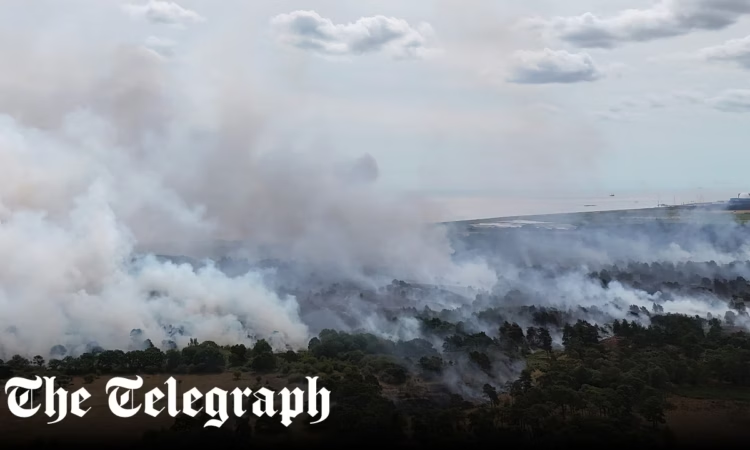
Sandy McCook, the local community council chairman, says: “It has been absolutely traumatic. We sit on the edge of Britain’s largest natural forest. A lot of these trees were centuries old and they’re gone.
“I was born and brought up here. I know the forest like the back of my hand, and when you’re seeing it be destroyed in that way, it just breaks your heart,” says McCook.
“The country is totally and utterly ill-prepared.”
The risk of forest fires, according to woodland managers, is not taken seriously enough.
“We’re just not prepared for it,” Nick Adams, the co-founder of Kilmaha Forestry, argues.
Around 10pc of England is covered in forestry, with 19pc in Scotland and 15pc in Wales.
Adams claims that forestry is no longer actively managed as it was when he was young.
“Thinning” is a process where some trees are removed, which reduces overcrowding and allows the remaining trees more access to light and nutrients.
If this doesn’t happen, some trees fall, which creates fuel load – more combustible material that increases the risk of fire.
Adams says: “If trees are shaded out, they die off and they tend to be quite small, so that’s your kindling. That’s what gets the fire going. Once it gets up into the canopy, you’ll never stop it.”
Thinning was standard practice when there were more workers on farms and estates who would take the wood to process it into pulp. It is now considered hardly worth the bother.
‘You need to do the boring stuff’
Adams also claims that fire breaks were previously cut into woodland to a greater extent than they are now.
In part, he thinks that it is now in vogue to just leave woodland alone and essentially allow it to “rewild”. There are plenty of cheerleaders for this approach, such as Chris Packham and Ben Goldsmith.
“They don’t ask people like me who work the ground and know what we’re doing,” Adams warns. “I’ve been in the woods since I was a child helping my dad.”
A lot of fire-prevention in woodland is “boring”, Adams admits, but essential nonetheless.
“There’s more interest”, he says, “in headline acts like beavers and megafauna, but to prevent fire you need to do the boring stuff: the weeding, going in and removing dead trees and the thinning.”
Adams is also concerned about stipulations on what happens to brash and deadwood after forestry work is carried out. When he was young, foresters tended to burn the brash, but it must now be left. This creates an ideal habitat for hedgehogs and wild pheasants, but it also forms ribbons of tinder-like fuel.
In Langdale forest, North Yorkshire, a fire burned for 40 days last year. It’s thought to have started because of somebody cooking over a naked flame that got out of control. The Government paid £3.2m for repairs to footpaths and conservation efforts.
Adams says that in the forestry community it’s estimated that £1m worth of commercial timber was destroyed.
That £3.2m figure is just £100,000 less than cuts that the North Yorkshire Fire and Rescue has been hit with more than the past three years.
This is a similar tale across the country. The National Fire Chiefs Council warned that the service’s funding had dropped by £1bn in the past decade, while call-outs had increased by a fifth.
The National Farmers Union (NFU) told The Telegraph that it had called on the Government for the first time this week to devise a national strategy for dealing with the increase in wildfires.
Paul Tompkins, the deputy president of the NFU, said: “Wildfires breaking out across parts of the UK like the one in Suffolk are devastating for those rural communities affected.”


