
The UK housing market is finally giving buyers more choice and negotiating power, but this is being tested by rising mortgage rates.
Loan availability has recovered from the sharp contraction seen in the spring, while a growing supply of homes is putting pressure on sellers to price realistically. Affordability, however, remains stretched, leaving buyers needing to borrow heavily with little room for comfort.
For investors, the picture is increasingly regional: the north and Scotland are holding up better, while London and the south remain under greater pressure. At the same time, subdued house-price growth is gradually improving affordability, but mortgage-rate volatility and high rents continue to weigh on activity.
Has the mortgage market recovered?
Sort of. The number of mortgage products available has recovered to its pre-war level of roughly 7,600, according to finance website Moneyfacts. This is up from a trough level of about 5,900 in March, when lenders were having to rapidly reprice or pull products in response to escalating debt costs.
Adam French, head of consumer finance at Moneyfacts, says the increase reflects renewed competition between lenders after the sharp withdrawals seen earlier this year.
“The mortgage market is pretty competitive, with lenders fighting for new business and smaller lenders and mutuals continuing to innovate,” he says.
The recovery has also extended to higher loan-to-value (LTV) mortgages, with more low-deposit products giving buyers greater choice. Longer mortgage terms are also becoming more common, while changes to affordability rules have allowed some lenders to increase the amount they will lend.

What about mortgage rates?
While this is all positive, the cost of borrowing is still prohibitive. As of 11 August, the average two-year fixed rate was 5.52 per cent for products requiring a 25 per cent deposit (75 per cent LTV), rising to 6.15 per cent for those requiring a 5 per cent one (95 per cent LTV). The smaller the deposit, the higher the average monthly mortgage payment tends to be.
Mortgage rates have ticked up since July as renewed uncertainty in the Middle East has cast fresh doubt on the trajectory of inflation and interest rates.
Opinions differ over where rates will go from here. French warns borrowers should expect continued volatility, while David Fell, lead analyst at Hamptons, takes a more positive view of the outlook.
“Our view is that markets have tended to overestimate the inflationary impact,” Fell says. He believes this leaves room for mortgage pricing to fall over the coming months, with the Bank of England’s next move more likely to be down than up.
But even if borrowing costs ease, many first-time buyers are still having to find other ways to make the numbers work. Higher borrowing costs have encouraged buyers to put down larger deposits and take out longer mortgage terms, according to Emily Williams, director of residential research at Savills. The average term for a first-time buyer is now more than 30 years.
Family support has also become increasingly important: Savills research found that more than half of first-time buyers received financial help from family in 2025, who contributed around £8.3bn towards purchases.

What’s happening to house prices?
House prices are under pressure, but the national picture is far from uniform. The average asking price of a newly listed property fell by 2 per cent this month to £365,000, according to Rightmove, a sharper decline than is typical for August.
There are also more homes available for sale at this time of year than in any August since 2014, giving buyers more choice and increasing competition between sellers.
Rightmove data shows average house prices are now 1 per cent lower than a year ago, marking the largest annual decline since December 2023.
The regional differences are significant. Prices in the north of England are 1.5 per cent higher than a year ago, while Scotland recorded growth of 1.1 per cent. The south of England is seeing considerably weaker conditions, with prices down 1.8 per cent year-on-year, while London has recorded the sharpest decline, with prices down 3.1 per cent.
Looking ahead, Savills has cut its UK house price forecasts for this year. It expects prices to fall by 2 per cent nationally in 2026, and by 4 per cent in London, the worst-performing region. It then expects them to recover in the coming years, with a cumulative UK price increase of 18.5 per cent over the five years to 2030.
How are sellers behaving?
The balance of supply and demand has shifted in favour of buyers due to the greater number of properties on the market at any point in time.
Nearly three-quarters of homes sold so far this year have done so without a price reduction, according to Rightmove. This suggests most sellers are pricing their properties realistically rather than listing them at an overly optimistic price before having to reduce them.
But there is still pressure, especially in southern and prime markets. In London, more than half of homes sold last month had been reduced before a sale was agreed, according to Hamptons.
Some homeowners who bought in the past four or five years may now achieve less than they paid, says Fell, with some flat owners who bought as long as a decade ago finding themselves in a similar position.
Is London becoming cheaper?
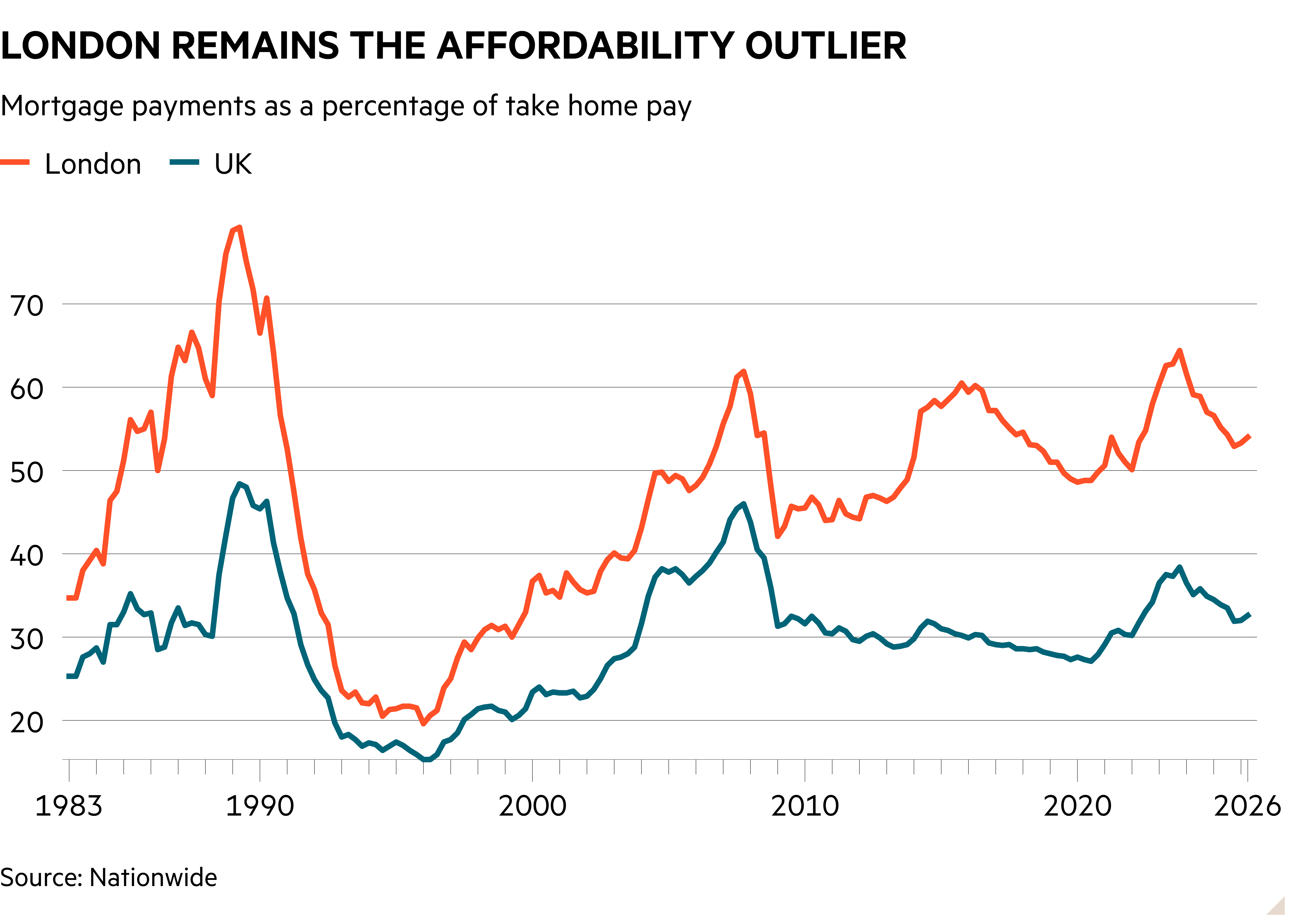
London remains the biggest affordability challenge despite the improvement from the extremes seen in 2023. The average first-time buyer faces forking out 7.4 times their salary on a property in the capital, nearly 60 per cent higher than the national average, according to Nationwide.
Once on the ladder, mortgage payments account for a whopping 54 per cent of take-home pay, compared with a third for the wider UK.
That is an improvement on the record level of 64.4 per cent recorded at the end of 2023 but comfortably above the long-run average of 46.2 per cent.
London has improved but remains an outlier, according to Nationwide’s chief economist Robert Gardiner. “London is always more expensive than the rest of the UK,” he says. “It’s improving, but it still doesn’t change the fact that, if you look at the level, it’s still less affordable compared to others.”
What is happening in the rental market?
The rental market may once again be tilting against renters, despite the recently passed Renters’ Rights Act.
There are still not enough homes to rent for the number of people looking, meaning competition remains high in many areas. Savills’ Williams says rental supply has contracted as some private landlords have sold up, while tenant demand has increased.
“People who are looking to rent are going to be in a much more competitive market,” she says.
Rightmove’s rental data, published in July, showed that the number of available rental homes was 1 per cent below the same point last year, the first fall below the previous year’s level since 2022.
The average advertised rent outside London has reached a record £1,397 a month, up 1.9 per cent in the latest quarter and 2.3 per cent on a year earlier, according to Rightmove. London rents have reached £2,791, up 2 per cent over the quarter and 2.9 per cent annually.
Rent increases are substantially higher for sitting tenants than for new ones, often due to their catching up with wider market rates.
Moreover, Rightmove estimates that buying is still cheaper than renting, despite the recent rise in mortgage rates. It puts the average monthly payment for a mortgage with a 10 per cent deposit at £1,200, about £100 cheaper than the average rent for an equivalent two-bed property.
What is needed for a strong autumn?
A strong autumn selling season is unlikely, but any improvement on what was ultimately a disappointing spring will depend on a combination of stable or falling mortgage rates, recovering buyer confidence and realistic pricing from sellers.
Fell says falling mortgage rates would provide the biggest short-term boost, particularly if some sub-4 per cent deals return for borrowers with the largest deposits.
Could the government step in?
Government intervention could also help the housing market, although any measures announced at the Budget on 28 October are unlikely to have much impact until next year.
“The industry has been calling for the last 18 months or so for more support for first-time buyers,” says Savills’ Williams. She reckons any future support is more likely to be targeted than a simple return of Help to Buy, which ran from 2013 to 2023.
Under that scheme, the government would lend first-time buyers up to 20 per cent of a new-build property’s value (up to 40 per cent in London) for properties valued at £500,000 and under. The loan was interest-free for the first five years and enabled buyers to purchase a property with a significantly smaller deposit or mortgage.
A similar equity-loan scheme would come as a boost to the UK’s faltering housebuilding industry.
Another option could be a reduction in stamp duty, which would be more helpful for pricier southern markets. “The stamp duty burden . . . is weighing down southern markets more heavily than ever,” says Fell.
Is now a good time to buy?
A slower housing market offers prospective buyers the luxury of less competition and more time. But that is partly explained by the recent prohibitive rise in borrowing costs and the fact that affordability is still stretched, particularly in London and the south.
For those with sufficient financial firepower, there may be some golden opportunities out there, especially from forced sellers who need to price their properties competitively.
For those whose financial position has been critically hurt by the recent rise in mortgage rates, there is the consolatory thought that a short, sharp increase in prices is unlikely during the next couple of years. There may be wisdom in biding your time.


