The Estate We Are In: Recent work by John Dargan
Daphne Oram Gallery, Canterbury Christ Church University
★★★★★
JOHN DARGAN’s work takes the urban environment as the source material for a graphically powerful narrative.
His line is minimal but always suggestive of complex form. He works both in film – where in animation his drawing pulsates with energy and movement – and still images, where his drawing depicts closely observed human figures moving through an urban landscape, their bodies transparent but mobile.
His latest compilation/exhibition/installation The Estate We Are In deals with development of council housing after the second world war.
This work stands at the intersection of art and politics and deals analytically with the creation of slum housing as a function of capitalism’s drive for profit; the development of people’s housing provided by the state through local councils; and looks in detail at the philanthropic impulses that underlay the slum clearances, the garden city movement and continental examples like Vienna’s Karl Marx Haus.
He discusses the influence of modernism and the Bauhaus on the innovative housing strategies of the postwar London County Council where progressive planners and communist architects worked on an essentially social democratic project today negated by Labour’s embrace of neoliberalism.
His film moves from didactic explanation, through graphic exposé, to an imaginative animated history.
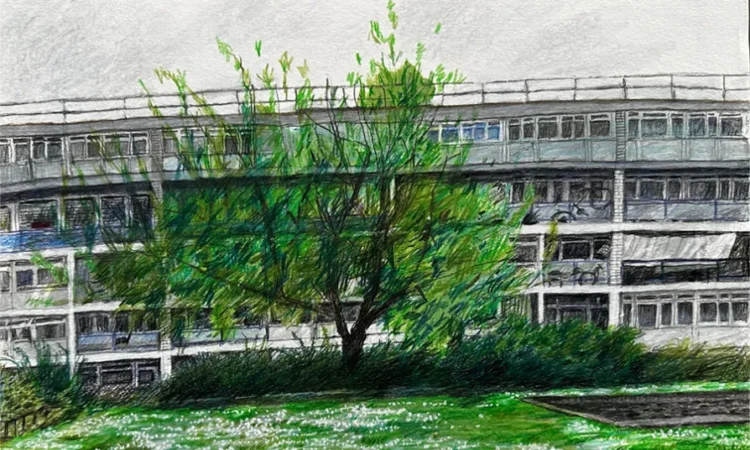
John Dargan is primarily a visual artist and his art works interpellate the political discourse provided by his film. These depict a working-class milieu that rarely finds itself the subject matter of fine art, and his method – working on an initial ground of gouache and then worked over by coloured pencil – creates a fluid and transparent structure for his animations.
Image

Taking the the LCC’s Churchill Gardens estate in Pimlico as an exemplar, his vivid pictures celebrate a working-class impulse to humanise and make individual the urban setting families found themselves in.
John Dargan argues that attitudes to the design and building of council housing after World War Two suggest that the modernist estate – exemplified by the human scale and intimacy of Churchill Gardens, built in 1947 – offers an approach that could be used today to resolve our current crisis of scarcity of affordable housing.
He frames his central problem as one of the contemporary relevance of art in our system of commodity production and asks the question: can art change things? Or is the nature of consuming art too interior to effect collective change?
This is a refreshing presentation of the question and it is answered both by the partisanship and the elegance of his work.
He says: “The work I make is conscious of the context in which I grew up: an era of collective activity where the unity of many without power were able effect societal change. There was a groundedness in social relations, where people accepted the idea of pooling resources in the creation of a supportive state for everyone.
“With social relations destroyed or disrupted by the deployment of monetarist policy in the 1980s, people were encouraged to see themselves as individuals, not part of a collective.”
Runs until December 11. For more information see canterbury.ac.uk