

The UK housing story has shifted. House prices barely moved in July at 0.1% and annual growth slowed to 1.8%, while the Iran war has lifted energy costs and pushed market interest rates higher. The Bank of England is holding base rates at 3.75%, but is openly worried about inflation staying above 4% next year if the conflict worsens. For UK housing market stocks, these are testing conditions rather than a rising tide. This article picks out three stocks exposed to this news backdrop that could be worth extra caution for your watchlist.
Nationwide Building Society (LSE:NBS)
Overview: Nationwide Building Society is a UK mutual lender and savings institution that offers current and savings accounts, mortgages, personal loans and credit cards, supported by digital, phone and branch banking. It also provides insurance products, investment and financial planning services and financing for social housing and infrastructure projects.
Operations: Nationwide generates £6.0b of revenue entirely from the United Kingdom.
Market Cap: £1.18b
Nationwide Building Society sits in the firing line of a softer UK housing market, with weak price growth and higher interest rates weighing on mortgage activity and borrower affordability. Management already bakes in the risk of house price declines and higher unemployment, and notes that extra house price weakness could lift expected credit losses by tens of millions of pounds. Profit margins have fallen sharply, earnings declined 54.1% over the past year and return on equity is only 5.2%, while the stock trades on a very low P/E and far below some estimates of fair value. For income focused investors, the near 8% dividend yield may look tempting, but the combination of falling earnings, rising costs and housing stress means the risks need close attention.
Nationwide Building Society’s falling margins, weaker earnings and housing stress suggest the story may be decoupling from its near 8% yield. Before relying on that income, review the 2 key rewards and 2 important warning signs
Berkeley Group Holdings (LSE:BKG)
Overview: Berkeley Group Holdings builds residential led and mixed use developments across the United Kingdom, creating new neighbourhoods under brands such as Berkeley, St Edward, St George, St James, St Joseph and St William. Its projects range from urban regeneration schemes on brownfield land to large scale housing developments that combine homes with shops, amenities and public spaces.
Operations: Berkeley Group generates £2.38b of revenue from residential led mixed use development activities, all in the United Kingdom.
Market Cap: £3.24b
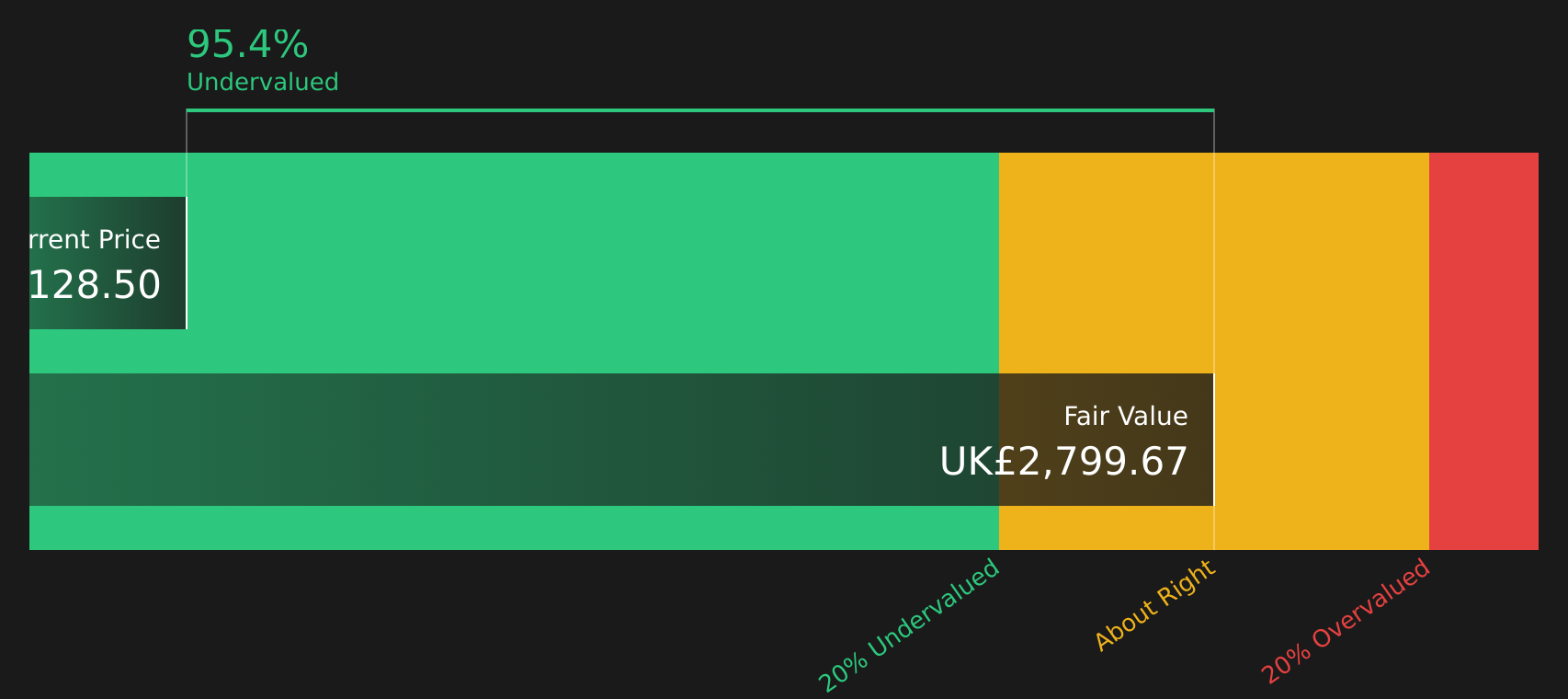
Berkeley Group Holdings is tightly linked to the UK housing cycle at a time when house price growth is soft, mortgage rates are higher and buyer urgency is fading. Management reports private sales volumes about one third lower than a year ago, forward sales expected to moderate and earnings and revenue both projected to decline over the next few years, even as new regulations, taxes and planning delays add extra costs and uncertainty. That is a cautious backdrop, yet the stock trades at a discount to some fair value estimates and analysts still see the company as a key player in urban regeneration. The question for investors is whether that apparent value is enough to compensate for the housing and earnings risks now building up.
Berkeley Group’s stalled sales, softer pricing and rising regulation risk suggest the story may not be fully priced in yet. Before assuming the discount is a cushion, read the 2 key rewards and 1 important major warning sign

Persimmon (LSE:PSN)
Overview: Persimmon is a UK house builder that sells family homes under the Persimmon Homes and Charles Church brands and social housing through Westbury Partnerships, alongside in house broadband, timber frame and panel systems, bricks and tiles that support its build pipeline.
Operations: Persimmon generates £3.75b of revenue from housebuilding in the United Kingdom.
Market Cap: £3.57b
Persimmon is tightly exposed to the softer UK housing backdrop, with only 0.1% house price growth, weaker buyer demand and higher funding costs. This raises questions about how far its 7.6% net margin and 5.4% dividend yield can stretch. Management has highlighted affordability strain, longer mortgage terms and slower sales rates, and earnings growth is forecast in single digits rather than rapid expansion. At the same time, the stock screens as heavily undervalued on some models and is still building out sites like Biggleswade that are expected to matter for 2026. For investors, the tension between apparent value and rising build, regulatory and financing costs is the real story that needs closer inspection.
Persimmon’s 7.6% margin and 5.4% yield can look reassuring, yet both rely on a fragile housing cycle. Before that comfort unravels, review the 3 key rewards and 2 important warning signs

Take Control of Your Investment Journey
If Nationwide Building Society or any of these companies are making you feel more cautious, register for FREE with Simply Wall St and add your companies to a Watchlist to monitor the share price against the fair value and track any new developments as they happen.
Once you’ve made your move, manage your holdings with our Portfolio Command Center that filters out the noise to deliver only the most critical, actionable updates.
Throughout your journey, our Community allows you to filter the best ideas from thousands of investor perspectives.
By uncovering hidden catalysts and risks early, you’ll accelerate your decision-making and stay one step ahead of the market.
Seeking Alternatives Before The Crowd Moves
Fresh stock ideas can move from quiet to breakout quickly, and once momentum flies, the best entry points can become harder to find. Scan new opportunities and act now.
- Spot companies quietly building momentum before it becomes obvious by scanning the 10 high quality undiscovered gems curated for strong fundamentals that are currently under the radar.
- Target durable income streams while yields still look appealing by reviewing the 5 dividend fortresses that focuses on businesses prioritising reliable cash generation.
- Position ahead of potential infrastructure and energy buildouts by checking the 35 power grid technology and infrastructure stocks that focuses on companies tied to long-run grid upgrades.
This article by Simply Wall St is general in nature. We provide commentary based on historical data
and analyst forecasts only using an unbiased methodology and our articles are not intended to be financial advice. It does not constitute a recommendation to buy or sell any stock, and does not take account of your objectives, or your
financial situation. We aim to bring you long-term focused analysis driven by fundamental data.
Note that our analysis may not factor in the latest price-sensitive company announcements or qualitative material.
Simply Wall St has no position in any stocks mentioned.
New: Manage All Your Stock Portfolios in One Place
We’ve created the ultimate portfolio companion for stock investors, and it’s free.
• Connect an unlimited number of Portfolios and see your total in one currency
• Be alerted to new Warning Signs or Risks via email or mobile
• Track the Fair Value of your stocks
Have feedback on this article? Concerned about the content? Get in touch with us directly. Alternatively, email editorial-team@simplywallst.com


