
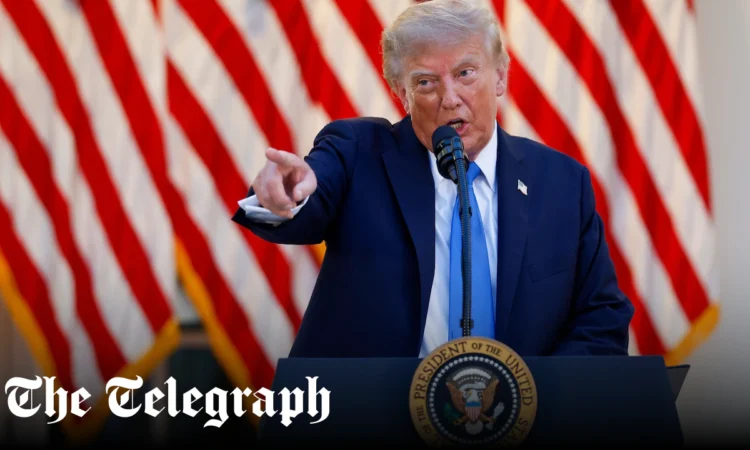
Donald Trump’s White House has accused Labour of censorship over its plans to promote “trusted” news online.
The US embassy in London said proposals to force tech giants to promote news from certain media outlets raised “serious” concerns about free speech.
It warned that a plan to give the Government influence over which news sources citizens see online “risks becoming a mechanism for viewpoint-based censorship”.
Lisa Nandy, the Culture Secretary, has outlined proposals to force tech firms such as Google, Facebook and X to prominently display news from public-service broadcasters such as the BBC, ITV and Channel 4.
Ministers have not explained how media outlets would qualify as “trusted” under the scheme, which could also be extended to local and national newspapers.
The White House said the move would harm independent journalism and warned the effect on any outlets that did not receive “trusted” status was “not meaningfully different than outright removal”.
It said the US government would “likely consider such a measure as facilitating censorship”, adding that any such measures could create a template for authoritarian regimes.
Ministers have refused to rule out requiring news publishers to submit to a state-backed regulator such as Impress, which was set up in the wake of the Leveson inquiry into phone hacking.
Andy Burnham previously called for a second phase of the inquiry, while he was joined on his by-election campaign by actors Hugh Grant and Steve Coogan, who are vocal supporters of the press reform group Hacked Off.
The US intervention suggests Labour risks fresh tensions with the Trump administration, which has previously attacked the UK over its approach to free speech and tighter regulation of tech giants.
The proposals form part of wider efforts to counteract a deluge of online misinformation and disinformation and to protect news publishers from a decline in traffic triggered by Google’s search changes and AI tools.
But any effort to tie prominence to tighter regulation has triggered fears that the Government would control what news people see online and be able to exert influence over the press.
The News Media Association – which represents titles including The Telegraph, The Times and The Guardian – said the proposed measures risked “narrowing the range of trusted voices available to people across the country”.
Officials have insisted that the measures would protect the plurality of news sources in the UK.
The White House said the changes could have a knock-on effect on what its users see around the world, adding: “The US government has made clear its opposition to measures resulting in extraterritorial censorship of protected speech by Americans online.”
The Trump administration also warned that any effort to promote British news outlets above others raised competition concerns and would place an unfair burden on US companies, especially after ministers introduced increased protections for so-called recognised news publishers under new online safety laws.
It said: “We encourage the UK to consider how prescriptive design mandates that boost ‘trustworthy news’ could affect the UK’s reputation as a jurisdiction that enables innovation – rather than one that unduly constrains the development and use of technology.”
A spokesman for the Department for Culture, Media and Sport said: “We welcome engagement and responses to our media green paper.
“We believe strongly in free expression and fair competition, and any action we take will ensure these are protected.”


