
Another African country gets $900 million Chinese-backed port investment amid Beijing’s billion-dollar race across the continent
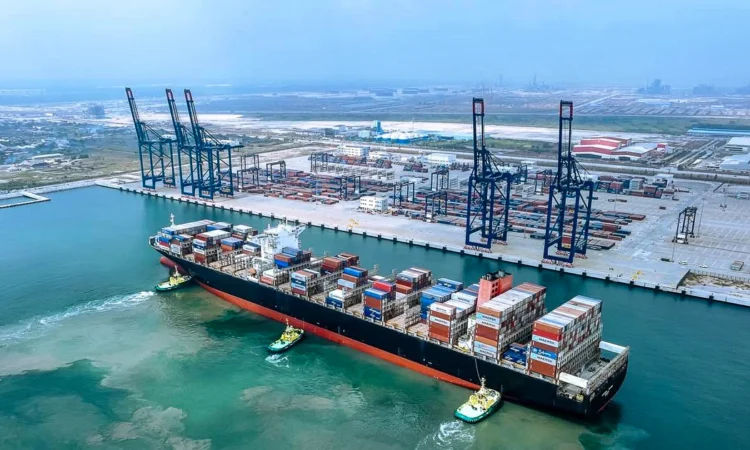
Angola has now become the latest African country to secure a major Chinese-backed infrastructure investment after Huatong Angola Industry committed $900 million to developing a new port terminal.
Specifically, the agreement covers the sub-concession, construction and operation of the Barra do Dande Port Terminal in the northern province of Bengo.
The deal was signed in Luanda on July 20 by the state-owned Barra do Dande Development Company, Huatong Angola Industry and financial partner Berkshire Waterhouse Infrastructure Development Ltd.
Under the agreement, the sub-concession will run for 25 years and may be renewed depending on the project’s commercial performance and long-term viability.
Angola bets on a new industrial export gateway
The project is expected to transform Barra do Dande into a major gateway for goods produced within the surrounding free trade zone.
Roque Saraiva, chairman of the Barra do Dande Development Company, said the parties signed two investment instruments.
The first agreement covers the $450 million port terminal, while the second includes supporting infrastructure, bringing the total planned investment to $900 million.
Meanwhile, Berkshire Waterhouse representative João Rufino said the investors would release the funds in phases as the project receives the required approvals.
The investment will finance the construction of the terminal, energy facilities and access roads connecting the port to industries operating within the free trade zone.
“This is entirely a private-sector investment,” Saraiva said.
Notably, the project will be implemented in three phases, with the first expected to take 24 months before the port begins handling exports from factories in the Barra do Dande Free Trade Zone.
The second and third phases are scheduled for completion between 2029 and 2030.
Once fully developed, the terminal will be able to receive ships carrying up to 80,000 tonnes. Project promoters expect the facility to generate more than $10 billion in turnover.
Limited port capacity holds back production
For Huatong, the investment is not only about building a port but also removing a major obstacle facing industries already operating in Barra do Dande.
Huatong Angola Industry chairman Zhang Wendong said the terminal would improve regional transport connections, increase Angola’s logistics capacity and support industrial expansion.
Currently, he said, limited port infrastructure restricts the movement of goods produced within the industrial complex.
As a result, Huatong has asked the Angolan government to support the terminal’s future operations through the allocation of maritime routes and better coordination of the country’s logistics network.
The Barra do Dande Free Trade Zone was established to attract manufacturers, reduce Angola’s dependence on oil and create about 21,000 jobs.
Already, the zone hosts the Sino-Ord Integrated Industrial Park, which comprises more than 10 manufacturing plants, as well as Huatong’s Aluminium Industrial Park.
The first phase of the aluminium plant started production in January 2026, creating 1,200 direct jobs and another 800 indirect jobs.
Meanwhile, an edible oil refinery is under construction and is scheduled for completion by mid-2028.
Huatong previously invested $250 million in the first phase of the aluminium project and plans to spend an estimated $1.6 billion across five phases over the next eight to 10 years.
Chinese capital spreads across strategic African assets
The Angola agreement adds to a growing wave of Chinese investments targeting some of Africa’s most strategic economic assets.
In June 2026, Kenya signed a $1.2 billion agreement with China Road and Bridge Corporation to expand Jomo Kenyatta International Airport.
The project includes a new terminal and other upgrades intended to raise the airport’s annual passenger capacity from 7.5 million to 22 million.
Elsewhere, Chinese battery manufacturer Gotion High-Tech is developing a $1.3 billion electric vehicle battery plant in Morocco.
The company could eventually invest as much as $6.5 billion as it expands production capacity.
Moroccan officials have described the facility, which is expected to begin production in 2026, as Africa’s first battery gigafactory.
By March 2026, Morocco’s Mohammed VI Tangier Tech City had also secured planned investments worth about $3.5 billion from 42 companies. Thirty-four of them were Chinese.
Beijing changes its Africa investment strategy
The new projects come as China changes its investment strategy on the continent.
Chinese lending to Africa fell to $2.1 billion in 2024, nearly half the previous year’s level and far below its $28.8 billion peak in 2016.
However, Chinese companies have increasingly moved towards foreign direct investment, private financing and commercially viable projects instead of relying mainly on large government-backed loans.
Angola’s privately financed port agreement reflects that shift while strengthening the country’s efforts to turn Barra do Dande into a regional manufacturing and export centre.


