Can PPL’s Financing Strategy Support Growth and Capital Investments? – September 23, 2026

Key Takeaways
- PPL completed its remaining 2026 financing with $900M of debt offerings due in 2056.
- PPL executed $2.3B of its 2026 capital plan through Q2, nearly 30% above the year-ago period.
- PPL targets about $23B of investments through 2029, supporting a 10.3% average annual rate-base growth.
PPL Corporation‘s (PPL – Free Report) financing strategy is supporting an extensive capital program while preserving financial flexibility. The strategy emphasizes maintaining liquidity while effectively managing financing requirements.
In the second quarter of 2026, PPL completed its remaining planned financing for the year through two debt offerings. The $500 million PPL Electric issuance at 5.75% and the $400 million Rhode Island Energy issuance at 6% are both due in 2056.
The company executed $2.3 billion of its 2026 capital plan through the second quarter, nearly 30% above the comparable period of 2025. It continues to target about $23 billion of capital investments through 2029, supporting average annual rate-base growth of 10.3%.
PPL estimates $10-$12 billion of potential generation-related investment upside through 2032 from economic development activity in Pennsylvania and Kentucky. The company forecasts annual EPS growth in the 6-8% range through 2029. Cash generation remains an important funding source, with PPL generating $1.14 billion in operating cash flow during the first six months of 2026, up 2.24% year over year. PPL issued $2.05 billion of long-term debt and retired $668 million while targeting a Funds From Operations and Cash Flow From Operations-to-debt ratio of 16-18%.
Despite a recent 25 basis-point rate increase, PPL’s second-quarter 2026 Times Interest Earned ratio of 2.8 indicates sufficient financial flexibility to meet its interest obligations. Thus, continued debt-market access, regulatory recovery and disciplined capital deployment can support rate-base and earnings growth.
Disciplined Debt Management Supports Utility Investments
Disciplined debt management can help utilities fund infrastructure expansion while maintaining financial stability. A balanced capital structure and effective debt maturities can support investment needs while reducing pressure on financial resources.
DTE Energy (DTE – Free Report) targets a balanced fixed-and-variable debt portfolio and investment-grade credit metrics, while expecting sufficient resources to support about $6.8 billion of utility capital investments in 2026 and growth.
Eversource Energy (ES – Free Report) used $1.7 billion of Aquarion sale proceeds to displace parent debt, strengthening credit metrics while supporting its $26.5 billion capital investment plan through 2030 across regulated utilities.
The Zacks Rundown on PPL
PPL’s Earnings Estimates
The Zacks Consensus Estimate for 2026 and 2027 EPS indicates a year-over-year increase of 7.73% and 8.35%, respectively.
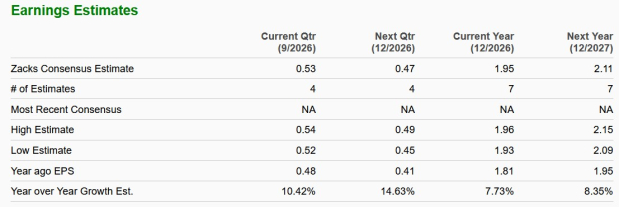
Image Source: Zacks Investment Research
Debt to Capital
PPL’s debt-to-capital currently stands at 57.46%, lower than the electric power industry’s 62.33%.
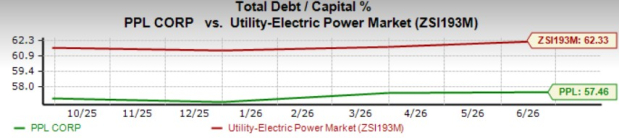
Image Source: Zacks Investment Research
PPL’s Stock Price Performance
In the past three months, the company’s shares have plunged 11.8% compared with the industry’s 11.4% decline.
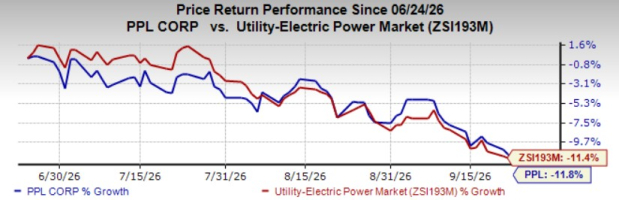
Image Source: Zacks Investment Research
PPL’s Zacks Rank
PPL currently carries a Zacks Rank #3 (Hold). You can see the complete list of today’s Zacks #1 Rank (Strong Buy) stocks here.