
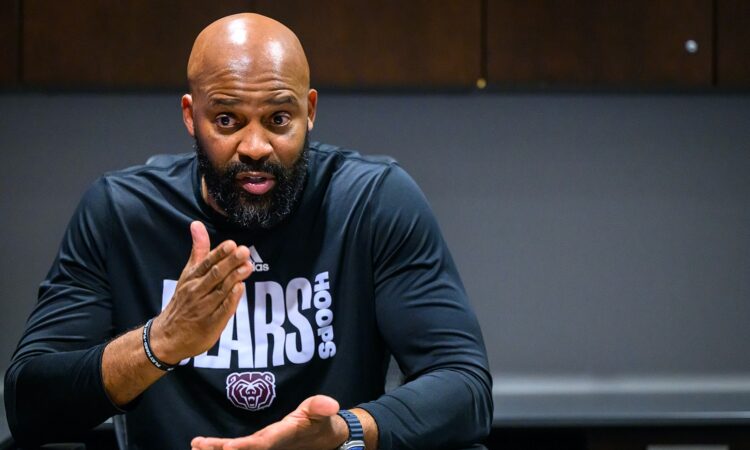

“Finally, I feel like Coach Martin has a good, realistic shot at a (conference championship).
MSU athletic director patrick ransdell on revenue share improvements aiding MSU basketball roster
when 6-foot-11 Missouri State forward Danny Moore sauntered off the Continental Arena floor following a Sweet 16 loss to No. 1 seed Duke on March 19, 1999 in East Rutherford, N.J., the 12th-seeded Bears’ Cinderella run seemed like a precursor to more NCAA Tournament appearances.

On the other side of the bracket, a tiny and relatively obscure Jesuit school from Spokane, Washington — No. 13 seed Gonzaga — would forge its way into the Elite Eight, a feat that appeared improbable to duplicate in following seasons.
The Bulldogs have since reached 27 consecutive NCAA Tournaments, appeared in 14 Sweet 16s and a pair of national title games.
Perhaps as unexpected as Gonzaga’s ascendance — at least to a maroon-clad fanbase in Springfield, Missouri — is MSU’s failure to return to March Madness since its historic ’99 run.
Tuesday, Aug. 4, 2026 marked the 10,000th day since the Bears’ previous NCAA Tournament game.
MSU, known as Southwest Missouri State until 2005, has since experienced a brand overhaul, six head coaches, the opening of an 11,000-seat basketball arena, a shift in conference affiliation (Missouri Valley to Conference USA), and a litany of NCAA rule changes.
Missouri State, which has often fielded a competitive mid-major product despite the lengthy March Madness drought, has since registered seven 20-win seasons and, on multiple occasions, come tantalizingly close to seeing its name appear on Selection Sunday.
Then-coach Barry Hinson’s 2006 Bears were widely believed to have been snubbed from the NCAA Tournament despite having a lofty RPI (21). Cuonzo Martin was able to lead the Bears to a 2011 MVC regular-season crown, but an at-large berth wouldn’t transpire following a conference tournament championship loss to Indiana State.

In his second Missouri State act, Martin, who leveraged the winning campaigns from his first MSU stint (2008-2011) to head-coaching jobs at Tennessee (2011-2014), Cal (2014-2017) and Mizzou (2017-2022), is navigating much different waters.
Between the NCAA transfer portal and the ever-changing Name, Image and Likeness (NIL) landscape, where players often make recruiting decisions based on the highest cash bidder, cultivating consistent mid-major success is more arduous than it was during his first stint.
See the Bears’ 9-23 (2-18 MVC) mark in Martin’s returning 2024-2025 season, MSU’s farewell to the MVC. Improvement was visible in Year 1 of Conference USA this past season with a new-look roster, but MSU was sub. 500 (16-18, 8-12 CUSA) again, though it narrowly fell in the CUSA Tournament semifinals to Louisiana Tech (69-66), a game after the Bears shocked top-seeded Liberty (77-69).
MSU’s three primary players have since departed, including All-CUSA wing Keith Palek (New York Knicks Summer League team and now overseas), All-CUSA forward Michael-Osei Bonsu (playing football his fifth year), and high-scoring guard Kobi Williams (transferred to Tulsa). Again, Missouri State’s roster will look much different in 2026-2027.
Money for players, where Martin said MSU has lagged behind most of its conference peers the past two seasons, has played an undeniable role in the talent MSU has been able to attract.
“I try diligently not to make any excuses, as every player on this roster is someone I recruited, but the one reality is it’s not as if you’re just recruiting and outworking somebody like you used to; it’s not that we’re not doing that, but you have to have money to do all of that,” Martin said. “You see teams where people say ‘Man, coach did a good job.’ Well, he also had a $20 million roster.”
MSU’s revenue share for players is said to have more than tripled between the 2024-2025 and 2025-2026 seasons, according to sources, but is still believed to have ranked among the bottom half of CUSA programs last year.
Martin believed last season’s roster — improvements he said were reflective of an increase in NIL — had the means to contend for a CUSA championship, but a string of injuries played a role in the makeup of his team that caught fire in March. MSU, a team that struggled mightily from the free-throw line (67%) and from 3-point range (33%) had nine losses to CUSA opponents by five or fewer points.
“We had the product, and ended up finishing strong,” Martin said.

Martin and athletic director Patrick Ransdell said MSU has since raised more NIL money than a year ago and that long, athletic and retooled 2026-2027 roster reflects the money they spent.
“Ransdell and his team did a good job helping get a roster that can really compete in this league,” said Martin, who returned three players from last year including starting point guard Trey Williams and fellow sophomore Melakih Cunningham, a 6-7 wing who started late in the year.
Ransdell agreed.
“Finally, I feel like Coach Martin has a good, realistic shot at a (conference championship),” he said.
It starts with length.
Among Missouri State’s dozen additions is 6-10 forward and Indiana transfer Andrej Acimovic, a versatile big man from Bosnia who redshirted for the Hoosiers as a freshman a year ago. Seven-footer Isaiah Medina from DePaul, 6-foot-10 Ngundeng Ruey from the junior college ranks (Mineral Area) and incoming freshman Kuol Kuol from Virignia-based prep basketball factory Oak Hill Academy, and returning 6-foot-10 big man Cameron Boone round out MSU’s skyscrapers. Another forward, 6-8 senior Christian Thompson from Division II West Alabama, also expects to contribute.
“Andrej is impressive,” Martin said when asked about the IU transfer. “I have been around some good basketball and a lot of good players in my day, and Andrej is a good basketball player. Physical, probably 250 pounds strong. Shoots the 3 and can post up.”
Along with Cunningham, MSU has athleticism on the wing, including the addition of former Division II standouts such as 6-7 Jordan Blair (Colorado State-Pueblo) and 6-7 Matt Gray (Davis & Elkins). Division II transfers have served MSU well in the past with Palek and Kobi Williams.
“The biggest difference (between the MVC and CUSA) is length, athleticism, and speed in CUSA, and I think we have that,” Martin said.
Ransdell, who said he understands how important it is for the city of Springfield for MSU to get back to the NCAA Tournament, points to all-around improvement.
“We’re going to be in a much better situation this year than we were last year, both from an investment standpoint into the program, a budgetary standpoint, and a revenue-sharing standpoint,” Ransdell said. “We’re competitive now with at least the upper half of Conference USA in basketball, but I think the product we put on the court this year is more representative of what a Conference USA team looks like.
“I think we’re going to look a lot like (CUSA Tournament champion) Kennesaw State did last year, Middle Tennessee State, and Louisiana Tech in how long and athletic those teams were. We have more pieces that are going to fit within the framework of what Coach Martin wants to do, what Conference USA looks like.”
Martin, who reached the NCAA Tournament at Tennessee, Cal and Mizzou, said he wants to see Missouri State back in the Big Dance more than anyone. He also believes the recently expanded tournament field (set for 76 teams in 2027) should be even bigger.
“It should be 90 teams, at the end of the day,” said Martin, noting there are more than 360 Division I programs. “But at the end of the day, Missouri State has to do what it has to do, win basketball games and the conference tournament.”


