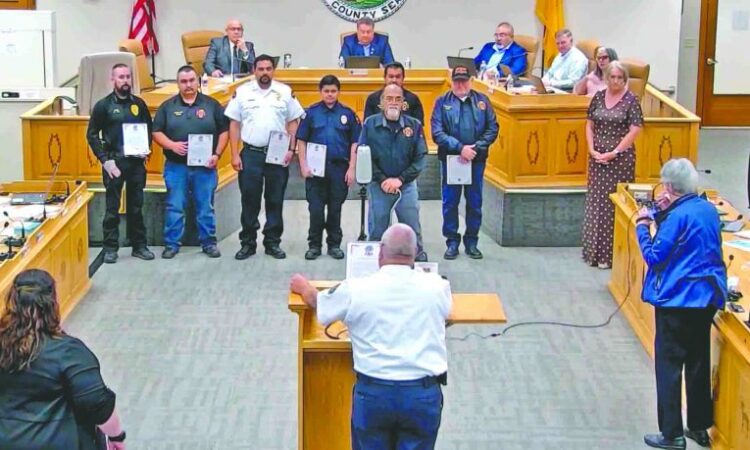


At Thursday’s Grant County Commission meeting, Grant County Fire Chief Roger Groves officially commended firefighters from the Santa Clara and Fort Bayard volunteer fire departments for their quick response that saved the life of one of their own.
Grant County Fire Chief Roger Groves described a harrowing incident to the County Commission at their meeting Thursday, where he also presented a commendation to several firefighters for their involvement in a lifesaving response.
“Their actions directly saved the life of their colleague,” he said. “Today, we recognize the individuals whose quick thinking, teamwork and professionalism exemplify the highest standard of emergency service.”
On Feb. 13, the Fort Bayard and Santa Clara fire departments were dispatched to N.M. 152 for a motor vehicle accident. Responders had begun to attend to the accident scene and the vehicle’s driver when a firefighter exited an emergency vehicle and suddenly collapsed. Junior Firefighter Mario Montoya of the Santa Clara Volunteer Fire Department junior program was the first to recognize that the firefighter was in distress, and his quick action drew attention of the rest of the response team. They determined that the firefighter was in cardiac arrest, immediately initiated CPR and were able to regain a pulse and revive their colleague.
Groves handed out certificates to Junior Firefighter Mario Montoya, Chief Larry Montoya and Assistant Chief Kevin Vigil of the Santa Clara Fire Department, along with Battalion Chief Daniel Saliaz, Battalion Chief Carlos Molina and Capt. Jim Lee of the Fort Bayard Fire Department.
Assistant County Manager Andrea Montoya updated commissioners on the preliminary budget that they will have to approve in May.
“Most department heads and elected officials requested a flat budget,” Montoya said. “We feel expenses were increased as they were appropriate by department.”
She said that the biggest fuel-related increase was in the roads department. She created a separate account for the housing of juvenile prisoners, so this expense can be tracked separately from that of adult prisoners.
Montoya also said the county would contribute $30,000 to support Corre Cantinas, whose funding had been a concern during a previous commission meeting.
District 4 Commissioner Eddie Flores brought up a related concern.
“I was contacted by several people that expressed their dissatisfaction with Corre Cantinas,” he said. “They are getting a ride to Silver City, … however, when they’re calling afterward for a ride back, they’re being told, ‘We can’t pick you up.’ … I appreciate this service they do, but I want to make sure that it’s not sporadic, and that it’s a consistent service.”
Flores said he would verify the specific claims that were brought to him, but if they were valid, he had concerns that people unable to get a ride would drive under the influence and maybe even have a legal defense against DWI.
According to Grant County Treasurer Patrick Cohn, the county has collected roughly $122.6 million over the past decade, resulting in an overall collection rate of 92.24 percent. The 2025 collection rate so far is 67.18 percent, which Cohn said is normal at this point in the cycle. He expects to see those numbers rise into the mid-90-percent range by year end.
At the same time, the report shows approximately $10.3 million in uncollected taxes over the same period.
“In summary, the county’s tax collection system is performing, and strongly and consistently,” Cohn said. “Long-term collection rates remain high and stable. There’s still room to improve recovery of outstanding balances.”
He then introduced Larry Lundberg of Moreton Capital Markets to present the status of county investments.
Grant County has about $8.9 million invested with Moreton Capital, and has made just under $74,000 year-to-date. Lundberg said that 80 percent of that money is in FDIC-insured certificates of deposit, and the other 12 percent is with U.S. government securities. The portfolio is performing at just over 4 percent. He said over the next year, the county could count on about $230,000 in cash flow from its investments. The average duration of all the securities is 1.6 years, and Moreton has staggered them to mature every three to six months.
“There’s constantly money rolling off, in the event that you need it,” Lundberg said, “and also to take advantage of if the market moves.”
Lundberg described a number of factors that have been impacting the market recently and are forecasted to in the near future.
A big source of uncertainty has been the Iran war and the resulting oil prices that surged to over $400 a barrel.
“It just completely spiked because of that blockade and Strait of Hormuz,” Lundberg said. “Honestly, the last 45 days … the main takeaway is volatility. Things have been up, things have been down.”
He pointed out that the market responds to news of any potential change in the situation. Things had changed, Lundberg said, even since last week, when he put the presentation together, with the deadline for a deal with Iran coming and going, being extended and concerns raised about mines having been placed in the Strait of Hormuz.
“One thing that I read this morning is they were talking about maybe not having that strait open until July, which is going to cause a lot of other problems,” Lundberg explained.
Another factor is the interest rate set by the Federal Reserve. Lundberg showed a graph of the Fed rate since the mid-2000s, showing a drop to zero for years after the 2008 financial crisis, a rally beginning in 2016, then another drop in response to COVID, and a recent spike to try to rein in post-COVID inflation.
“It got all the way up to about 9 percent,” Lundberg said. “The mandate for the Fed is to try to keep inflation right around 2 percent, so they aggressively raised rates. … Things leveled up, then things started to kind of come back down. This is the way that interest rates go.”
He said projections forecast one Fed rate cut this year, and maybe one next year. He pointed to a red line across the middle of the graph, saying that when interest rates go below that point, he works with Cohn to move more assets into fixed-income investments.
“We’re trying to avoid these long periods of low, low interest rates,” Lundberg said. “Then we’re not able to help make money and help with your cash flow.”
District 2 Commissioner Eloy Medina asked about a change in value in an account showing an $11,000 loss.
Lundberg called this a change in the net asset value, and said it goes up and down each month, depending on what markets are doing.
“This is a paper loss or a paper gain,” Lundberg explained. “At maturity, everything comes back at what we call it the par level. … This is the great thing about fixed income — there’s a maturity date, and at that maturity date, you get all of your principal back, plus all of your interest.”
District 5 Commissioner Thomas Shelley asked Cohn to explain briefly what money goes into these investments, and what they are kept for.
“It’s just being a good steward and investing taxpayer money,” Cohn said. “It’s good to have investments in case there’s ever, God forbid, a crisis of some kind, we can always go back and have our investments to fall back on.”
Cohn said that the principal is almost entirely from property tax revenue, although he will occasionally invest money from other sources.
“If there’s other revenue there that I can see that I could use to make us more money, I will invest that, as well,” Cohn said, “but I do forecast to ensure what I can invest so we have money to expend.”
During commissioner comments, District 3 Commissioner Nancy Stephens encouraged the public to prepare for fire season by signing up for county text alerts — text GRANTCO to 80946 — and also familiarizing themselves with the “Ready Set Go” fire readiness protocol on the county’s website.
—JO LUTZ