
TORONTO, Aug. 14, 2026 /CNW/ — Canada Pension Plan Investment Board (CPP Investments) today announced additional portfolio-level disclosure related to its carbon footprint, introducing a snapshot of carbon intensity and transition governance indicators across the Fund’s holdings.

CPP Investments’ Climate Change Principles, including regular reporting on its portfolio emissions, help inform how the organization fulfills its mandate against the backdrop of increasing climate risk and opportunities as the world navigates a whole economy transition.
“Our investment strategy remains focused on delivering long-term value to help ensure the Canada Pension Plan’s financial sustainability for many generations. We consider material risks, including climate-related risks and opportunities, to support risk-adjusted returns over decades. We know that progress towards a lower-carbon future will not be linear, and we are committed to continued transparency as we invest across sectors and work with companies to reduce risk and preserve value,” said John Graham, President & CEO, CPP Investments.
Framework to Analyze CPP Investments’ global portfolio carbon footprint
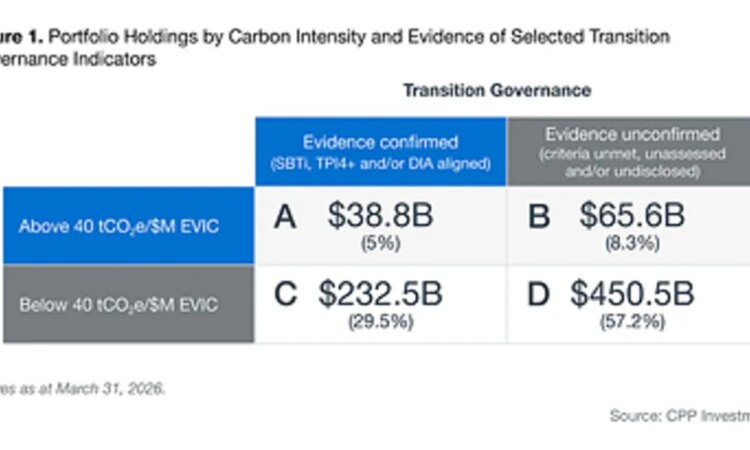
CPP Investments has reported portfolio carbon footprint metrics since 2018. This enhanced reporting provides a point-in-time view of the composition of that footprint by classifying individual portfolio holdings across two dimensions: Carbon Intensity and Transition Governance.
Carbon Intensity refers to a company’s Scope 1 and Scope 2 greenhouse gas emissions (GHG) relative to its total enterprise value by utilizing the Partnership for Carbon Accounting Financials metric of tonnes of carbon dioxide equivalent per $1 million of Enterprise Value Including Cash (tCO₂e/$M EVIC). Using information from the S&P Global LargeMid Cap reference portfolio, applying Global Industry Classification Standard (GICS) level 3 industry classification and then taking into account definitions of “hard to abate” and “high emitting” from the International Energy Agency and TPI respectively, we established a threshold of 40 tCO2e/$M EVIC to capture assets from harder to abate industries and those that have elevated carbon intensity relative to the rest of the portfolio. Companies at or below the threshold are not necessarily low-emitting or do not necessarily have low transition risk. Companies above the threshold are not necessarily high-emitting or necessarily have high transition risk.
Transition Governance refers to observable evidence that a company has taken steps to understand and prepare for transition-related risks and opportunities and there is evidence of a company’s alignment with at least one of three key indicators of transition-related governance or planning: either Science Based Targets initiative (SBTi) approved targets, Transition Pathway Initiative (TPI) Level 4 or 5 or participation in CPP Investments’ Decarbonization Investment Approach (DIA). Where the analysis has identified evidence of transition governance as above, companies are categorized as Confirmed. Holdings that do not meet these criteria or holdings that have not yet been assessed due to data limitations, lack of external coverage, or an inability to match a company to external datasets, or the company has not yet been assessed through DIA, are categorized as Unconfirmed.


