📖 Literature Information and Abstract Translation
Do investments in sport pay off: a systematic review and exploratory quasi meta-analysis of social return on investment in sport and physical activity
📕Koch, Ágoston, et al. “Do investments in sport pay off: a systematic review and exploratory quasi meta-analysis of social return on investment in sport and physical activity.” International Journal of Behavioral Nutrition and Physical Activity (2026). https://doi.org/10.1186/s12966-026-01957-2
🔗 DOI, PubMed, Google Scholar
[Background/Objective] Physical inactivity remains one of the most pressing health issues globally, contributing to millions of deaths annually and placing a significant financial burden on public health systems through increased medical costs. Sport and physical activity are recognized as effective means for promoting health, enhancing social inclusion, and improving overall well-being. While traditional evaluation methods such as cost-benefit analysis and cost-effectiveness analysis have been useful in demonstrating economic value, they often fail to capture broader social outcomes. The Social Return on Investment (SROI) framework provides a more comprehensive approach by holistically evaluating the health, economic, and social value generated per unit of investment.
[Methods] This systematic review conducted an exploratory quasi-meta-analytic synthesis to investigate studies published between 2018 and 2024 that applied the SROI framework to sport and physical activity interventions. Following PRISMA guidelines, five academic databases and the Social Value UK repository were searched. Studies reporting SROI ratios for empirical sport or physical activity interventions were included. Data on study and intervention characteristics, outcome domains, and methodological quality were extracted. Methodological quality was assessed using the 12-point evaluation framework by Krlev et al. Since most studies did not report standard deviations or confidence intervals, a formal variance-weighted pooled analysis could not be performed. Therefore, descriptive unweighted and sample-size-weighted averages were calculated, supported by sensitivity analysis and exploratory correlation analysis between SROI and study characteristics.
✅ What is the Social Return on Investment (SROI) framework?
・SROI stands for Social Return on Investment, an indicator calculated by dividing the monetary value of health improvements and social benefits by the investment amount. It does not represent actual monetary profit.
[Results] 16 studies met the selection criteria, yielding a total of 17 SROI estimates for interventions ranging from preventive health programs to sport-for-development initiatives.
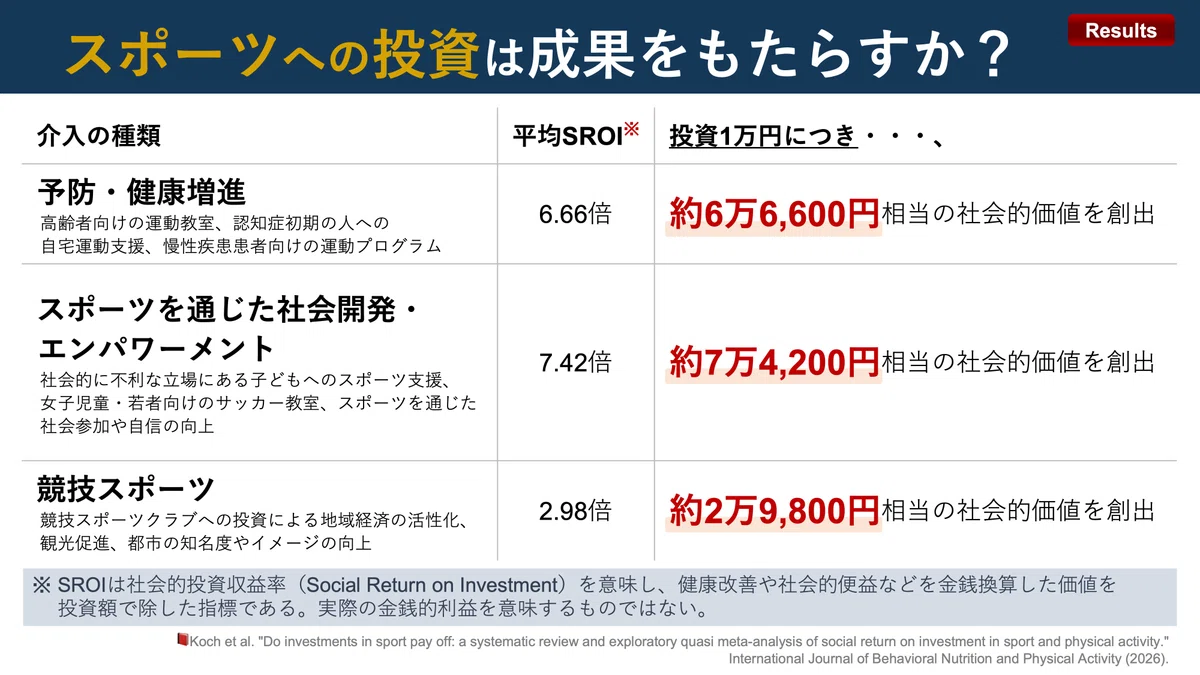
・Exercise classes for the elderly, home exercise support for people with early-stage dementia, and exercise programs for patients with chronic diseases
・Average SROI: 6.66x (creates approximately 66,600 yen worth of social value per 10,000 yen invested)
・Sport support for disadvantaged children, soccer classes for girls and youth, and social participation and confidence building through sport
・Average SROI: 7.42x (creates approximately 74,200 yen worth of social value per 10,000 yen invested)
・Regional economic revitalization through investment in competitive sports clubs, tourism promotion, and improvement of city recognition and image
・Average SROI: 2.98x (creates approximately 29,800 yen worth of social value per 10,000 yen invested)
[Conclusion] Overall, the evidence indicates that investments in sport and physical activity generally generate positive social value, often yielding returns several times the initial cost. However, the integrated mean is highly sensitive to extreme SROI values, and the significant variation between studies highlights the need for improved methodological consistency, clearer reporting, and broader geographical coverage.
🌱 So What?: What did I find interesting?
I had four gold medals, but you can’t eat four gold medals.
“I had four gold medals, but you can’t eat four gold medals.”
“Sport and money.”
This is a very delicate theme.
What makes it delicate, I think, is the underlying assumption that the outcome of sport is not money in the first place.
“I don’t like professional baseball. But I like Koshien. Because they aren’t doing it for money.”
I often hear words like this from patients and the general public.
Certainly, I think there is beauty and wonder in the fact that sport is simply fun to do, that one becomes absorbed in it, and that through selfless effort, one’s own body and spirit are refined…
That is undeniable, and I agree.
However, when concepts like business, investment, and the allocation of social resources get involved, the situation changes completely.
Well, simply put, it’s the adult world.
As shown in the opening quote, as an adult athlete, you cannot live on just having fun.
As an investor or politician, you cannot allocate resources if you cannot expect any concrete benefits, just because something is beautiful.
It becomes a double standard, a complex entanglement of diverse values.
The meta-analysis I read this time provided data that supports the argument that “I think it is a good thing to invest in sport.”
In this study, a new analysis called the SROI framework was used to estimate the monetary value of investing in sport.
As a result, it became clear that returns equivalent to several times the investment can be expected from sport-related investments in various fields.
I believe this is a result that policymakers, investors, and sports business managers should know.
And, although it may sound like a pipe dream, I think it would be ideal if a world came where players didn’t have to worry about that part.
Managers and operators work hard on the economic side.
And players just do sport for the sake of sport.
A time to just immerse oneself in the conversation with one’s own body, and in the wonder and beauty that sport brings.
An economic foundation and system that just protects that.
I think that is very important when considering the sustainability of sport.
⬇︎ Related note & 𝕏 post✨
📕スポーツへの投資は成果をもたらすか?
・メタ解析 [16研究]
・社会的投資収益率を分析投資1万円につき,
🔹予防・健康増進:6万6,600円
🔹社会開発・エンパワーメント:7万4,200円
🔹競技スポーツ:2万9,800円
相当の社会的価値を創出スポーツへの投資はプラスの社会的価値を生み出すようです😲 pic.twitter.com/iLLA9Si6v6
— 理学療法士_海津陽一 Ph.D. (@copellist) November 16, 2026
○●━━━━━━━━━━━・・・‥ ‥ ‥ ‥
High-quality Rehabilitation Medicine & English Paper Reading ‘ARI’
From here♪
↓↓↓

‥ ‥ ‥ ‥・・・━━━━━━━━━━━●
#️⃣ #PhysicalTherapy #ClinicalResearch #Research #Rehabilitation #EnglishPaper #LiteratureReview #EnglishLiteratureReview #Evidence #Science #DailyUpdate #RecentLearning #Paper #PaperIntroduction #MedicalPaper #PaperReview #PaperExplanation