
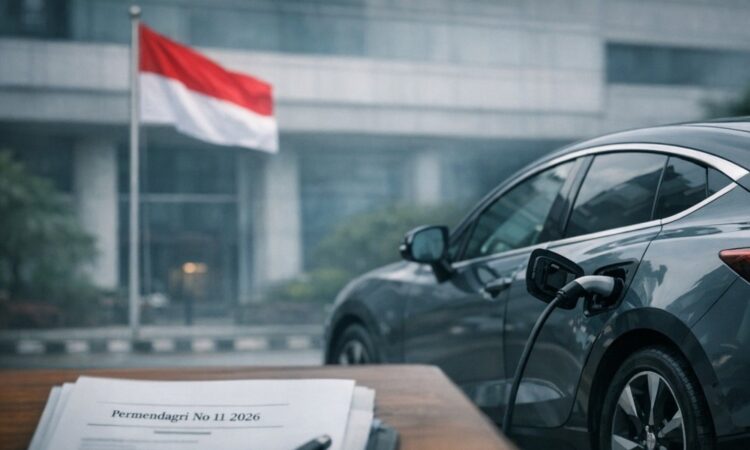
Gotrade News – Indonesia imposed a new vehicle tax on electric cars through Regional Regulation No. 11/2026, reversing their tax-exempt status. The policy drew immediate criticism from economists who warn it threatens billions in EV investments.
The move contradicts President Prabowo Subianto’s push to accelerate vehicle electrification across the archipelago. Industry players question a policy that promotes EVs while simultaneously burdening consumers with new levies.
Key Takeaways:
- $2.73 billion in EV investments over the past three years are at risk due to regulatory uncertainty
- IESR says the regulation contradicts Indonesia’s Law No. 1/2022 on Central-Regional Financial Relations
- A potential $14 billion GDP contribution and 1.9 million jobs from the EV ecosystem could stall
IESR argues Permendagri 11/2026 conflicts with Indonesia’s Law No. 1 of 2022 on financial decentralization. That law explicitly excluded renewable energy-based vehicles from regional taxation.
IESR CEO Fabby Tumiwa said the regulation needs synchronization with existing national legislation. Policy signals that shift every two years undermine decarbonization efforts, according to Tumiwa.
INDEF noted EV sector investments reached $2.73 billion over the past three years in Indonesia. The full value of these investments is now at risk from regional tax uncertainty.
INDEF’s Andry Satrio Nugroho cautioned that investors may relocate manufacturing to other countries. Vietnam is the primary alternative, offering significantly stronger EV incentives, according to Nugroho.
INDEF projects the EV ecosystem could contribute $14 billion to Indonesia’s GDP by 2030. The sector could also generate 1.9 million new jobs through domestic manufacturing.
IESR calculates mass EV adoption by 2030 could save $3 billion in annual fuel import costs. Fuel subsidies could also decline by $1.1 billion per year if the transition stays on track.
Decentralized tax-rate setting is a key concern for EV industry players across Indonesia. Each regional government can set its own rates, creating price disparities that confuse consumers.
Automotive analyst Bebin Djuana questioned the fiscal motives behind the EV tax policy. Djuana suggested the tax may fund fuel subsidies, contradicting the president’s electrification vision.
Dual pressure from this policy threatens Indonesia’s overall automotive industry performance. Conventional vehicle sales remain weak while EV growth risks stalling under the new tax burden.
IESR is urging the government to delay implementation for battery electric vehicles. Policy harmonization is needed to maintain regulatory certainty and sustain energy transition momentum.
Sources:


