Low rental yields mean it’s hard to make a buck from residential investment property

House prices might be in the doldrums but they are not yet at a level that makes residential property attractive as an investment, at least not if the property is being purchased with a mortgage.
Interest.co.nz uses the Real Estate Institute of New Zealand’s lower quartile selling price and Tenancy Services’ median rent data to produce theoretical gross rental yields, nationally and for the six main urban regions.
A rental yield is the amount of rent a property could generate in a year, expressed as a percentage of its purchase price.
At the national level, the lower quartile price was $580,000 in September, while the median rent was $599 a week.
That would provide annual rental income of $31,148 a year and a gross rental yield of 5.4%.
That may not seem too bad when the most you are likely to get on a three-year term deposit with a bank is around 4.6%.
However, the term deposit rate is net, which means the 4.6% is what your receive, before tax.
But the yield figure is gross, which means it makes no allowance for normal expenses a landlord will face, such as rates, insurance, maintenance, accounting and property management expenses and loss of rental income due to periods of vacancy.
When these costs are taken into account, then it’s quite possible, perhaps even probable, that the return from a rental property would be below what can be achieved from a bank deposit.
And of course the above figures are based on paying cash for a property, without a mortgage.
Interest.co.nz calculates that if a property was purchased at the national lower quartile price of $580,000 with a 60% mortgage ($348,000), the mortgage payments could be around $548 a week. That’s based on an interest rate of 5.42% and a 20 year term.
If the property was rented at the median rent of $599, that would leave the landlord with just $51 a week after the mortgage was paid, and out of that they would need to pay their expenses – rates, insurance, maintenance, vacancy and whatever else crops up.
There’s an extremely high probability that the $51 a week that would be left after the mortgage was paid would not be enough to cover those costs and the landlord would be in negative cash flow.
That means the landlord would be parting out money from other sources to cover the ongoing costs of the so-called investment.
In the absence of capital gains, it probably should be regarded as a liability rather than an asset.
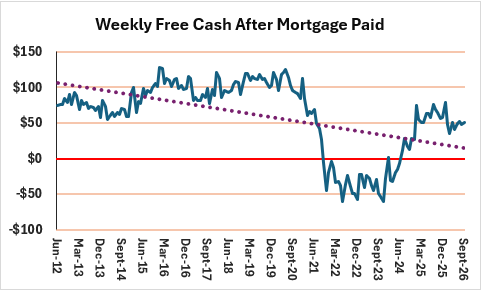
The graph below illustrates how that cash flow figure, after paying the mortgage but before paying expenses, has changed over the last 14 years.
Of special note is the period from October 2021 to June 2024, when cash flow was not even enough to cover the mortgage and investors would have been straight into negative cash flow as they chased capital gains, which have likely turned into capital losses for many.
And even prior to that, when the free cash after paying the mortgage was around $100 a week, that still wasn’t much money to play around with.
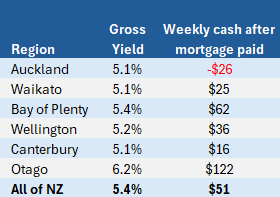
Naturally there are regional differences in the above figures, but the figures for the six main urbans regions all tell a similar story of low yields and insufficient cash flow.
In Auckland, the country’s largest and most expensive rental region, the gross yield would be 5.1%, and with a 60% mortgage the rental income would be insufficient to cover the mortgage payments, let alone pay other expenses.
Around the other major regions the gross yields range from 5.1% in Waikato and Canterbury to 6.2% in Otago. See the table below for the regional yield and cash flow figures.
Looking at the numbers described above, it’s no wonder that investors are increasingly sitting on the sidelines.
In the absence of capital gains, negative cash flows are a strong possibility for residential property investment. And on current figures you would be more likely to be losing money rather than making it if you had to purchase with a reasonably sized mortgage.