
This piece is sponsored by Southeast Technical College.
Major facility investments combined with growing student demand are adding up to significant momentum at Southeast Technical College.
“It’s an exciting time to be here. We’re seeing waitlists in many of our programs, and that tells us students recognize the value of a technical education,” said Dr. Cory Clasemann, president of STC. “At the same time, donors of all sizes are stepping up because they see Southeast Tech as a direct investment in the future workforce of this region.”

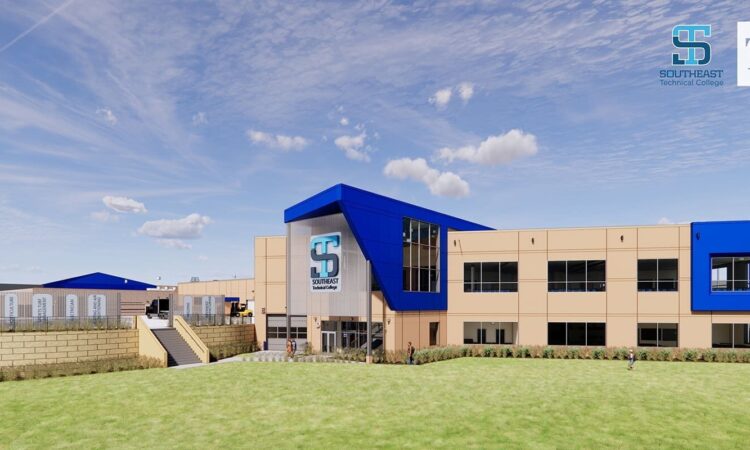
Significant investments from major donors soon will lead to cutting-edge buildings filled with programs for everything from residential construction to advanced manufacturing.
“Enrollment continues to trend up, and that momentum is translating into results. We’ve had record fall enrollment two years in a row, and we’re on track for record graduation numbers, which means more skilled graduates are entering the workforce.”
Clasemann credits the overall growth of opportunities in the Sioux Falls area combined with increased awareness. “Students are realizing they don’t always need a four‑year degree to build a successful career. They’re looking for focused, high‑quality training that gets them into the workforce quickly, and that’s exactly what we’re designed to deliver.”
Investments accelerate opportunity
That demand is being met with a wave of new investment — driven by the successful completion of Campaign NEXT, a five-year fundraising effort that secured $38.5 million to support students, programs and workforce development.
Originally launched with a $25 million goal and later increased to $30 million, the campaign ultimately exceeded expectations, drawing support from more than 300 donors across industries, businesses and the broader community.
“What stood out was how broad the support was — from major employers to smaller donors,” Clasemann said. “People saw the opportunity in front of us and said ‘we’re all-in’ because they understand how critical this work is to Sioux Falls’ growth.”
Those investments are translating into new facilities and expanded capacity across high-demand programs.
Among them is the upcoming Wells Fargo Homebuilding Lab, made possible by a $2 million grant from Wells Fargo, which will bring residential construction training directly onto campus. Construction is expected to begin in early May with an opening in early 2027.

“This creates a more consistent, higher‑quality learning experience for students,” Clasemann said, noting that students previously built homes off-site and were limited by weather conditions. “Now, we can train year‑round and intentionally bring together students from plumbing, electrical, HVAC and construction programs to mirror how these trades actually work together in the field.”
The lab will be highly visible, located along the interstate, and will feature viewing windows, offering a real-time look at students building homes.
At the same time, Southeast Tech is advancing plans for the James Abdnor Center for Advanced Manufacturing, supported in part by $6 million in state funding along with private and federal contributions.

The approximately $24 million project will add more than 53,000 square feet of new and renovated space and is expected to open in 2027, creating capacity for about 130 additional students annually.
It will include state-of-the-art labs, classrooms and collaborative learning environments and support programs such as advanced manufacturing maintenance technology, advanced manufacturing automation technology, mechanical engineering technology and welding.
The facility is designed to align directly with growing industry needs, including those of major employers expanding in the Sioux Falls area.

“As major employers ramp up operations and expand facilities, our timing aligns perfectly. This building ensures we’re ready to supply the skilled talent they’ll need when demand peaks,” Clasemann said, referencing companies such as CJ Schwan’s and Smithfield Foods.
In addition to degree programs, Southeast Tech is working with employers to offer shorter-term training opportunities.
“One of my goals is to expand those opportunities,” he said. “The question we’re asking is how we can bring people to campus for targeted, short‑term upskilling that meets immediate workforce needs without requiring a full certificate or degree?”
One emerging area of focus is automation technicians — a role that bridges operations and maintenance in modern manufacturing environments.
“Right now, we tend to teach more of the maintenance and repair side,” Clasemann said. “But businesses need professionals who can operate equipment, recognize when something isn’t right and handle basic troubleshooting. That space between operations and maintenance is where demand is growing and where we’re intentionally building programs to address.”
Support from industry partners is helping strengthen those efforts. A $1 million investment from Marmen Energy will upgrade welding labs within the new manufacturing center and existing facilities, ensuring that students train with equipment that reflects real-world industry environments.
Demand driving growth
While facilities expand, student demand continues to climb, particularly in high-need fields.
“Sixteen of our programs reached capacity this past fall, and all indicators show that demand will continue to grow,” Clasemann said.

Healthcare programs are among the most in demand. The college’s Healthcare Simulation Center — a key outcome of Campaign NEXT — has helped expand capacity and provide realistic, hands-on training environments.
In some cases, demand is so strong that waitlists have formed.
“Our sonography program has a two-year wait,” Clasemann said. “We’ve added faculty and expanded to a spring start to try to meet demand.”
Trades programs such as electrical and welding also are seeing increased interest, prompting the college to add faculty and additional cohorts where possible.
“If we don’t accelerate how many students we can get into programs, businesses will feel like they’re falling further behind,” he said.

While about 85 percent of Southeast Tech students come from the Sioux Falls area, the college increasingly is drawing from across the region — and in some cases, nationally.
Programs such as sonography attract students from across the country, including as far away as Alaska.
At the same time, the vast majority of graduates stay local.
“About 86 to 88 percent of our students stay here,” Clasemann said. “We’re a net importer of talent, and that’s a huge win for the region. This means students come here to train and choose to stay to build their careers.”
Preparing students for what’s next
As industries evolve, Southeast Tech also is adapting how it prepares students, including how emerging technologies such as artificial intelligence are integrated into programs.
Rather than offering stand-alone AI courses, the college is embedding the technology across disciplines.
“Our goal is to make AI part of continuous learning rather than isolating it in a single course,” Clasemann said. “In business, in manufacturing, in design, it’s about how AI is impacting that specific field.”
That approach reflects what the college is hearing from employers.

“They’re telling us what they needed two months ago is different today,” he said. “AI isn’t replacing people, but people who understand how to use AI effectively will have a clear advantage in the workforce.”
For Clasemann, the combination of student demand, community investment and employer partnership points to a clear trajectory.
“I’m encouraged by the momentum we’re seeing. Support from students, employers and the community continues to build, and that gives us confidence we’re moving in the right direction,” he said.
To learn more about Southeast Technical College, visit southeasttech.edu.


