
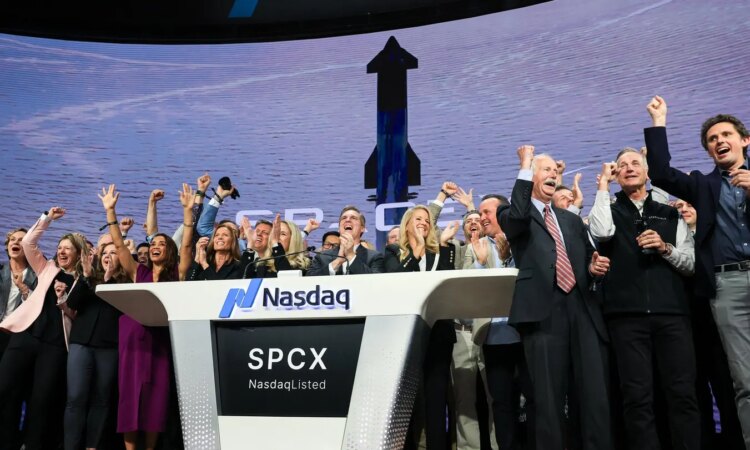
Gwynne Shotwell and SpaceX executives at Nasdaq on the day of the company’s historic IPO.
AFP via Getty Images
SpaceX’s IPO is the largest in history, and the rocket company’s venture capital backers including Founders Fund and Valor Equity Partners have collectively minted hundreds of billions in gains. Where do these checks sit among the all-time best venture capital investments?
There are multiple ways to define the most lucrative VC outcomes. You could look at the multiple, or total return on investment — where Benchmark’s landmark 90,000% return from its 1997 bet on Ebay remains a standout. In dollar terms though, Benchmark’s stake was worth $4 billion at the time of the auction site’s 1999 float ($8.1 billion in today’s dollars). When ranking investment deals that are decades apart, it is easiest to look at the inflated-adjusted dollar value of the stake at the time of the IPO. On that basis Benchmark’s signature investment, widely considered a banner one for venture capital funds, doesn’t crack the top ten. Now, that’s dominated by SpaceX.
Returns from the rocket maker’s historic IPO are only outmatched by investments from institutions like SoftBank. The ten exits listed below now overshadow what have long been considered some of the all-time greatest startup investments, like the billions of dollars generated by Andreessen Horowitz’s bet on Coinbase, Benchmark on Uber, Accel on UiPath or Index on Robinhood.
The scale of the returns from SpaceX, which listed at $135 per share today, mean that even big winners, like A16z’s $10 billion stake or Coatue’s $6 billion holding, don’t rank. Then there are other investors, like Luke Nosek’s Gigafund, or Alex Tamas’ Vy Capital, who were major and early SpaceX investors but their holdings are not yet known. Other unknowns include when minority shareholders would have exited positions, and at what price.
These are the 10 greatest VC investments of all time, based on inflation-adjusted total gains.
1. SoftBank and Alibaba
In 2000, Masa Son invested $20 million into what would become Jack Ma’s Chinese ecommerce giant. At the time of its 2014 IPO, SoftBank owned a 32% stake worth over $100 billion (adjusted for inflation). Masa would sell down this war chest over the next decade to offset losses from Vision Fund bets like WeWork, and a new major investment — OpenAI.
2. Naspers and Tencent
South African publishing house Naspers invested $32 million into Chinese tech startup Tencent, which now owns and operates WeChat, when it was just two years old. Nasper held Tencent stock long after its 2004 IPO, and even after several multi-billion share sales, owns a stake in the company worth $120 billion which is managed by its Amsterdam-listed investment vehicle Prosus.
3. Valor Equity Partners and SpaceX
The Chicago-based fund of Elon Musk’s friend, fixer and associate Antonio Gracias holds a $71 billion stake in the rocket maker.
4. Founders Fund and SpaceX
In 2008, Peter Thiel’s fund led the first institutional investment of $20 million into SpaceX, which had been self funded to that point. The investment came just days before a third failed launch test for an early generation of SpaceX’s rockets. That, along with an additional $600 million invested over the years since, is now worth around $67 billion.
5. SoftBank and Coupang
When Lydia Jett first joined the Vision Fund in 2015, one of her first investments was Korean ecommerce platform Coupang. SoftBank would invest $2.7 billion over the next three years, amassing a 33% stake. At the time of its March 2021 listing, Son’s fund held a stake valued at close to $33 billion (adjusted for inflation).
6. DFJ Growth and SpaceX
The spinout growth fund from Draper Fisher Jurvetson invested over $800 million in SpaceX starting in 2009. It’s expected to earn an estimated $33 billion stake at the time of the initial public offering.
7. Sequoia Capital and SpaceX
Even investors who joined relatively late into SpaceX’s 24-year march to becoming a public company are standing on massive gains. Shaun Maguire joined Sequoia in July 2019, and one of his first investments was SpaceX. Sequoia’s stake is now worth over $29 billion. That return eclipses some of the marquee investments from the world’s most famous venture fund, like Airbnb ($12 billion), DoorDash ($10 billion), Google ($4.7 billion), Wiz ($3 billion), WhatsApp ($3 billion).
8. 137 Ventures and SpaceX
137 founder Justin Fishner-Wolfson was a junior investor at Founders Fund at the time of its 2008 investment in SpaceX. After striking out on his own, he would build a holding worth over $19 billion in Musk’s space company, investing in SpaceX’s raises and tender offers.
9. Greenoaks and Coupang
Growth investor Neil Mehta also bet big on the Korean ecommerce giant. At the time of its initial public offering, Greenoaks owned a 16.6% stake that adjusted for inflation would be worth $17.7 billion.
10. Accel and Facebook
The Silicon Valley fund first invested in Facebook in 2005. At the time of its 2012 initial public offering, and after earlier shares sales, Accel’s stake in the social network was worth an inflation-adjusted $13.1 billion.
A few notes on methodology:
This list is sourced from Forbes reporting and coverage, Bloomberg, WSJ, The Information, TechCrunch, Reuters, Crunchbase and Fortune, with all numbers adjusted for inflation.
Because it is a corporation, Google is excluded from the above list but has made some stellar startup investments. Google first invested in SpaceX in 2015 and its stake is now worth a reported $107 billion. It has also been a major backer of Anthropic, with its stake now worth $135 billion.
Legendary venture investments into companies like Google, Apple and Nvidia don’t feature because most companies in this era had to go public early. Much of the gains were captured by shareholders, not venture capitalists. In this earlier era, many investors also would have sold post-lockup period, or distributed shares to limited partners. In the modern era, many funds like Sequoia have continuity vehicles that will hold shares post IPO.
The numbers reported for SpaceX are all paper profits. According to its S1 prospectus, “certain significant investors” cannot sell shares for at least a year. Given the company’s astronomical price-to-earnings ratio, it’s not clear if the current valuation will hold until investors can actually cash in. Then again, we’re talking about Elon Musk. Tesla trades with a price-to-earnings ratio that has more in common with the ballistic trajectory of his rockets than automaker peers.
Several of the investors and funds named above have been fixtures of the Midas List for decades (see the 2026 list here). The eligibility criteria for Midas means that some investors who invested off corporate balance sheets (such as SoftBank or Naspers), or bought secondary stakes in startups, are not included.


