
The Last Mile: How sustained, targeted investment can help imperiled wildlife recover

The RCW is considered a keystone species, because once a bird abandons a cavity, the hole rarely sits empty. Other birds, reptiles, insects and even small mammals move in, many of them unable to excavate the resin-soaked wood on their own. Remove the woodpecker from a longleaf forest, and many other species lose shelter. The forest itself works on the same principle at a larger scale. The longleaf range is home to more than 900 plant species found nowhere else on earth as well as 40 other threatened or endangered species. These forests also filter drinking water across much of the Southeast. It is the case for preserving biodiversity in miniature: pull one thread, and you find it’s rarely just one thread.
RCWs remain threatened and vulnerable to habitat loss, fragmentation and severe weather that can erase years of progress in a single season. Hurricane Helene, for example, destroyed 18 nest cavity trees at one Florida site. That vulnerability is why continued investment matters, and why this year’s National Species Recovery Grants slate includes two new Arkansas projects for RCW. The Nature Conservancy will use prescribed fire and timber thinning to restore open-pine foraging habitat and connectivity corridors. The Arkansas Natural Heritage Commission will install 50 prefabricated nesting cavities, translocate juvenile birds and work with landowners to increase RCW populations across southern Arkansas by an estimated 5 percent annually.
Building a partnership around Kirtland’s warbler
Kirtland’s warbler faced a different combination of challenges. This small, striking songbird nests on the ground beneath young jack pine in Michigan, Wisconsin and Ontario. Each fall, it flies more than a thousand miles to the Bahamas and returns each spring to the same patch of young pine. Biologists consider the Kirtland’s warbler an indicator species: how the bird is faring offers insight into the health of the broader jack pine ecosystem and the other species that depend on it.
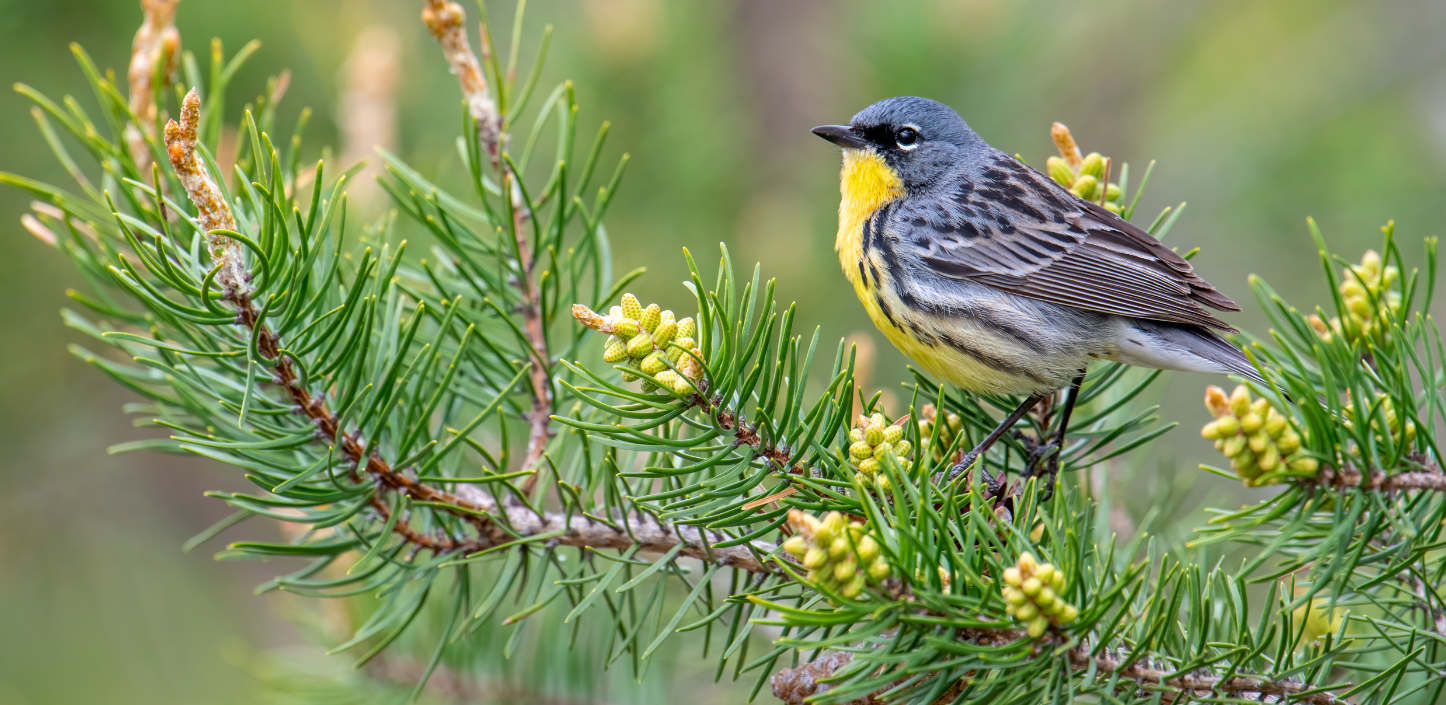
The warbler’s habitat once renewed itself through fire. As wildfires killed mature stands, the heat would pop open fallen pinecones to allow a new stand to grow. After decades of fire suppression, that cycle broke, and suitable warbler nesting habitat disappeared faster than it could be replaced. Biologists monitoring the species from the 1940s recorded a steady decline. The bird was listed as endangered in 1967 and carried onto the rolls of the Endangered Species Act (ESA) when the law took effect in 1973. By 1974, the population had fallen to 167 breeding pairs. A second problem compounded the habitat loss: brown-headed cowbirds, a nest parasite that lay eggs in other birds’ nests, leaving the host to raise a cowbird chick that outcompetes the host’s own young for food.
For nearly four decades after that low point, the warbler’s recovery depended largely on direct action. FWS began trapping cowbirds in 1972, cutting parasitism rates from roughly 70 percent to single digits within a year. Michigan’s state forestry agency, working with the U.S. Forest Service, began cutting and replanting jack pine on a rotation timed to the warbler’s needs. Population growth was slow through the 1970s and 1980s, then accelerated after 1987. By 2001, the population had passed the recovery plan’s target of 1,000 breeding pairs.
That long run of success created a new problem. Nearly every dollar behind the effort — the cowbird traps, the survey crews, the cutting and replanting — came from ESA funding tied directly to the bird’s listing. None of it was designed to survive delisting, which by the early 2010s was clearly approaching. Beginning around 2010, NFWF adopted Kirtland’s warbler as a keystone species with a business plan and proposed a strategy to address that gap: a partnership built on a “Friends” group dedicated to the bird, a long-term funding source for cowbird control, formal agency commitments to continue habitat management regardless of the bird’s listing status and the institutional infrastructure to hold those pieces together. The plan led to the Kirtland’s Warbler Alliance in 2013 and an endowed designated fund intended to support cowbird control and habitat work over the long term. Partners led by Huron Pines and FWS raised $1 million to seed the fund.
Six years after that plan took shape, FWS announced in October 2019 that Kirtland’s warbler, one of the earliest species protected under federal endangered species legislation, had officially recovered. The population had grown to more than 2,300 breeding pairs, more than double the original target. Surveyors have since logged record counts in Wisconsin and Ontario as the bird’s range continues to expand.
Despite its remarkable comeback, the Kirtland’s warbler remains conservation-reliant: without continued forest management and cowbird control, its numbers could decline again. The partnership model NFWF helped establish reflects that reality in mind, giving the species a durable support system rather than a one-time fix.
Helping more species reach the “last mile” of recovery
NFWF and FWS are applying lessons from recoveries like these through the National Species Recovery Grants program. The program targets species that a few more years of well-placed funding could plausibly move across the recovery line, as well as species whose ranges overlap extensively with working lands used for farming, ranching, forestry and other land uses.
The program is designed to fund the “last mile” of species recovery. By the time a grant like this arrives, much of what a species needs is usually already in place: decades of research, habitat work and patient management. What’s missing is the last increment: 50 artificial cavities, a thinned forest, a cowbird trap checked for one more season.
The RCW and Kirtland’s warbler each took roughly 50 years to reach their current status, following paths that look quite different — one bird patiently drilling its own home out of living wood, the other dependent on active forest management to make a home — but are more alike than they first appear. As the National Species Recovery Grants program moves new projects into the field, NFWF and FWS are hoping the same formula holds for the species that comes next: not one decisive act, but small, sustained investments that compound for as long as recovery takes.


