
April 24, 2026, 4:22 a.m. ET
Are New Jersey’s diners — our iconic roadside restaurants that have fed our communities for decades — facing extinction?
They’re certainly under threat.
As staff writer Matt Cortina has reported, while the Garden State remains the capital of diners, many owners and operators are feeling real pressures amid an economy defined by rising costs — both for food and utilities — and changing consumer behaviors. In the last decade, as many as 150 New Jersey diners have shuttered.
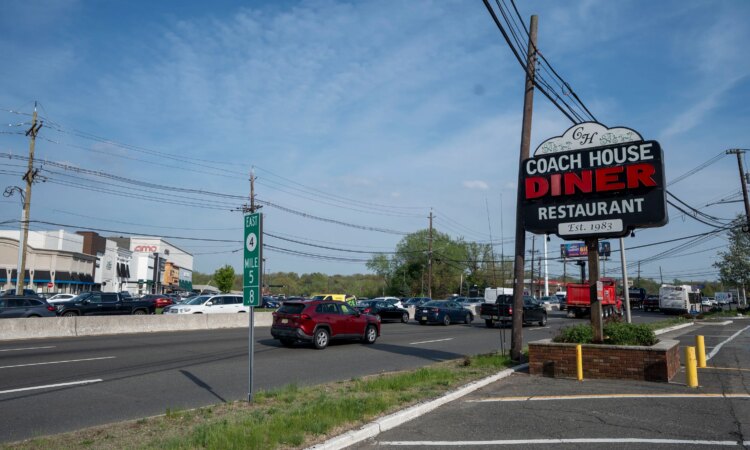
The latest casualty is the Coach House Diner, located on Route 4 in Hackensack, which closed April 16.
“This is a notice of permanent closure,” read a letter taped to the front door of the restaurant as of April 16. “Thank you for your loyalty and support. It has meant everything to us. We’ve been honored to serve you and be a part of this community.”

Nostalgic readers who know the Coach House well have flocked to our coverage of its demise. It will not reopen as a restaurant — public records indicate that the property was purchased earlier this month by a car wash company. The Coach House, which had been open 24 hours a day, first opened in 1983.
Readers shared their memories with NorthJersey.com and The Record after the closure.
“Met a blind date at the Coach House and had tuna melts,” one wrote. “That awas almost 40 years ago and we were married less than a year later — and still are!”
Costs mount as customers evolve

We’ve been monitoring the health of New Jersey’s diners for several years now. Several high-profile closures, including the Summit West Diner in Denville and the Americana Diner in Orange, prompted “Counter Culture,” a special report published jointly by NorthJersey.com and app.com and the Asbury Park Press in summer 2025.
That report dove deep into the complex economics of New Jersey diners and found a number of competing pressures.
Diners open around the clock are increasingly uncommon — we’ve reported that there likely fewer than 20 left across New Jersey. The pandemic, which upended so much about suburban life and culture, is partly to blame — customers disappeared overnight, diner owners have told us. Diners run on in-person dining — and volume; the pandemic thinned crowds.
Now, diner owners still in the game are contending with rising costs for food, electricity and more.
Nick Kallas, a diner proprietor who owns the Broad Street Diner in Keyport and the Roadside Diner in Wall, talked with Cortina about the complexities of running a diner today.
“Business, listen: It’s … We’re doing OK,” said Kallas. “There’s not much left anymore, between the rise of utilities and the cost of food prices. We’re surviving, but it’s just a paycheck.”
Themis Nissirios, owner of the State Line Diner in Mahwah, which is still open 24 hours a day, recently told us that he’s evaluating how long he could stay open. The old Jersey tradition of going out to a bar — and then going to a diner to chow down on needed food — is waning, he said.
“People are not leaving a bar and going straight to a diner to have a burger. People are taking an Uber and going straight home and trying to order Uber Eats and have it delivered,” he said. “Because there isn’t anyone else up here open 24 hours, I’ll tend to pull from New York state as well as up here in northern Jersey. It still is worth it for us. For how long … I think I’ll keep on doing it as long as the volume is up there.”
Michael C. Gabriele, who has written two books on the history and evolution of the New Jersey diner was a bit more bullish — acknowledging that diners had faced cyclical downturns in the past, he was optimistic that many diners would survive.
“Yes, there’s a downturn, but I try to put it into perspective, because there have been downturns before,” Gabriele said. “The diner business is always evolving; it’s a moving target, it’s always changing. People are rightfully upset about what’s been happening in the last couple of years, but diners have survived other downturns.”
What could help New Jersey’s diners?
Beyond a resurgence of late-night customers and stabilizing food and utility costs, what could be done to help the Garden State’s iconic diners?
A bill circulating in Trenton — the SODA POP (Saving Our Diners & Protecting Our Past) Act — would offer tax breaks to historic diners and their owners. The legislation, sponsored by a gaggle of lawmakers in both the state Senate and Assembly, would “provides sales and use tax exemption and corporation business and gross income tax credits for historic diners and restaurants included on annual registry.”
The bill passed in the Assembly in January, but not the state Senate. Since its passage in the lower house, the Legislature has entered a new session. The bill has been reintroduced but has yet advanced for further consideration.
Whether Trenton lawmakers will ultimately take up the cause of their constituents’ diners remains to be seen — but we encourage them to find ways to help.
We believe the diner is an essential — and we hope indelible — piece of New Jersey’s food culture.
Get to your local diner and order some disco fries. Every plate can help.


